

I gave up alcohol for Lent and lasted less than two weeks. But my intentions were good. It was the first time I had intended to do Lent in a serious way — call it a Christian way, if you will. I’ve been attending a liberal Anglican church in north London, on and off, for a year and a half, and before that a Quaker Meeting House.
Listening to sermons in the lead up to Lent this year, I established for the first time my own interpretation of the meaning of those 40 days Jesus spent fasting in the desert after his baptism, echoing the 40 days Moses spent on Mount Sinai fasting and praying, during which time he received the 10 commandments. I saw that, in my own life, days had no pattern or structure. I seemed to be travelling through time too fast to feel as though my actions had any meaning or roots in the world. The Lenten period, as I see it now, is about trying to find a bit of desert-time for oneself, in order to discern what the world is actually demanding of you.
Evidently, I didn’t get very far in that work this Lent, but five years ago no part of me would have imagined the rituals of churchgoing could become an answer to the feeling I had that I wasn’t living up to the ways I had wanted to exist in the world. As a young leftwing person with a simplified understanding of a lot of things, I was sceptical, bordering on hostile, about the very idea of Christianity, assuming that it uniformly shunted its believers towards all kinds of intolerant social positions, mostly around sexuality. Appropriating the language of the American Christian right, politicians such as Nigel Farage talk nostalgically about the need to restore “Judeo-Christian culture”, by which they mean a return to so-called Christian values as a solution to all that they see wrong in modern society. That wasn’t how I saw the world.
Then, in 2021, I started attending church alongside young people all around Britain for a book I was writing on the subject. I had been hearing anecdotally for a while that more people in their twenties, like me, were finding their way into churches. A recent survey, commissioned by the Bible Society and conducted by YouGov, showed 16 per cent of those aged 18 to 24 in England and Wales said they attended church at least monthly, significantly up from 4 per cent in 2018.
The reasons for this tentative resurgence are as various as the young people who make up the statistics. For some it was in response to a pervasive sense of loneliness in the wake of the pandemic. Others told me they were seeking a form of spiritual meaning which had no relation to the engines of capitalism and consumerism that seemed to otherwise govern their days. The ways their new faiths played out were fascinatingly varied too. I met some who had immediately left their jobs or their partners after converting, and others for whom faith scarcely caused a ripple in their day-to-day existence — except for an hour every Sunday attending church alongside a growing sense that the world might be a little more mysterious than they had once assumed.
I also met young Christian converts at every mark of the political dial. I was far more interested in hearing how their attitudes have been complicated or transformed by their faith than in hearing politicians and public figures apply aspects of Christian belief as if it were just another tool in the culture wars. And it was the stories I heard — of a faith that seemed both to sharpen and draw them more deeply into a radical, active kind of politics — that kept me going to church well beyond the end of my research.
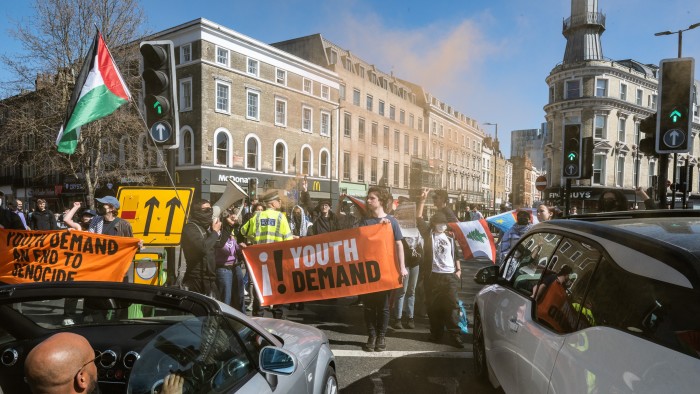
This March I participated in two actions on the streets of London organised by Christian groups. The first was a prayer vigil outside the Home Office for “Victims of Global Borders”, led by the London Catholic Worker, a radical pacifist movement; the second a Quaker Meeting for Worship outside New Scotland Yard. The latter gathering was in response to a police raid on the Quaker Meeting House in Westminster, during which six young women attending a welcome meeting of the group Youth Demand were arrested. But I encountered many of the same faces at the two events.
At protests in my early twenties, I’d often noted the presence of various Christian blocs within the crowds. Back then, I knew so little about Christianity as to assume they must be there in spite of their faith, that their politics existed in direct contravention of their religion’s demands, which I imagined must ask them to disavow the beliefs of those from different religious backgrounds, to think that any sexuality outside of heterosexual norms was sinful, to not care passionately about the climate emergency because their religion taught them to imagine a perfected world beyond the one we are presently destroying. Such a faith surely had no meaning or relevance beyond the confines of a Sunday morning church service.
Before the vigil outside the Home Office, a woman told me that the previous morning the priest at her Catholic Church had reminded the congregation that it is our human duty to look after one another and bear witness when the world fails to live up to this most straightforward of interpersonal obligations. That was why she had showed up today. At 12.30pm we gathered in an oval to read prayers of repentance and intercession, the letter of a man called Walid whose brother died attempting to cross the Channel at the end of 2024, and to sing hymns a capella. Then speakers took it in turns to read out the names of all those who had died trying to obtain sanctuary in Europe or the UK since the previous March. As they read out the list, a passing man yelled, “Why don’t you pay for them, then?”
Two weeks later, I visited the Catholic Worker house in Harringay, north London, which since the start of the new millennium has welcomed asylum seekers and refugees to stay for as long as they need alongside a live-in community of volunteers. I was there to meet Francisco, who was in his late twenties and had been a live-in volunteer at the London Catholic Worker for six months. Before that he spent two and a half years at the Catholic Worker farm in Hertfordshire, which provides temporary accommodation to female asylum seekers (and their children) without access to public funds. The live-in volunteers are not paid but rely on donations.
From the outside, the place looked like a typical residential house. Inside, though, Francisco pointed out to me how almost every available room had been turned into a bedroom for the guests who stay here while they wait to receive papers that might grant them leave to remain in the UK. In the kitchen, several other young Catholic Workers were preparing an enormous pot of soup. Francisco led us out into an alleyway behind the house that connected it to the church next door, which was a Baptist church until the 1970s, then a Catholic church that was finally taken over by the London Catholic Worker when the congregation numbers had dwindled to nothing. Here, too, every spare inch of space had been reconfigured into a place where someone could sleep, including the confessional — the red and green lights above its door once used to indicate whether it was occupied by a priest and his confessor now redundant.
The Catholic Worker began life in 1933 as a monthly newspaper distributed in New York City for a penny a copy. It was founded by Dorothy Day, a Catholic convert who had spent her twenties involved in radical political movements, and Peter Maurin, a Catholic migrant from Europe who would become Day’s partner. They hoped that the paper’s articles might integrate their political convictions with their faith, discussing issues like pacifism and poverty through the lens of Catholic social teaching, as fascism advanced across Europe and the Great Depression wore on in America. In the first issue, Day asked, “Is it not possible to be radical and not atheist?” This question remains live; the movement into which Day’s humble newspaper has now grown offers an answer in the affirmative.
In 1934, she and Maurin established the first of the Catholic Worker “Houses of Hospitality” in New York, where those who were homeless or living in poverty could come to stay. Day was guided by the Catholic practice known as the Corporal Works of Mercy, taken from the parable in which Jesus exhorts his followers to feed the hungry and shelter the homeless. There are now close to 200 hospitality houses worldwide.
The London Catholic Worker was brought together in 2000 by the Trident Ploughshares disarmament action, during which Catholic activists entered an RAF base in Cambridgeshire and disarmed the vehicle which was to carry nuclear warheads to Trident nuclear submarines. They were following in the footsteps of the anti-nuclear Plowshares movement that began in the US, taking its name from the Book of Isaiah: “they shall beat their swords into plowshares”, for “nation shall not lift up sword against nation, neither shall they learn war any more”.
For an hour Francisco and I sat talking in the red-carpeted sanctuary of the church where they still hold their evening prayer services (it also doubles as a storage space, a mattress pressed up against the organ, several bicycles in the nave). On the altar was a painting of Christ staring out from behind barbed wire which I recognised from the vigil, as well as several tiny icon-like paintings of Day.
Francisco became a practising Catholic in response to a radical conversion at 22. He is from Lisbon and had grown up in a sheltered environment; after university, he was heading for the kind of career and life where one could just “float through in a space of comfort”. Following his conversion, he discovered he could no longer position himself at the centre of the universe, “because you put yourself in front of God and you are nothing in front of God”, he told me, his voice so soft that it seemed to evaporate into the air.
On returning home to Portugal, he discovered that the Catholic Church with which he’d vaguely engaged as a child now seemed repulsive to him. “It was this very institutionalised Church that sanctifies the power of old families,” he says. Around him he saw peers converting to Catholicism, but many of them associated such transformations with a “reactionary identity”, positioned as a return to some glorious past.
Seeking other ways to live out his faith, Francisco discovered the Catholic Worker by way of Day’s 1952 autobiography, The Long Loneliness, in which she wrote: “Community — that was the social answer to the long loneliness.” This was not just the “basic community of the family, but also a community of families, with a combination of private and communal property”. Christ’s message in the gospels, as Francisco interprets them, is about “breaking up systems of kinship”. He points to a gospel passage in which Christ is informed that his mother and brothers want to speak to him. “Who is my mother and who are my brothers?” he replies. Then he gestures to his disciples, “Here are my mother and my brothers.”
I’ve always found the radicalism of that passage challenging: for Francisco it was the call that eventually brought him here.
Francisco finds it hard to disentangle his political and Catholic awakenings, but I’ve met several young Christians who were actively involved in social justice before their conversions. Theo and Laura live together with a couple of other Christians in London. (I have changed both their names at their request.) Theo (who uses they/them pronouns) converted to Catholicism in their late twenties. Laura started attending an Anglican church after her conversion. A PhD student and a Marxist, she was concerned at first with how to square her politics with the feeling she was being called to church. Like a lot of people who end up at St James’s Piccadilly, she turned up after googling “progressive church London”.
The sermons she heard there drew from liberation theology (the radical late-20th-century movement which holds that the church itself must act politically to bring about justice for the oppressed), were critical of British colonialism and proactively trans-inclusive. So she kept coming back.
At its best, progressive politics might be about the furthering of human dignity; faith helps you to situate that dignity “within the beauty of creation”, Laura told me. But this does not mean her faith or her politics are fixed and unchanging.
Theo, an academic, has found that becoming a Christian not only strengthens their political beliefs; but requires a continual questioning of such beliefs. “After a conversion, you essentially have two frames for viewing the world, the secular frame preceding your conversion and your new religious frame,” Theo told me. “You have a chance to see your political commitments from the outside. I was forced to examine the positions I held rather than accept them as a kind of package deal, and articulate them more rigorously.” Doubt is an important feature of Theo’s politics. By going to Mass alongside those who might disagree with you on all kinds of issues, you are afforded the space to imagine, as Theo put it, that “you could be wrong”.
The journalist Casey Cep describes how the Marxists that Day moved with before her conversion found it hard to make sense of her “dichotomous agenda” once she began the Catholic Worker, taking “prophetic stands” against racial segregation and nuclear warfare (she was regularly arrested for her nonviolent anti-nuclear protests), while opposing abortion, birth control and the welfare state.
In 1966, the theologian Charles Davis publicly left the Catholic Church because he believed it had become too vast, impersonal and compromised as a system of authority. In response, Herbert McCabe, the Catholic and socialist theologian and priest wrote: “it is because we believe that the hierarchical institutions of the Roman Catholic Church, with all their decadence, their corruption and their sheer silliness, do in fact link us to areas of Christian truth beyond our own particular experience and ultimately to truths beyond any experience, that we remain, and see our Christian lives in terms of remaining, members of this Church.” You do not become a Christian because it has good politics as an institution, Theo told me: “Their positions on women, on gay people, clearly a lot of it is not what I think.” Rather, Theo became a Catholic because they came to believe in God.
Back in the Catholic Worker church in Harringay, with the daylight fading fast, Francisco told me that, “If the next Pope ends up being a horrible human being, I’m not going to stop being a Catholic.” By continuing to participate in Catholicism, the Catholic Worker is able to confront the ways in which the institutional Church fails to live up to what they believe it means to follow Jesus’s teachings of mercy and equality in the gospels.
Like Laura, I seek out Anglican churches that vocally stand for the political positions which feel non-negotiable to me. It reminds me that there is no single way to enact one’s faith. Some people need to find churches where they feel their particular identity is actively welcomed. Others are happier wrestling with the fact of a diversity of political beliefs within the congregation and clergy, or feel that the political beliefs of others are irrelevant to their experience of arriving at church to encounter their God.
My conversation with Francisco was ended by the dinner bell. In the kitchen, on two wooden tables pressed together were six Catholic Worker live-in volunteers and five guests. Over soup, we discussed football, our Premier League teams and our national teams, answers coming in from across the world.
Later I asked Francisco how becoming a Catholic Worker has changed him. “It’s living in a very simple way,” he said, “in solidarity with the people who suffer the violence of the world.” With the climate crisis exacerbating other problems, he suggested, there is the sense that there will be no major political alternative to the reality the world faces. “What can we do?” The Catholic Worker movement’s answer is to “provide hospitality”, he told me.
After dinner, we returned to the church for evening prayers. The young Catholic Workers lit the candles on the altar, then warned me that the only person who was good at singing was away. Earlier, Francisco had told me that the rituals of Catholicism are a gift. They take you beyond your private, personal revelations and into a more communal revelatory experience. Religious ritual is not a dead, inert thing but rather something that should keep evolving, he said. It reminds you that faith ought to play an embodied, active role in the whole of your life.
Another young Christian had told me that both Christianity and the social justice movements they participate in ask you to “dream beyond what we can imagine now”. The writer Eugene McCarraher, in an article about McCabe’s revolutionary faith, suggests Christian sacraments like Communion are themselves “foretastes of a banquet at which everyone will dine”. In the simple, radical act of hospitality I witnessed that evening at the London Catholic Worker house, I saw something of this too.
Lamorna Ash is the author of “Don’t Forget We’re Here Forever”, which will be published by Bloomsbury in May
Find out about our latest stories first — follow FT Weekend Magazine on X and FT Weekend on Instagram
Read the full article here