

Unlock the Editor’s Digest for free
Roula Khalaf, Editor of the FT, selects her favourite stories in this weekly newsletter.
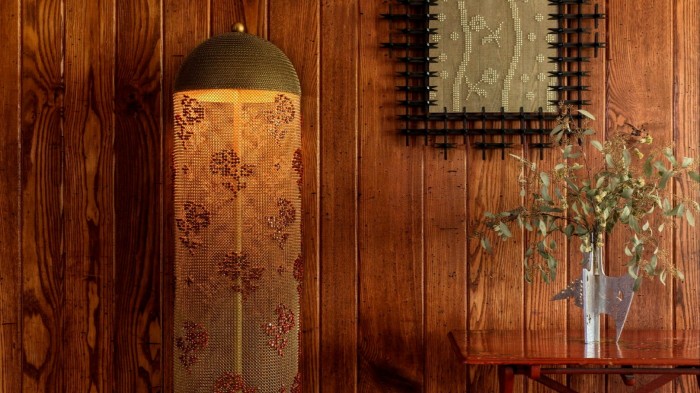
Georgia Somary wants to turn people’s homes into “contemporary castles”, where historically inspired decor evokes “wonder and enchantment”, she says. Her new Mathilde lamp, named after the 11th-century countess Matilda of Tuscany, is draped in chainmail, recalling knightly armour; the handles of a bronze incense bowl resemble medieval axes. The era, generally agreed to cover the fifth to 15th centuries in Europe, is an enduring source of inspiration for the designer’s homeware and interiors. “The gothic has always been something that appeals to me,” Somary says.
Somary started out as a set decorator in the UK. “We filmed in locations including Bamburgh and Alnwick castles, and spent a lot of time in armouries,” she recalls. The exposure inspired her to work in a London armoury, creating swords and restoring historic weapons. When she subsequently relocated to LA and turned her hand to design under the name Earl Grey Studio, the experience shaped her aesthetic.
Whether it’s the use of materials such as chainmail or the embrace of gothic architectural motifs, there is a thrilling medieval darkness rippling through the design world. Monastic in feel yet exuberant in expression, these works form a tonic to the staid maximalism versus minimalism debate, and a welcome design obsession with something other than the 20th century.
For New York-based studio Wretched Flowers, medieval weaponry forms the basis of two homeware designs — a spiked mace ball as a candleholder and a halberd (a spear-battleaxe mix) as a vase. For a series of lamps, meanwhile, founders Loney Abrams and Johnny Stanish drew inspiration from collections in the Metropolitan Museum of Art. “We saw these knight helmets in the medieval armour section and thought, ‘That could be a lamp.’ So we translated it,” says Stanish.
The lamps, with hemispherical shades, are covered in veils of chainmail that often reach to the floor, intricately decorated with beading or embroidery. “It’s about reframing the darker aspects of our history in a way that literally sheds light — and provides comfort and beauty in the home,” says Abrams. “Combining that kind of brutal, masculine, violent history with something more feminine and craft oriented.”
Medieval references can also be seen in Joseph Dupré’s ceramic vessels and plates — some of which were recently exhibited at James Freeman Gallery’s themed group show Medieval Eyes — featuring knights, castles and heraldry, often in the style of the era’s paintings. Laura Benson’s miniature sculptural objects recall medieval Christian reliquaries, while one particularly delightful candleholder depicts a Camelot-esque castle. Agnieszka Owsiany’s hand-forged steel Campanula candelabra is a “modernised version of a medieval church candelabra”, the designer says.
The Belial stool by Studio S II, in steel and leather, draws inspiration from the Savonarola chair, an X-frame design popular in medieval Italy. “Gothic arches, sharp spikes and oxblood leather transform the chair’s penitential silhouette into an object of seductive defiance,” say co-founders Erica Sellers and Jeremy Silberberg.
Tbilisi-based Rooms Studio, meanwhile, has designed chairs that draw on shapes from Georgia’s medieval architecture, including arches in the sixth-century Anchiskhati Basilica in Tbilisi, the city’s oldest surviving church.
The religious connotations of medieval design — rooted in a time when Christianity was spreading rapidly in Europe — were explored in editor, curator and interior designer Jermaine Gallacher’s þe Sellokest Swyn exhibition in London this spring; its title a quote from the 14th-century chivalric romance Sir Gawain and the Green Knight.
Reflecting his interest in deconsecrated monasteries, Gallacher featured works such as a stone table resembling a baptismal font by Emma Sheridan, and a hand-carved wooden chair by Ralph Parks inspired by examples he had seen in a Romanesque church in Switzerland.
Medieval-core is cropping up elsewhere in popular culture through TV shows such as the BBC’s current King & Conqueror and the upcoming Robin Hood series from MGM+, both centred on England in the Middle Ages. And in an exhibition curated by Valentina Ciuffi currently showing in Milan, Dark Times, Bright Signs, medieval references are balanced by contemporary design expression.
The period seems to attract designers for its embrace of pre-industrial craft and pre-Enlightenment mysticism. “There’s a wild, untamed quality to the era,” says Rooms Studio co-founder Nata Janberidze. “A closeness to nature, raw materials and symbolism that contrasts sharply with our current hyper-digital world.”
Find out about our latest stories first — follow @ft_houseandhome on Instagram
Read the full article here