

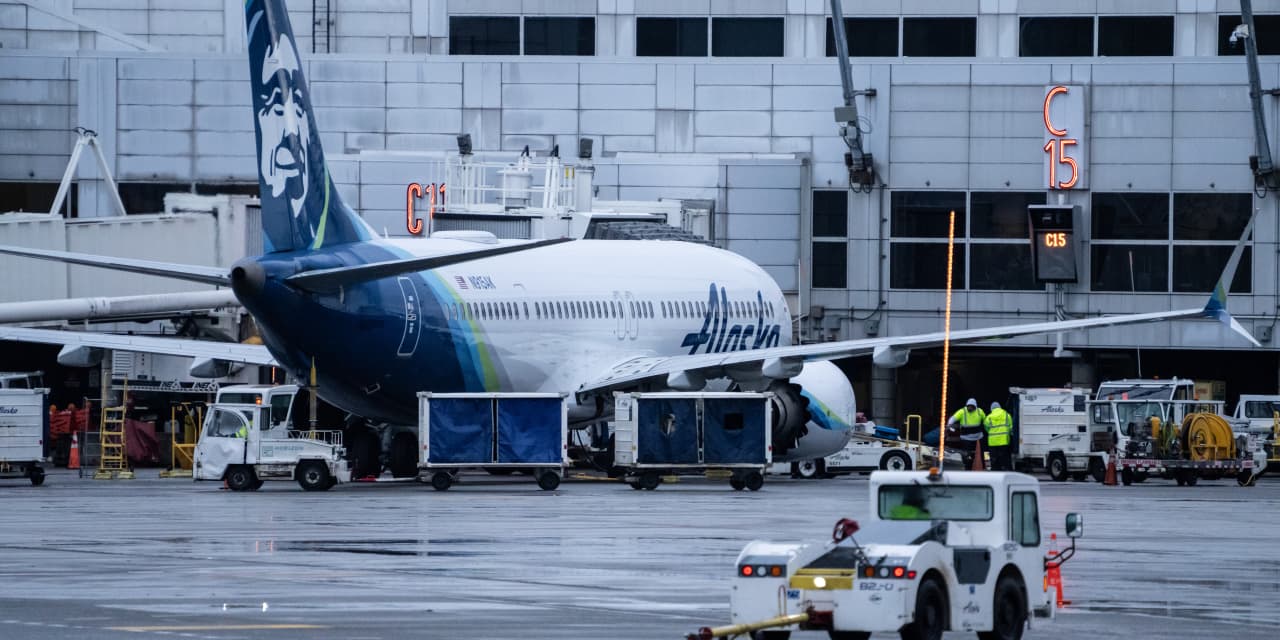
A
Boeing
737 MAX-9 operated by
Alaska Air Group
lost an “emergency door plug” midair on Friday evening causing an emergency landing and sending shares of Alaska,
Boeing,
and Boeing suppliers lower in early trading Monday.
Wall Street doesn’t seem as concerned as investors, but it’s going to take days, perhaps weeks, to sort through the latest 737 MAX problem.
Boeing stock was down 8.4% at $228.00 in Monday trading, while the
S&P 500
was up 0.4% and the
Dow Jones Industrial Average
was down 0.4%.
Alaska Air
shares were down 4.1%, while shares of Boeing fuselage supplier
Spirit AeroSystems
were down about 13%. Spirit Aero makes the part that failed.
General Electric,
whose stock was down 0.8%, doesn’t have anything to do with the fuselage but makes all the engines for 737 MAX jets.
Airbus
stock was up 2.9%. Spirit Aero makes parts for Airbus too, but the market seems to be saying that the latest MAX problem helps A320 market share in the long run. That is the family of Airbus jets that compete with the 737 family of jets.
The MAX was grounded worldwide from March 2019 to November 2020 following two deadly crashes within five months. The crashes were tied back to a design issue with flight control software.
This incident appears to be a manufacturing issue and not a design problem, wrote Citi analyst Jason Gursky in a Sunday report. Still, he isn’t making a definitive call yet. “While we tend to believe this event is related to a manufacturing issue, we can’t rule out problems with the design.”
One reason he feels that way is that 737 jets have been flying with plugged emergency doors since the 1990s. That’s good information, but raises questions of what is an emergency door plug anyway, and why plug an emergency exit at all?
“Extra emergency doors are required for some aircraft with higher passenger capacity,” wrote Melius Research analyst Robert Spingarn in a Sunday report. “However, some airlines such as Alaska configure their aircraft with fewer seats for passenger comfort and do not need extra doors. For this relatively small group of customers, it is more efficient to plug them than to build the fuselage without them.”
The MAX “dash-nine,” the models with plugged doors, began flying in 2015 and has not experienced a similar issue as the Alaska Air flight ran into, added Gursky.
The FAA grounded 171 jets following the incident. European safety regulators grounded the jets too, but noted that no European operators have MAX-9 jets in their fleets. Alaska has 65 MAX-9 jets and has completed about one-quarter of its MAX-9 inspections without finding anything troubling.
Jefferies analyst Sheila Kahyaoglu estimates there are about 220 in service around the world. Boeing has delivered about 1,400 MAX jets overall. Spingarn added in his Sunday report that he expects about 30 MAX-9 jets to be delivered in 2024, out of about 540 737 jets total.
All that seems to indicate Boeing can manage through its latest MAX issue, but it won’t spare shares from volatility as investors take a wait-and-see approach. Boeing stock entered the week at about $249 a share. Shareholders have endured a lot. Boeing stock was about $446 in March 2019, just before the second MAX crash.
Write to Al Root at [email protected] and Brian Swint at [email protected]
Read the full article here