

- Canadian Dollar extended declines after US PMIs cast a long shadow.
- Bank of Canada remains dovish on inflation outlook.
- Canadian money markets are trimming their BoC rate cut bets.
The Canadian Dollar (CAD) fell on Wednesday, pushed lower across the FX market as the Loonie struggles under the weight of a dovish Bank of Canada (BoC) that is still extremely cautious on rate cuts with Canadian inflation not expected to return to the BoC’s 2% target until 2025.
Canada saw money markets trim bets of a BoC rate cut in April down to 40%, tumbling from 65% before the BoC’s monetary policy statement on Wednesday morning. The Bank of Canada followed up their latest policy statement with a press conference, where BoC Governor Tiff Macklem highlighted the BOC’s determination to see inflation come down before adding rate cut discussions to the table.
Daily digest market movers: Canadian Dollar grinds lower on soft BoC, US PMI beat
- Bank of Canada reiterates that monetary policy structure is currently working, but there is still a long way to go on inflation.
- BoC Governor Tiff Macklem states that internal discussions should remain squarely focused on how long to keep rates at 5%, rather than focusing on delivering rate cuts as soon as possible.
- Canadian money markets are pulling away from BoC rate cut bets, odds of an April rate cut down to 40% from 65% prior to BoC statement.
- BoC hopes that Canadian growth will slowly pick up its pace through the second half of 2024 with inflation falling below 2% in early 2025.
- BoC continues to focus on rising rents and shelter costs alongside high wage growth as problematic areas.
- Tiff Macklem comments on policy outlook
- Wednesday’s US Purchasing Managers’ Index (PMI) drove investors into safe havens after US figures cleanly beat the market, putting downside pressure on broad-market rate cut hopes.
- The US’ S&P Global Manufacturing PMI hit a 15-month high of 50.3 versus the expected hold at 47.9 in January as the US economy continues to outpace forecasts put forth by markets hoping for an economic backslide to spark a rate cut cycle.
- The US’ S&P Global Services PMI component also hit a seven-month high of 52.9 versus the forecasted decline from 51.4 to 51.0.
Canadian Dollar price today
The table below shows the percentage change of Canadian Dollar (CAD) against listed major currencies today. Canadian Dollar was the weakest against the Swiss Franc.
| USD | EUR | GBP | CAD | AUD | JPY | NZD | CHF | |
| USD | -0.44% | -0.46% | 0.16% | -0.29% | -0.67% | -0.41% | -0.74% | |
| EUR | 0.44% | -0.02% | 0.59% | 0.14% | -0.24% | 0.03% | -0.31% | |
| GBP | 0.45% | 0.01% | 0.60% | 0.13% | -0.22% | 0.03% | -0.30% | |
| CAD | -0.17% | -0.57% | -0.62% | -0.48% | -0.83% | -0.58% | -0.91% | |
| AUD | 0.29% | -0.13% | -0.16% | 0.44% | -0.33% | -0.14% | -0.45% | |
| JPY | 0.66% | 0.23% | 0.22% | 0.80% | 0.37% | 0.25% | -0.07% | |
| NZD | 0.43% | -0.05% | -0.07% | 0.54% | 0.11% | -0.26% | -0.36% | |
| CHF | 0.74% | 0.30% | 0.28% | 0.89% | 0.44% | 0.08% | 0.33% |
The heat map shows percentage changes of major currencies against each other. The base currency is picked from the left column, while the quote currency is picked from the top row. For example, if you pick the Euro from the left column and move along the horizontal line to the Japanese Yen, the percentage change displayed in the box will represent EUR (base)/JPY (quote).
Technical Outlook: Canadian Dollar struggles under the weight of entrenched BoC
The Canadian Dollar (CAD) is on pace to be the poorest performer of the majors on Wednesday. The CAD is in the red across the board, down close to a full percent against the Japanese Yen (JPY) and the Swiss Franc (CHF). The Loonie saw its most moderate losses against the US Dollar (USD) but still shed around a fifth of a percent against the Greenback for the day.
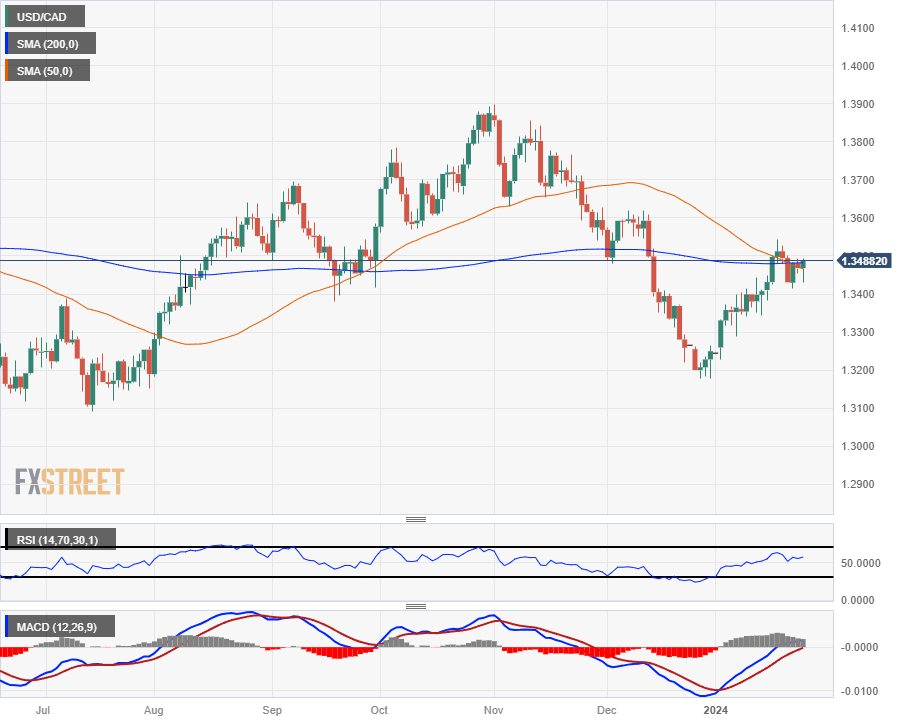
The USD/CAD rallied back into the 1.3490 neighborhood after an early plunge to 1.3430 on Wednesday. The pair is seeing some technical friction from the 200-hour Simple Moving Average (SMA), but near-term momentum remains tilted toward the bullish side with the early week’s swing low pricing in a technical floor at 1.3420.
Continued bullish momentum will send the USD/CAD through a technical congestion zone as the 50-day and 200-day SMAs consolidate near the 1.3500 handle. The pair is on pace to close in the green for a fourth straight week as the USD/CAD grinds back up from December’s bottom bids near 1.3200.
USD/CAD Hourly Chart
USD/CAD Daily Chart![]()
Bank of Canada FAQs
The Bank of Canada (BoC), based in Ottawa, is the institution that sets interest rates and manages monetary policy for Canada. It does so at eight scheduled meetings a year and ad hoc emergency meetings that are held as required. The BoC primary mandate is to maintain price stability, which means keeping inflation at between 1-3%. Its main tool for achieving this is by raising or lowering interest rates. Relatively high interest rates will usually result in a stronger Canadian Dollar (CAD) and vice versa. Other tools used include quantitative easing and tightening.
In extreme situations, the Bank of Canada can enact a policy tool called Quantitative Easing. QE is the process by which the BoC prints Canadian Dollars for the purpose of buying assets – usually government or corporate bonds – from financial institutions. QE usually results in a weaker CAD. QE is a last resort when simply lowering interest rates is unlikely to achieve the objective of price stability. The Bank of Canada used the measure during the Great Financial Crisis of 2009-11 when credit froze after banks lost faith in each other’s ability to repay debts.
Quantitative tightening (QT) is the reverse of QE. It is undertaken after QE when an economic recovery is underway and inflation starts rising. Whilst in QE the Bank of Canada purchases government and corporate bonds from financial institutions to provide them with liquidity, in QT the BoC stops buying more assets, and stops reinvesting the principal maturing on the bonds it already holds. It is usually positive (or bullish) for the Canadian Dollar.
Read the full article here