

- US NFP on Friday prints big upswing to expectations but steep revisions.
- Canada also mixed, adding more jobs than expected but softer wages.
- Next week: US CPI inflation, strictly low-tier Canadian data.
The Canadian Dollar (CAD) roiled against the US Dollar (USD) on Friday after US Nonfarm Payrolls (NFP) figures came in mixed, and Canadian employment figures were broadly overshadowed by US data. The CAD is broadly softer on the day, shedding weight against all of its major currency peers.
Canada added more jobs than expected in February, but wage growth slowed slightly while the Unemployment Rate ticked a bit higher. On the US side, a big beat on NFP forecasts was overshadowed by a massive downside revision to January’s jobs figure, leaving market sentiment hamstrung. Next week’s economic calendar is notably light on Canadian releases, and markets will be getting the next update on US inflation when February’s Consumer Price Index (CPI) prints next Tuesday.
Daily digest market movers: Split NFP print leaves markets churning on Friday
- The US NFP for February added 275K new jobs during the month versus the forecast of 200K.
- January’s NFP print saw a steep correction, revised down to 229K from the previous 11-month peak of 353K.
- Annualized Hourly Earnings growth for the year ended February eased to 4.3% versus the expected 4.4%, and the previous print saw a slight downside revision from 4.5%.
- The US Unemployment Rate also rose in February, ticking up to 3.9% compared to the expected steady print at 3.7%.
- Canada added 40.7K jobs in February, over double the forecast of 20K and rising slightly from the previous month’s 37.2K.
- The Canadian Unemployment Rate also ticked higher to 5.8% in February from 5.7%, in-line with expectations.
- Canadian Average Hourly Wages printed at 4.9% YoY, easing back from the previous period’s 5.3%.
Canadian Dollar price today
The table below shows the percentage change of Canadian Dollar (CAD) against listed major currencies today. Canadian Dollar was the weakest against the Japanese Yen.
| USD | EUR | GBP | CAD | AUD | JPY | NZD | CHF | |
| USD | 0.04% | -0.29% | 0.10% | -0.08% | -0.43% | 0.00% | -0.11% | |
| EUR | -0.06% | -0.36% | 0.05% | -0.13% | -0.51% | -0.06% | -0.18% | |
| GBP | 0.31% | 0.36% | 0.41% | 0.22% | -0.12% | 0.30% | 0.18% | |
| CAD | -0.10% | -0.06% | -0.41% | -0.19% | -0.53% | -0.09% | -0.23% | |
| AUD | 0.09% | 0.13% | -0.24% | 0.20% | -0.33% | 0.08% | -0.02% | |
| JPY | 0.45% | 0.52% | 0.15% | 0.55% | 0.36% | 0.47% | 0.32% | |
| NZD | -0.01% | 0.04% | -0.30% | 0.11% | -0.08% | -0.43% | -0.17% | |
| CHF | 0.13% | 0.18% | -0.18% | 0.22% | 0.05% | -0.31% | 0.13% |
The heat map shows percentage changes of major currencies against each other. The base currency is picked from the left column, while the quote currency is picked from the top row. For example, if you pick the Euro from the left column and move along the horizontal line to the Japanese Yen, the percentage change displayed in the box will represent EUR (base)/JPY (quote).
Technical analysis: Canadian Dollar softens on Friday, leaks recent gains against Greenback
The Canadian Dollar (CAD) is broadly softer on Friday heading into the trading week’s close, shedding around half a percent against the Japanese Yen (JPY) and the Pound Sterling (GBP). The CAD is also down about a fifth of a percent against the Australian Dollar (AUD), as well as down a tenth of a percent against the Euro (EUR) and the US Dollar.
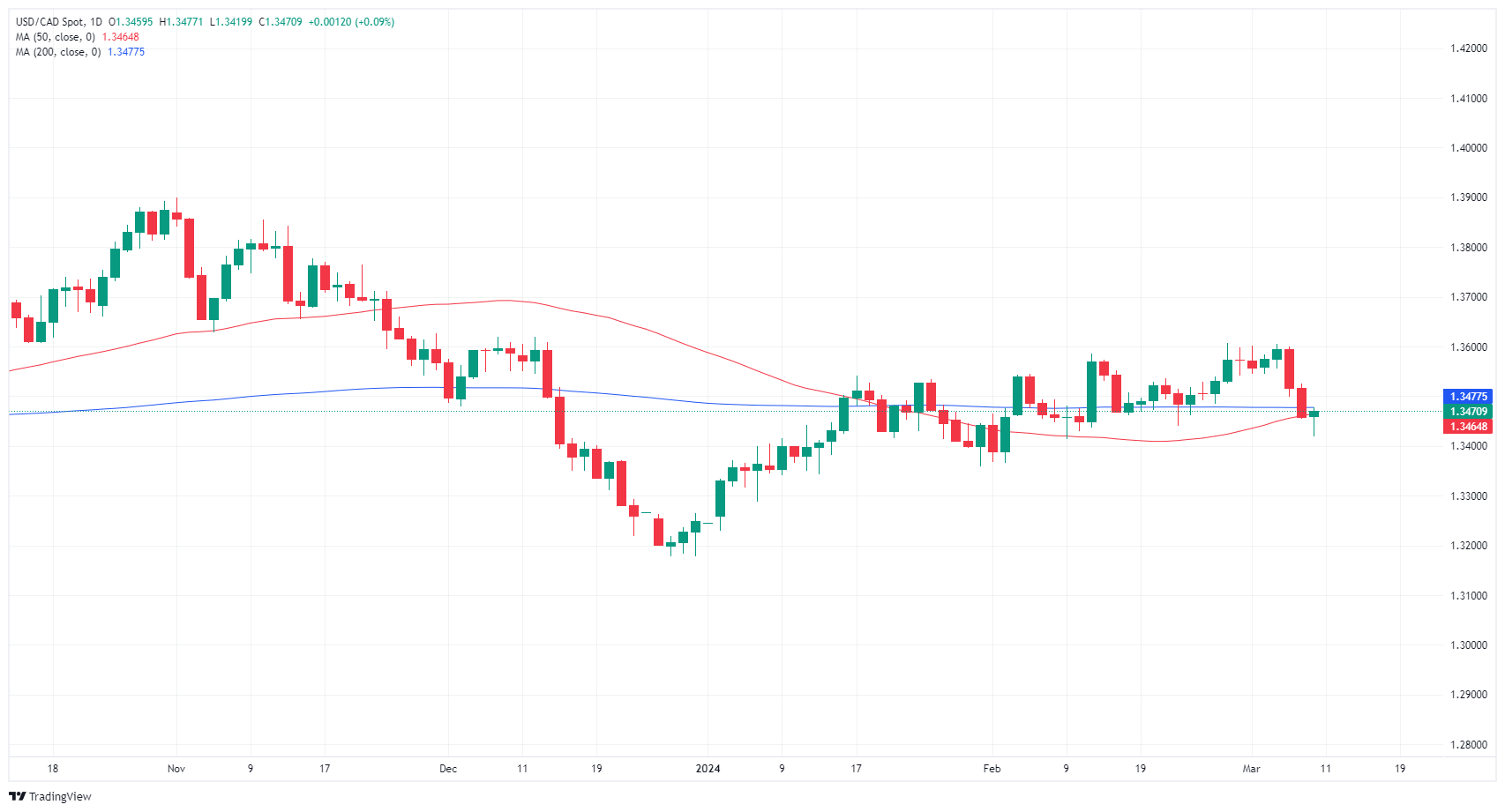
The USD/CAD roiled during the US trading session, sending the pair down to 1.3420 before recovering into the 1.3475 region. The Loonie is still sharply down from the week’s highs near 1.3605, but it is recovering toward the midrange as Friday markets take aim at the weekend.
Friday’s post-dip recovery sends USD/CAD back into the 200-day Simple Moving Average (SMA) at 1.3477. The long-term moving average has flatlined just below the 1.3800 handle for most of 2024, and the pair is set to continue struggling in the near term as it churns within a rough range between 1.3600 and 1.3400.
USD/CAD hourly chart
USD/CAD daily chart![]()
Canadian Dollar FAQs
The key factors driving the Canadian Dollar (CAD) are the level of interest rates set by the Bank of Canada (BoC), the price of Oil, Canada’s largest export, the health of its economy, inflation and the Trade Balance, which is the difference between the value of Canada’s exports versus its imports. Other factors include market sentiment – whether investors are taking on more risky assets (risk-on) or seeking safe-havens (risk-off) – with risk-on being CAD-positive. As its largest trading partner, the health of the US economy is also a key factor influencing the Canadian Dollar.
The Bank of Canada (BoC) has a significant influence on the Canadian Dollar by setting the level of interest rates that banks can lend to one another. This influences the level of interest rates for everyone. The main goal of the BoC is to maintain inflation at 1-3% by adjusting interest rates up or down. Relatively higher interest rates tend to be positive for the CAD. The Bank of Canada can also use quantitative easing and tightening to influence credit conditions, with the former CAD-negative and the latter CAD-positive.
The price of Oil is a key factor impacting the value of the Canadian Dollar. Petroleum is Canada’s biggest export, so Oil price tends to have an immediate impact on the CAD value. Generally, if Oil price rises CAD also goes up, as aggregate demand for the currency increases. The opposite is the case if the price of Oil falls. Higher Oil prices also tend to result in a greater likelihood of a positive Trade Balance, which is also supportive of the CAD.
While inflation had always traditionally been thought of as a negative factor for a currency since it lowers the value of money, the opposite has actually been the case in modern times with the relaxation of cross-border capital controls. Higher inflation tends to lead central banks to put up interest rates which attracts more capital inflows from global investors seeking a lucrative place to keep their money. This increases demand for the local currency, which in Canada’s case is the Canadian Dollar.
Macroeconomic data releases gauge the health of the economy and can have an impact on the Canadian Dollar. Indicators such as GDP, Manufacturing and Services PMIs, employment, and consumer sentiment surveys can all influence the direction of the CAD. A strong economy is good for the Canadian Dollar. Not only does it attract more foreign investment but it may encourage the Bank of Canada to put up interest rates, leading to a stronger currency. If economic data is weak, however, the CAD is likely to fall.
Nonfarm Payrolls FAQs
Nonfarm Payrolls (NFP) are part of the US Bureau of Labor Statistics monthly jobs report. The Nonfarm Payrolls component specifically measures the change in the number of people employed in the US during the previous month, excluding the farming industry.
The Nonfarm Payrolls figure can influence the decisions of the Federal Reserve by providing a measure of how successfully the Fed is meeting its mandate of fostering full employment and 2% inflation.
A relatively high NFP figure means more people are in employment, earning more money and therefore probably spending more. A relatively low Nonfarm Payrolls’ result, on the either hand, could mean people are struggling to find work.
The Fed will typically raise interest rates to combat high inflation triggered by low unemployment, and lower them to stimulate a stagnant labor market.
Nonfarm Payrolls generally have a positive correlation with the US Dollar. This means when payrolls’ figures come out higher-than-expected the USD tends to rally and vice versa when they are lower.
NFPs influence the US Dollar by virtue of their impact on inflation, monetary policy expectations and interest rates. A higher NFP usually means the Federal Reserve will be more tight in its monetary policy, supporting the USD.
Nonfarm Payrolls are generally negatively-correlated with the price of Gold. This means a higher-than-expected payrolls’ figure will have a depressing effect on the Gold price and vice versa.
Higher NFP generally has a positive effect on the value of the USD, and like most major commodities Gold is priced in US Dollars. If the USD gains in value, therefore, it requires less Dollars to buy an ounce of Gold.
Also, higher interest rates (typically helped higher NFPs) also lessen the attractiveness of Gold as an investment compared to staying in cash, where the money will at least earn interest.
Nonfarm Payrolls is only one component within a bigger jobs report and it can be overshadowed by the other components.
At times, when NFP come out higher-than-forecast, but the Average Weekly Earnings is lower than expected, the market has ignored the potentially inflationary effect of the headline result and interpreted the fall in earnings as deflationary.
The Participation Rate and the Average Weekly Hours components can also influence the market reaction, but only in seldom events like the “Great Resignation” or the Global Financial Crisis.
Read the full article here