

- The Canadian Dollar gave up further ground to the US Dollar despite a broad recovery.
- Canadian CPI inflation printed mostly as expected, market bets of a BoC rate cut eased.
- Crude Oil roils again as geopolitical concerns weigh on fossil fuel market flows.
The Canadian Dollar (CAD) climbed against most of its currency trading peers on Tuesday, but fell back against the US Dollar (USD), which took top spot as the best-performing major currency.
Canada’s Consumer Price Index (CPI) inflation in December mostly came in at expectation, but a lack of price growth easing has trimmed market bets of a March rate cut from the Bank of Canada (BoC).
Daily digest market movers: Canadian inflation hits forecasts, but gives little else for rate cut hopes
- Canadian MoM CPI inflation in December printed as expected as -0.3% versus November’s 0.1%.
- Annualized Canadian CPI rose, printed at market forecasts of 3.4% for the year through December compared to the previous period’s 3.1%.
- Canadian money markets now see a 34% chance of a BoC rate cut in March, down from 46% pre-CPI inflation print.
- Canadian annualized Housing Starts rose to 249.3K for the year through December, over the previous 210.9K (revised from 212.6K), beating the forecast of 243K.
- Federal Reserve (Fed) officials continue to talk down market bets of rate cuts, Fed Governor Christopher Waller notes that inflation needs to be on a gradual pace to 2%.
- Fed’s Waller: Near-term data allows Fed to discuss policy cuts in 2024
- Crude Oil markets continue to churn on geopolitical factors surrounding Houthi attacks targeting civilian cargo ships through the Red Sea.
Canadian Dollar price today
The table below shows the percentage change of Canadian Dollar (CAD) against listed major currencies today. Canadian Dollar was the strongest against the Australian Dollar.
| USD | EUR | GBP | CAD | AUD | JPY | NZD | CHF | |
| USD | 0.70% | 0.57% | 0.35% | 0.97% | 0.96% | 0.85% | 0.65% | |
| EUR | -0.71% | -0.13% | -0.35% | 0.26% | 0.25% | 0.15% | -0.05% | |
| GBP | -0.58% | 0.12% | -0.23% | 0.39% | 0.37% | 0.26% | 0.07% | |
| CAD | -0.35% | 0.36% | 0.23% | 0.62% | 0.61% | 0.50% | 0.30% | |
| AUD | -0.97% | -0.27% | -0.39% | -0.62% | -0.01% | -0.12% | -0.31% | |
| JPY | -0.96% | -0.25% | -0.37% | -0.61% | 0.00% | -0.11% | -0.30% | |
| NZD | -0.81% | -0.09% | -0.21% | -0.47% | 0.17% | 0.13% | -0.15% | |
| CHF | -0.66% | 0.06% | -0.06% | -0.30% | 0.31% | 0.30% | 0.19% |
The heat map shows percentage changes of major currencies against each other. The base currency is picked from the left column, while the quote currency is picked from the top row. For example, if you pick the Euro from the left column and move along the horizontal line to the Japanese Yen, the percentage change displayed in the box will represent EUR (base)/JPY (quote).
Technical Analysis: Canadian Dollar broadly gains but recedes against Greenback
The Canadian Dollar (CAD) is down around a quarter of a percent against the US Dollar on Tuesday but is climbing against the rest of its major currency peers. The Canadian Dollar gained around half a percent against the Japanese Yen (JPY) and the Australian Dollar (AUD), while climbing over a third of a percent against the New Zealand Dollar (NZD) and the Euro (EUR).
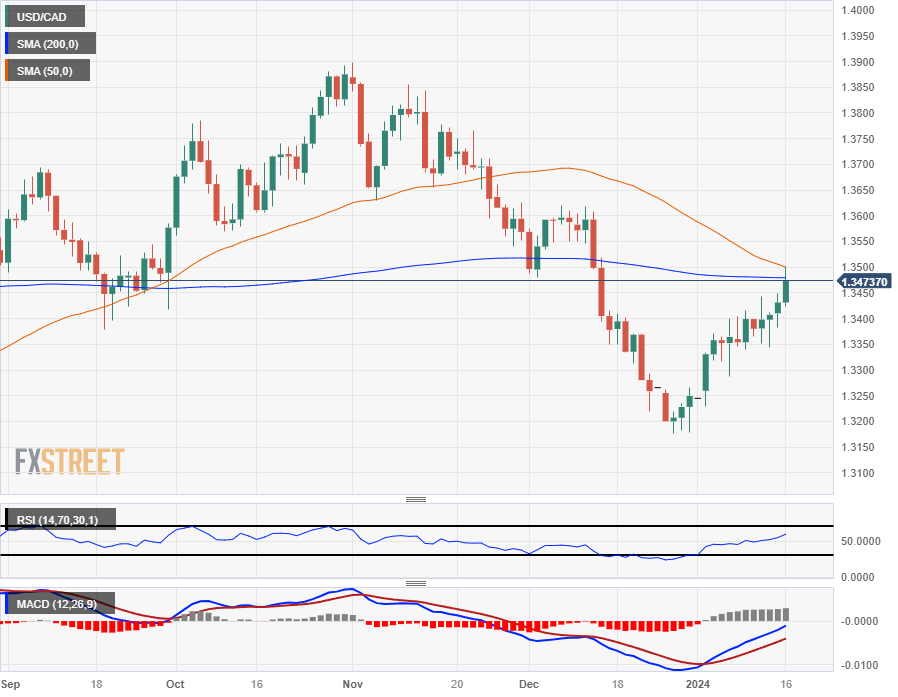
The USD/CAD rose back into the 1.3500 handle for the first time since mid-December as the US Dollar gained against the Loonie, dragging the pair higher after last week’s late bounce from the 200-hour Simple Moving Average (SMA) near 1.3350.
Daily candlesticks have the USD/CAD climbing directly into the 200-day SMA, and continued bullish momentum faces a technical quagmire with the 50-day SMA descending into 1.3500 and set for a bearish cross of the long-term moving average.
Continued bidding pressure will have the pair set for a fresh challenge of November’s peak near 1.3900, while the technical floor sits at December’s swing low into 1.3200.
USD/CAD Hourly Chart
USD/CAD Daily Chart![]()
Interest rates FAQs
Interest rates are charged by financial institutions on loans to borrowers and are paid as interest to savers and depositors. They are influenced by base lending rates, which are set by central banks in response to changes in the economy. Central banks normally have a mandate to ensure price stability, which in most cases means targeting a core inflation rate of around 2%.
If inflation falls below target the central bank may cut base lending rates, with a view to stimulating lending and boosting the economy. If inflation rises substantially above 2% it normally results in the central bank raising base lending rates in an attempt to lower inflation.
Higher interest rates generally help strengthen a country’s currency as they make it a more attractive place for global investors to park their money.
Higher interest rates overall weigh on the price of Gold because they increase the opportunity cost of holding Gold instead of investing in an interest-bearing asset or placing cash in the bank.
If interest rates are high that usually pushes up the price of the US Dollar (USD), and since Gold is priced in Dollars, this has the effect of lowering the price of Gold.
The Fed funds rate is the overnight rate at which US banks lend to each other. It is the oft-quoted headline rate set by the Federal Reserve at its FOMC meetings. It is set as a range, for example 4.75%-5.00%, though the upper limit (in that case 5.00%) is the quoted figure.
Market expectations for future Fed funds rate are tracked by the CME FedWatch tool, which shapes how many financial markets behave in anticipation of future Federal Reserve monetary policy decisions.
Read the full article here