

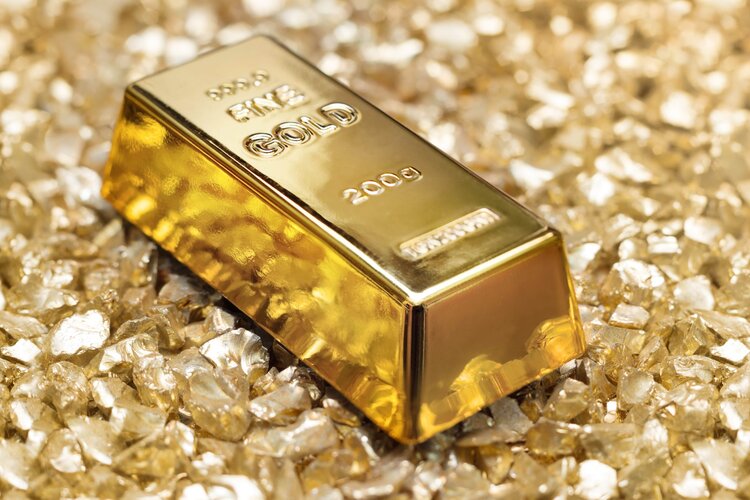
- Gold price builds on its recent recovery from a multi-month low and climbs to a two-week high.
- Geopolitical tensions, sliding bond yields and a softer USD continue to lend support to the metal.
- The US CPI report could offer fresh cues about the Fed’s rate-hike path and provide some impetus.
Gold price (XAU/USD) climbs to a fresh two-week high during the Asian session on Thursday and seems poised to prolong its recent strong recovery move from the $1,810 area, or a seven-month low touched last week. As geopolitical tensions flare in the Middle East, the precious metal has regained its status as a safe haven of choice and draws additional support from the recent US Dollar (USD) decline. Apart from this, falling global bond yields turn out to be another factor benefiting the non-yielding yellow metal and fuelling the rally.
With the latest leg up, the Gold price has now recovered over 30% of its losses registered in September and the positive move seems rather unaffected by a generally positive tone around the equity markets. This, along with speculations that the Federal Reserve (Fed) is nearing the end of its rate-hiking cycle, suggests that the path of least resistance for the XAU/USD remains to the upside. Traders, however, might prefer to wait for the latest consumer inflation figures from the United States (US), due later during the North American session.
Any signs of further moderation in the US inflationary pressures will reaffirm market bets that the Fed will maintain the status quo in Novmber and fuel speculations about a possibile rate cut in Q2 2024. This will set the stage for a further depreciating move for the Grenback and boost demand for the US Dollar-denominated Gold price. In contrast, a strong print will keep the door open for at least one more Fed rate hike move by the end of this year and prompt some profit-taking around the XAU/USD.
Daily Digest Market Movers: Gold price strengthens further on Fed’s dovish tone
- The conflict between Israel and Palestinian Islamist group, Hamas, continues to drive haven flows towards the Gold price.
- Federal Reserve officials suggested that the recent surge in Treasury yields might make further rate hikes less necessary.
- Fed Governor Christopher Waller said on Wednesday that higher market rates may let policymakers “watch and see”.
- The US PPI increased more than expected in September, though the underlying inflationary pressure continued to abate.
- Investors seem convinced that the Fed is nearing the end of its policy-tightening cycle and that interest rates have peaked.
- The yield on the benchmark 10-year US Treasury note retreated further from the highest levels since 2007 touched last week.
- The US Dollar moves further away from the 11-month high and turns out to be another factor underpinning the XAU/USD.
- The minutes from the September FOMC meeting showed that most Fed members backed the case for one more rate hike.
- Market participants now look to the latest US consumer inflation figures for cues about the Fed’s future rate-hike path.
- The headline CPI is expected to have slowed to 0.3% in September and the yearly rate is seen ticking down to 3.6%.
- The more closely watched Core CPI is forecast to have remained steady at a 0.3% monthly pace and come in at 4.1% YoY.
- The crucial CPI report will influence the Fed’s next policy move and provide a fresh directional move to the commodity.
Technical Analysis: Gold price seems poised to extend its steady ascent
The overnight sustained move beyond the $1,865-1,866 horizontal barrier might have already set the stage for additional gains towards the next relevant hurdle near the $1,885 region. Meanwhile, technical indicators on the daily chart – though have recovered from the negative territory – are yet to confirm a bullish bias. Hence, any subsequent move up is more likely to confront stiff resistance and remain capped near the $1,900 round-figure mark. Some follow-through buying, however, will be seen as a fresh trigger for bullish traders and allow the Gold price to challenge the 200-day SMA, currently pegged near the $1,928-1,930 region.
On the flip side, the $1,866-1,865 resistance breakpoint might now protect the immediate downside ahead of the $1,853-1,850 region. The next relevant support is pegged near the $1,835-1,833 zone, representing a multi-day-old trading range resistance breakpoint. A convincing break below the latter will negate any near-term positive outlook and make the Gold price vulnerable to retest the multi-month low, around the $1,810 zone touched last week.
US Dollar price this week
The table below shows the percentage change of US Dollar (USD) against listed major currencies this week. US Dollar was the strongest against the Japanese Yen.
| USD | EUR | GBP | CAD | AUD | JPY | NZD | CHF | |
| USD | -0.55% | -0.78% | -0.53% | -0.75% | 0.03% | -0.67% | -0.94% | |
| EUR | 0.53% | -0.23% | 0.01% | -0.23% | 0.57% | -0.13% | -0.38% | |
| GBP | 0.77% | 0.23% | 0.25% | -0.02% | 0.80% | 0.08% | -0.15% | |
| CAD | 0.53% | -0.02% | -0.25% | -0.22% | 0.56% | -0.14% | -0.40% | |
| AUD | 0.75% | 0.25% | 0.02% | 0.27% | 0.82% | 0.10% | -0.14% | |
| JPY | -0.04% | -0.59% | -0.81% | -0.54% | -0.87% | -0.75% | -0.96% | |
| NZD | 0.68% | 0.15% | -0.08% | 0.16% | -0.10% | 0.73% | -0.26% | |
| CHF | 0.90% | 0.39% | 0.15% | 0.41% | 0.15% | 0.95% | 0.24% |
The heat map shows percentage changes of major currencies against each other. The base currency is picked from the left column, while the quote currency is picked from the top row. For example, if you pick the Euro from the left column and move along the horizontal line to the Japanese Yen, the percentage change displayed in the box will represent EUR (base)/JPY (quote).
Fed FAQs
Monetary policy in the US is shaped by the Federal Reserve (Fed). The Fed has two mandates: to achieve price stability and foster full employment. Its primary tool to achieve these goals is by adjusting interest rates.
When prices are rising too quickly and inflation is above the Fed’s 2% target, it raises interest rates, increasing borrowing costs throughout the economy. This results in a stronger US Dollar (USD) as it makes the US a more attractive place for international investors to park their money.
When inflation falls below 2% or the Unemployment Rate is too high, the Fed may lower interest rates to encourage borrowing, which weighs on the Greenback.
The Federal Reserve (Fed) holds eight policy meetings a year, where the Federal Open Market Committee (FOMC) assesses economic conditions and makes monetary policy decisions.
The FOMC is attended by twelve Fed officials – the seven members of the Board of Governors, the president of the Federal Reserve Bank of New York, and four of the remaining eleven regional Reserve Bank presidents, who serve one-year terms on a rotating basis.
In extreme situations, the Federal Reserve may resort to a policy named Quantitative Easing (QE). QE is the process by which the Fed substantially increases the flow of credit in a stuck financial system.
It is a non-standard policy measure used during crises or when inflation is extremely low. It was the Fed’s weapon of choice during the Great Financial Crisis in 2008. It involves the Fed printing more Dollars and using them to buy high grade bonds from financial institutions. QE usually weakens the US Dollar.
Quantitative tightening (QT) is the reverse process of QE, whereby the Federal Reserve stops buying bonds from financial institutions and does not reinvest the principal from the bonds it holds maturing, to purchase new bonds. It is usually positive for the value of the US Dollar.
Read the full article here