

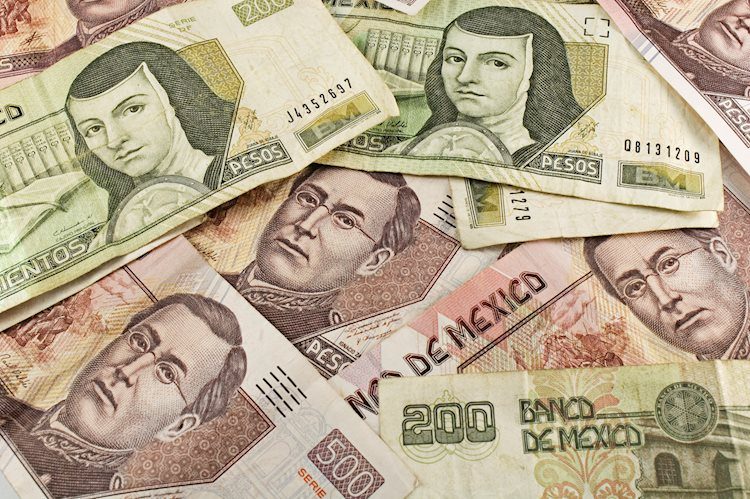
- Mexican Peso stages a comeback but faces strong support as USD/MXN hovers above the 100-day SMA.
- Mexico’s Thursday inflation report could thwart the Bank of Mexico’s easing plans.
- USD/MXN traders are eyeing important US jobs data ahead of the important Nonfarm Payrolls on Friday.
Mexican Peso (MXN) staged a recovery on Tuesday after registering earlier loses against the US Dollar (USD) in the North American session after the USD/MXN briefly tested the 200-day Simple Moving Average (SMA), a critical resistance level. Nevertheless, the pair reversed its course and is trading in the red, at around 17.37, losing 0.32% on the day.
Mexico’s economic calendar remains light on Tuesday, but it will gather some pace on Wednesday, with the release of Consumer Confidence for November, after October’s data printed 46. If confidence slips below the prior month’s figure, it would be the third straight reading that Mexican households are shifting pessimistic on the economic outlook. On Thursday, the National Statistics Agency, known as INEGI, will reveal inflation for November, with most economists expecting a higher rate than in October. That could prevent the Bank of Mexico (Banxico) from easing policy, despite recent comments by Governor Victoria Rodriguez Ceja and Deputy Governor Heath.
Aside from this, the Mexican currency remains stressed as market sentiment turns sour. The financial markets narrative suggests traders had become overly optimistic about rate cuts by the Federal Reserve (Fed). On the data front, the US JOLTs report showed the labor market is easing, while both Services PMI readings revealed by S&P Global and the Institute for Supply Management (ISM) showed the US economy remains resilient.
Daily digest movers: Mexican Peso gains traction as traders await Mexico’s inflation report
- Banxico revised economic growth upward from 3% to 3.3% for 2023 and projects the economy will rise 3% in 2024, from 2.1% previously forecast.
- Regarding inflation prospects, the Mexican central bank foresees headline inflation at 4.4% in Q4 2023 (5.3% for core), while at the end of 2024, it is estimated at 3.4% (3.3% for core). The central bank forecasts headline and core inflation not to hit the 3% target imposed by the institution until 2025.
- The Federal Reserve’s favorite inflation gauge in October, the Core PCE Price Index rate softened from 3.7% to 3.5% YoY. Moreover, headline PCE inflation dropped from 3.4% to 3.0% YoY for the same twelve-month period.
- On November 27, Banxico’s Deputy Governor, Jonathan Heath, commented that core prices must come down more, adding that one or two rate cuts may come next year, but “very gradually” and “with great caution.”
- Mexico’s annual inflation increased from 4.31% to 4.32%, while core continued to ease from 5.33% to 5.31%, according to data on November 23.
- A Citibanamex poll suggests that 25 of 32 economists expect Banxico’s first rate cut in the first half of 2024.
- The poll shows “a great dispersion” for interest rates next year, between 8.0% and 10.25%, revealed Citibanamex.
- The same survey revealed that economists foresee headline annual inflation at 4.00% and core at 4.06%, both readings for the next year, while the USD/MXN exchange rate is seen at 19.00, up from 18.95, toward the end of 2024
Technical Analysis: Mexican Peso weakens further, as the USD/MXN hovers around the 200-day SMA
The USD/MXN popped and printed a three-week high of 17.56, piercing the 200-day SMA at 17.56, before retracing below the 17.50 area, with bulls taking a breather, as volatility continues to pick up. A decisive breach above the 200-day SMA could open the door to challenging the 50-day SMA at 17.69, ahead of the May 23 swing high at 17.99.
On the other hand, if the exotic pair fails at the 200-day SMA, that could pave the way to challenge the 100-day SMA at 17.37. The next demand zone would be the December 4 daily low of 17.16.
Inflation FAQs
Inflation measures the rise in the price of a representative basket of goods and services. Headline inflation is usually expressed as a percentage change on a month-on-month (MoM) and year-on-year (YoY) basis. Core inflation excludes more volatile elements such as food and fuel which can fluctuate because of geopolitical and seasonal factors. Core inflation is the figure economists focus on and is the level targeted by central banks, which are mandated to keep inflation at a manageable level, usually around 2%.
The Consumer Price Index (CPI) measures the change in prices of a basket of goods and services over a period of time. It is usually expressed as a percentage change on a month-on-month (MoM) and year-on-year (YoY) basis. Core CPI is the figure targeted by central banks as it excludes volatile food and fuel inputs. When Core CPI rises above 2% it usually results in higher interest rates and vice versa when it falls below 2%. Since higher interest rates are positive for a currency, higher inflation usually results in a stronger currency. The opposite is true when inflation falls.
Although it may seem counter-intuitive, high inflation in a country pushes up the value of its currency and vice versa for lower inflation. This is because the central bank will normally raise interest rates to combat the higher inflation, which attract more global capital inflows from investors looking for a lucrative place to park their money.
Formerly, Gold was the asset investors turned to in times of high inflation because it preserved its value, and whilst investors will often still buy Gold for its safe-haven properties in times of extreme market turmoil, this is not the case most of the time. This is because when inflation is high, central banks will put up interest rates to combat it.
Higher interest rates are negative for Gold because they increase the opportunity-cost of holding Gold vis-a-vis an interest-bearing asset or placing the money in a cash deposit account. On the flipside, lower inflation tends to be positive for Gold as it brings interest rates down, making the bright metal a more viable investment alternative.
Read the full article here