

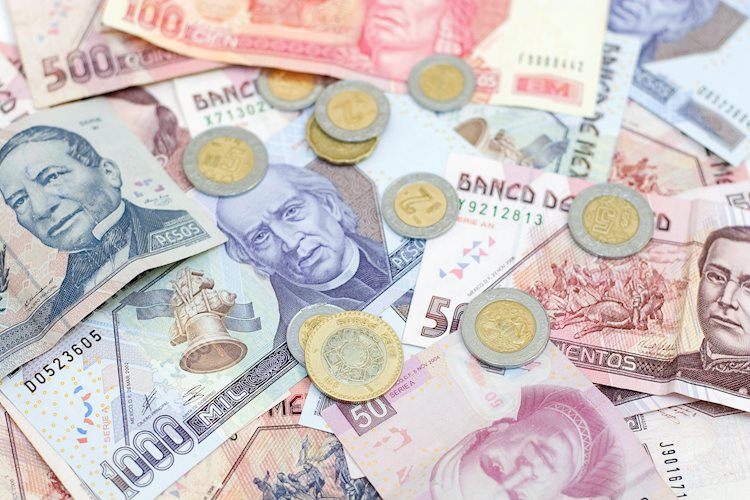
- The Mexican Peso remains soft ahead of the Bank of Mexico’s decision.
- Mexico’s central bank is forecasted to keep rates at 11.25%, though uncertainty looms around the tone of the statement.
- USD/MXN edged higher due to solid US Retail Sales and fewer Americans asking for unemployment claims.
The Mexican Peso (MXN) depreciates against the US Dollar (USD), losing some ground gained on Wednesday after the US Federal Reserve (Fed) decided to end its tightening cycle, hinting it’s ready to cut rates in 2024. However, USD/MXN traders remain wary as the Bank of Mexico (Banxico) is next with its latest decision of 2023. The exotic pair is trading at 17.28, gaining 0.31% on the day.
The Banxico is expected to keep rates unchanged at 11.25%, a level set in March 2023. Since then, Mexico’s central bank has maintained this rate level, adding to the mantra of “higher for longer.” Nevertheless, the bank statement’s tone has gradually softened, saying it will keep rates higher for “some time,” while some officials commented that rate cut discussions could begin in the first quarter of the next year.
Daily Digest Market Movers: Mexican Peso awaiting Banxico for direction
- A Reuters poll showed that 22 of 23 analysts expect the Bank of Mexico would keep rates at 11.25%, while one estimates a rate cut to 11%. Banxico’s decision is due at 19:00 GMT. Annual inflation ticked up to 4.32% in November, though it didn’t dent policymakers’ intentions to ease policy next year if data confirms the disinflation process.
- Meanwhile, the USD/MXN gathered some traction after strong US economic data. US Retail Sales in November rose by 0.3% MoM above estimates for a 0.1% decline.
- At the same time, the US Bureau of Labor Statistics (BLS) revealed that Initial Jobless Claims for the week ending December 9 jumped by 202K, less than the 220K forecast and last week’s 221K reported.
- The latest Federal Reserve’s decision to hold rates and its pivot towards easing policy in 2024 might keep the USD/MXN undermined below the 18.00 figure toward the end of the year, barring a surprise by Banxico.
- Fed officials expect to lower the federal funds rates (FFR) to 4.60% in 2024, though they remain data-dependent.
- The Summary of Economic Projections (SEP) updated by policymakers suggests the US economy would grow 2.6% in 2023, up from September’s 2.1%, while headline inflation is expected to dip below 3% from 3.3% and core to slide towards 3.2% from 3.7%,.
- Fed Chair Jerome Powell’s failure to push back against aggressive rate cut bets sent the Greenback plummeting to a 4-month low.
- Money market futures estimate the Fed will slash rates by 141 basis points toward the end of next year, twice the Fed’s forecasts of three 25 bps cuts.
Technical analysis: USD/MXN buyers target 100-day SMA
The USD/MXN bias remains neutral after touching yearly lows below the 17.00 figure, and since mid-September, the exchange rate has stabilized at around the 17.00-18.48 range. At the time of writing, the pair hit the 100-day Simple Moving Average (SMA) at 17.40 but retreated toward the 17.30 area, with traders awaiting Banxico’s decision.
For a bearish continuation, the pair must drop below the current week’s low of 17.18, which could expose the area of 17.00-17.05, a solid support level reached in November. If those two levels are surpassed, then the pair could challenge the year-to-date (YTD) low of 16.62.
On the flip side, buyers need to reclaim the 100-day SMA to challenge strong resistance at the 200-day and 50-day SMAs, at 17.53 and 17.62, respectively.
Central banks FAQs
Central Banks have a key mandate which is making sure that there is price stability in a country or region. Economies are constantly facing inflation or deflation when prices for certain goods and services are fluctuating. Constant rising prices for the same goods means inflation, constant lowered prices for the same goods means deflation. It is the task of the central bank to keep the demand in line by tweaking its policy rate. For the biggest central banks like the US Federal Reserve (Fed), the European Central Bank (ECB) or the Bank of England (BoE), the mandate is to keep inflation close to 2%.
A central bank has one important tool at its disposal to get inflation higher or lower, and that is by tweaking its benchmark policy rate, commonly known as interest rate. On pre-communicated moments, the central bank will issue a statement with its policy rate and provide additional reasoning on why it is either remaining or changing (cutting or hiking) it. Local banks will adjust their savings and lending rates accordingly, which in turn will make it either harder or easier for people to earn on their savings or for companies to take out loans and make investments in their businesses. When the central bank hikes interest rates substantially, this is called monetary tightening. When it is cutting its benchmark rate, it is called monetary easing.
A central bank is often politically independent. Members of the central bank policy board are passing through a series of panels and hearings before being appointed to a policy board seat. Each member in that board often has a certain conviction on how the central bank should control inflation and the subsequent monetary policy. Members that want a very loose monetary policy, with low rates and cheap lending, to boost the economy substantially while being content to see inflation slightly above 2%, are called ‘doves’. Members that rather want to see higher rates to reward savings and want to keep a lit on inflation at all time are called ‘hawks’ and will not rest until inflation is at or just below 2%.
Normally, there is a chairman or president who leads each meeting, needs to create a consensus between the hawks or doves and has his or her final say when it would come down to a vote split to avoid a 50-50 tie on whether the current policy should be adjusted. The chairman will deliver speeches which often can be followed live, where the current monetary stance and outlook is being communicated. A central bank will try to push forward its monetary policy without triggering violent swings in rates, equities, or its currency. All members of the central bank will channel their stance toward the markets in advance of a policy meeting event. A few days before a policy meeting takes place until the new policy has been communicated, members are forbidden to talk publicly. This is called the blackout period.
Read the full article here