

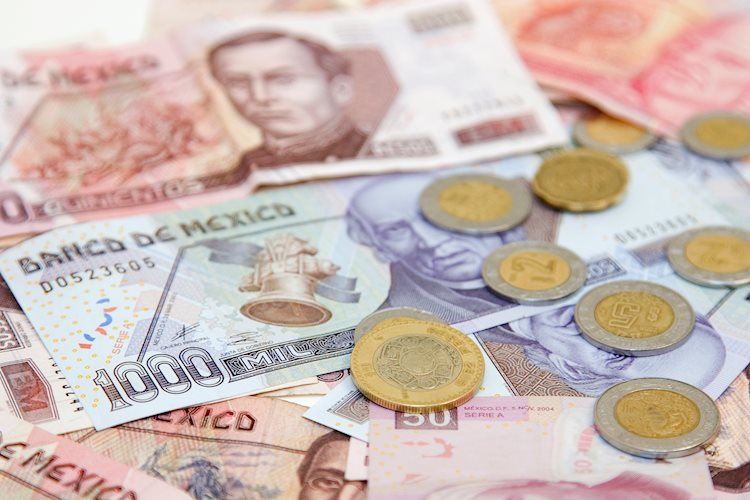
- Mexican Peso is stable against US Dollar as US jobs data improves, but housing paints mixed outlook.
- Drop in US unemployment claims indicates the economy remains resilient, strengthening US Dollar.
- USD/MXN traders await further Fed speakers, Mexico’s Retail Sales on Friday.
The Mexican Peso (MXN) is virtually unchanged against the US Dollar (USD) after a tranche of mixed economic data from the United States (US) and traders paring rate cut bets on the Federal Reserve (Fed), which is keeping the Greenback (USD) bid across the board. It should be said that the USD/MXN trades at 17.18 on the day after hitting a daily low of 17.15, up 0.07% and trapped within strong support and resistance levels, with the 50-day Simple Moving Average (SMA) on the bottom and the 200-day SMA on the top.
The US Bureau of Labor Statistics (BLS) revealed that unemployment claims for last week grew at a slower pace than the previous reading and expectations. The print portrays a tight labor market. Meanwhile, the US Department of Commerce (DoC) released Housing Starts and Building Permits data, which came in mixed, failing to keep the USD/MXN in positive territory. Ahead on Thursday, Atlanta Fed President Raphael Bostic’s comments will cross the newswires.
Daily digest market movers: Mexican Peso stays firm despite mixed US economic data
- The latest Initial Jobless Claims report for the week ending January 12 revealed a decrease to 187,000, lower than both the previous week’s numbers and the anticipated consensus of 207,000. This suggests that the labor market remains tight.
- Regarding the labor market, the Federal Reserve’s latest Beige Book, released on Wednesday, presented a more nuanced picture, reporting that “nearly all districts cited one or more signs of a cooling labor market,” indicating some emerging signs of a slowdown in employment growth across various regions.
- US housing data presented a mixed picture recently. Building Permits saw an increase of 1.9% and reached 1.495 million, compared to 1.467 million in November and surpassing the forecast of 1.48 million. On the other hand, Housing Starts experienced a decline, dropping from 1.525 million in November to 1.46 million in December, a contraction of -4.3%.
- The strongest catalyst in the week has been Federal Reserve Governor Christopher Waller’s speech: “no reason to move as quickly or cut as rapidly as in the past.” This kept investors in check despite supporting rate cuts if inflation indeed gets lowered.
- Besides that, December’s Retail Sales report and Industrial Production have fueled speculation that the US economy would likely grow by 2.4% in Q4 2023 as shown by the Atlanta GDPNow model. This spurred a reaction by fed funds rate (FFR) traders, who trimmed rate cut bets for 2024 from 175 basis points to just 150.
- The lack of data in Mexico keeps traders leaning on the latest inflation figures, which edged higher than expected in headline inflation, but core data suggests the Bank of Mexico (Banxico) has done a good job, curbing elevated prices after hiking rates toward 11.25%.
- Although December’s meeting minutes from Banxico (the Central Bank of Mexico) suggest that the central bank might contemplate easing its monetary policy, the inflation report for December could hinder any move toward policy relaxation.
- Analysts at Standard Chartered noted, “We expect the policy rate to be lowered to 9.25% by end-2024, although an official downward revision in the output gap could open the door for more aggressive rate cuts.”
- On January 5, a Reuters poll suggested the Mexican Peso could weaken 5.4% to 18.00 per US Dollar in the 12 months following December.
Technical analysis: Mexican Peso stays firm as USD/MXN meanders around 17.20
The USD/MXN daily chart remains neutral to upward biased, but failure to decisively break the 200-day SMA (Simple Moving Average) at 17.37 exacerbated a pullback below the 17.20 area. A breach of the 50-day SMA at 17.17 would pave the way to challenge the January 12 low of 16.82. Further downside is seen at the January 8 low of 16.78. Once those levels are hurdled, the next demand level would be the August 28 cycle low of 16.69, ahead of last year’s low of 16.62.
On the other hand, if buyers reclaim the 17.20 area, that could open the door to test the 200-day SMA at 17.37. Once surpassed, the next resistance emerges at the 100-day SMA at 17.41, ahead of the December 5 high at 17.56, before testing the May 23 high of 17.99.
USD/MXN Price Action – Daily Chart
Banxico FAQs
The Bank of Mexico, also known as Banxico, is the country’s central bank. Its mission is to preserve the value of Mexico’s currency, the Mexican Peso (MXN), and to set the monetary policy. To this end, its main objective is to maintain low and stable inflation within target levels – at or close to its target of 3%, the midpoint in a tolerance band of between 2% and 4%.
The main tool of the Banxico to guide monetary policy is by setting interest rates. When inflation is above target, the bank will attempt to tame it by raising rates, making it more expensive for households and businesses to borrow money and thus cooling the economy. Higher interest rates are generally positive for the Mexican Peso (MXN) as they lead to higher yields, making the country a more attractive place for investors. On the contrary, lower interest rates tend to weaken MXN. The rate differential with the USD, or how the Banxico is expected to set interest rates compared with the US Federal Reserve (Fed), is a key factor.
Banxico meets eight times a year, and its monetary policy is greatly influenced by decisions of the US Federal Reserve (Fed). Therefore, the central bank’s decision-making committee usually gathers a week after the Fed. In doing so, Banxico reacts and sometimes anticipates monetary policy measures set by the Federal Reserve. For example, after the Covid-19 pandemic, before the Fed raised rates, Banxico did it first in an attempt to diminish the chances of a substantial depreciation of the Mexican Peso (MXN) and to prevent capital outflows that could destabilize the country.
Read the full article here