

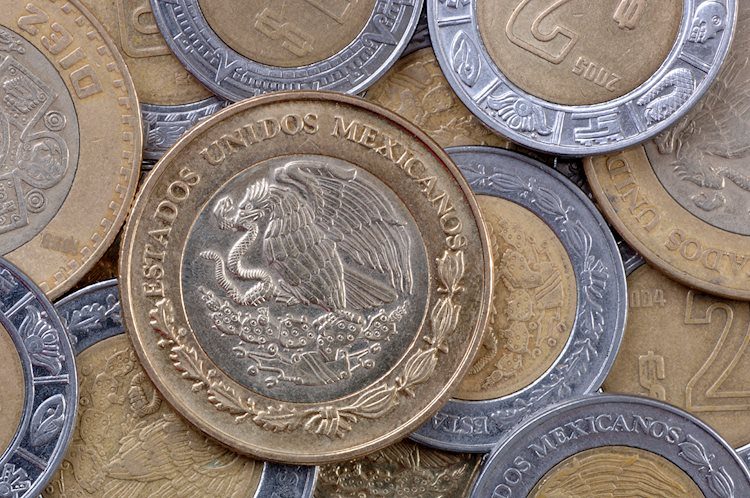
- USD/MXN drops as revised US inflation data fuel expectations for Fed easing.
- US inflation adjustments show success in price control, leading to a weakened Dollar outlook.
- Banxico holds rates at 11.25%, with changes in policy statements indicating a careful stance on future adjustments.
Mexican Peso (MXN) gathers momentum against the US Dollar (USD), buoyed after the release of the latest adjustments to inflation figures in the United States (US). These revisions affirm the effectiveness of the Federal Reserve’s (Fed) strategies to mitigate high inflation levels, potentially paving the way for a reduction in interest rates. As a result, the US Dollar (USD) has softened in the exchange, leading to the USD/MXN trading pair dropping to 17.09, which marks a decrease of 0.36%.
Mexico’s economic docket during the last two days has been busy. Inflation is heading up, while the Bank of Mexico (Banxico) decided to hold rates at 11.25%, though it removed hawkish language from the monetary policy statement. Instead, they added, “In the next monetary policy meetings, it will assess, depending on available information, the possibility of adjusting the reference rate.”
Across the border, Atlanta’s Fed President Raphael Bostic said the Fed must be resolute and added that he’s “laser-focused” on inflation. At the same time, Dallas Fed President Lorie Logan noted that there’s no urgency on cutting rates.
Daily digest market movers: Mexican Peso appreciates despite Banxico dropping hawkish comments
- Banxico’s Governing Council stated that inflationary risks are tilted to the upside in the near term while adding that higher core inflation, foreign exchange depreciation, and a greater-than-expected economic resilience in the country would keep inflationary pressure up.
- On the downside, a global economic slowdown and lower exchange rate levels in relation to the first months of 2023 “contribute more than anticipated to reduce certain pressures on inflation.”
- Mexico’s central bank revised their inflation expectations to the upside for Q1 to Q3 of 2024, and they expected to converge toward 3.5% in Q4.
- Before Wall Street opened, the National Statistics Agency (INEGI) announced that Mexican Industrial Production fell 0.7% in December from November and was flat YoY.
- On Thursday, INEGI revealed that Mexico´s Consumer Price Index (CPI) in January, rose by 4.88% YoY, while underlying inflation moderated to 4.76%.
- The US Bureau of Labor Statistics (BLS) released an inflation data revision, indicating that US inflation rates at the end of 2023 were consistent with initial reports, even after annual revisions. The core CPI, which excludes food and energy, increased at a 3.3% annualized rate in Q4 2023, aligning with previous estimates. The headline inflation figure saw minimal adjustments with December’s monthly rise slightly revised down to 0.2% from 0.3%.
- US Initial Jobless Claims of 218K for the last week were lower than estimates of 220K, down from 227K in the previous reading.
- US Federal Reserve officials remain cautious about guiding market participants about when they would begin easing policy. Yesterday, Richmond Fed President Thomas Barkin was asked about Powell’s comments: “Chairman Powell always speaks for the Committee.”
Technical analysis: Mexican Peso surges as USD/MXN tumbles below 17.10
The USD/MXN is neutral to downwardly biased after clashing with the 50-day Simple Moving Average (SMA) at 17.12 with buyers unable to decisively break that level. Since then, the exotic pair has resumed its downtrend, though it could remain at around the 17.05/17.17 range. Further downside lies ahead as the Relative Strength Index (RSI) shows bears are gathering momentum with the slope peaking two days ago before extending its downtrend. The next support levels lie at 17.05, the psychological 17.00 figure and last year’s low of 16.62.
On the other hand, if buyers reclaim the 50-day SMA, that can pave the way to test the 200-day SMA at 17.31. Upside risks emerge once that barrier is cleared. The next real resistance comes at 17.41, the 100-day SMA.
USD/MXN Price Action – Daily Chart
Banxico FAQs
The Bank of Mexico, also known as Banxico, is the country’s central bank. Its mission is to preserve the value of Mexico’s currency, the Mexican Peso (MXN), and to set the monetary policy. To this end, its main objective is to maintain low and stable inflation within target levels – at or close to its target of 3%, the midpoint in a tolerance band of between 2% and 4%.
The main tool of the Banxico to guide monetary policy is by setting interest rates. When inflation is above target, the bank will attempt to tame it by raising rates, making it more expensive for households and businesses to borrow money and thus cooling the economy. Higher interest rates are generally positive for the Mexican Peso (MXN) as they lead to higher yields, making the country a more attractive place for investors. On the contrary, lower interest rates tend to weaken MXN. The rate differential with the USD, or how the Banxico is expected to set interest rates compared with the US Federal Reserve (Fed), is a key factor.
Banxico meets eight times a year, and its monetary policy is greatly influenced by decisions of the US Federal Reserve (Fed). Therefore, the central bank’s decision-making committee usually gathers a week after the Fed. In doing so, Banxico reacts and sometimes anticipates monetary policy measures set by the Federal Reserve. For example, after the Covid-19 pandemic, before the Fed raised rates, Banxico did it first in an attempt to diminish the chances of a substantial depreciation of the Mexican Peso (MXN) and to prevent capital outflows that could destabilize the country.
Read the full article here