

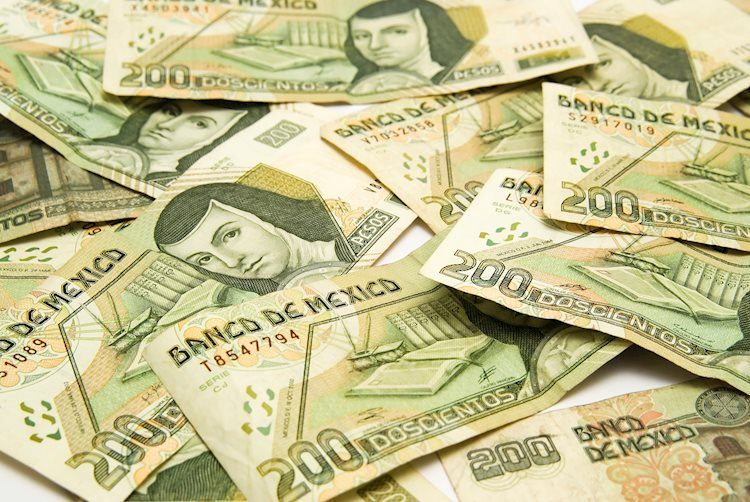
- The Mexican Peso trades lower in its major pairs at the start of the new trading week.
- Global growth fears and the unwillingness of the Fed to lower borrowing costs are curbing enthusiasm and weighing on MXN.
- USD/MXN is still pulling back in the midst of a short and medium-term uptrend.
The Mexican Peso (MXN) edges lower in its key pairs on Monday as market sentiment sours and commodity prices sell-off on global growth fears. As a “risk-on” currency, the Peso accordingly takes some heat.
At the time of writing, a single US Dollar (USD) buys 18.49 Mexican Pesos, EUR/MXN is trading at 19.81 and GBP/MXN at 23.44.
Mexican Peso edges lower on global outlook, Fed caution
The Mexican Peso trades marginally bearish at the start of the new trading week as global growth concerns weigh. A contraction in official Chinese manufacturing data in May combined with a fall in commodity imports due to rising prices are partly to blame. However, the US Federal Reserve’s (Fed) cautious stance at its meeting on Wednesday, with the bank clearly not in a hurry to reduce borrowing costs, further weighed on overall market sentiment.
This comes after a recovery rally for MXN on Thursday, due to verbal intervention by the President of the Banco de Mexico (Banxico), Victoria Rodriguez Ceja, who said Banxico would step in to prop up the Peso if volatility became too “extreme”.
Political risk also continues to provide a background risk for the Peso. Investors are fretting over the victory of President-elect Claudia Sheinbaum and her left-wing coalition Sigamos Haciendo Historia (SHH) at the June 2 elections. SHH won a supermajority in the Mexican House of Deputies and came two seats away in the Senate. This will give it a mandate to push through radical amendments to the constitution that have set markets on edge.
Market positioning has added fuel to sell-off following the build-up of an overweight long bet on the Mexican Peso since its long-term uptrend began in 2020. Relatively high interest rates of 11.00%, set by the Banxico to control inflation, have been a major draw for investors seeking returns. This is especially true of carry traders, for example, who borrow in currencies with low interest rates like the Japanese Yen (Apr circa 0.0% -0.1%) and invest in currencies like the Mexican Peso that offer higher returns (Apr circa 11.00%), pocketing the difference.
“Before the election, we’d been arguing for some time that the Peso appeared increasingly overvalued and was vulnerable to a sharp fall – the declines over the past couple of weeks have taken it within touching distance of our long-standing year-end forecast of 19.00 (USD/MXN),” said Jason Tuvey, Deputy Chief Emerging Markets Economist at Capital Economics, to FXStreet.
Technical Analysis: USD/MXN pulls back but remains in short-term uptrend
USD/MXN appears to be resuming its short-term uptrend after a pullback, and given “the trend is your friend,” the odds favor a continuation higher, probably to the next target situated at 19.22 (March 2023 high).
USD/MXN Daily Chart
A break above Friday’s high at 18.68 would provide additional confirmation of more upside towards the target at 19.22.
The Relative Strength Index (RSI) has just exited the overbought zone, which is a signal for traders to close their longs. This suggests a risk the correction could still go deeper. That said, the established uptrend is likely to resume eventually.
The direction of the long-term trend is in doubt after the break above the October 2023 high. Previous to that, it was down.
Banxico FAQs
The Bank of Mexico, also known as Banxico, is the country’s central bank. Its mission is to preserve the value of Mexico’s currency, the Mexican Peso (MXN), and to set the monetary policy. To this end, its main objective is to maintain low and stable inflation within target levels – at or close to its target of 3%, the midpoint in a tolerance band of between 2% and 4%.
The main tool of the Banxico to guide monetary policy is by setting interest rates. When inflation is above target, the bank will attempt to tame it by raising rates, making it more expensive for households and businesses to borrow money and thus cooling the economy. Higher interest rates are generally positive for the Mexican Peso (MXN) as they lead to higher yields, making the country a more attractive place for investors. On the contrary, lower interest rates tend to weaken MXN. The rate differential with the USD, or how the Banxico is expected to set interest rates compared with the US Federal Reserve (Fed), is a key factor.
Banxico meets eight times a year, and its monetary policy is greatly influenced by decisions of the US Federal Reserve (Fed). Therefore, the central bank’s decision-making committee usually gathers a week after the Fed. In doing so, Banxico reacts and sometimes anticipates monetary policy measures set by the Federal Reserve. For example, after the Covid-19 pandemic, before the Fed raised rates, Banxico did it first in an attempt to diminish the chances of a substantial depreciation of the Mexican Peso (MXN) and to prevent capital outflows that could destabilize the country.
Read the full article here