


Nasdaq, S&P 500 and Dow futures are trading below value and near critical lower gates ahead of the New York open, keeping the focus on whether support holds or the downside extends.
MacroStructure index futures desk report — March 6
Markets covered: Dow Futures (YM), S&P 500 Futures (ES), Nasdaq Futures (NQ).
Method: Structure-first map using Market Profile / TPO + Volume Profile (POC / VPOC) and MacroStructure levels.
Opening summary (London – New York)
All three index futures are entering the New York session under pressure, trading below value and leaning on important lower structure. The common message across the board is clear: the lower gates are the immediate battlefield.
Dow is sitting just under its lower gate after yesterday’s sell-off, with price still below pivot and below value. ES is in a similar position, already trading beneath its lower gate and pointing back toward the lower range unless buyers can quickly reclaim balance. Nasdaq remains the most responsive of the three and is leaning directly on its own lower gate, making it the cleanest momentum tell going into the open.
From a structural point of view, none of the three indices has repaired the damage yet. Recovery is possible, but only if price can reclaim the lower gates, rebuild inside value, and then work back toward the central pivots. Until that happens, the downside remains active.
The key into New York is not prediction — it is acceptance versus rejection at the edges. If the lower gates hold, the market can attempt a repair move. If they fail, the lower ranges come back into focus quickly.
Dow Futures (YM) — March 6
Market snapshot
Current price: 47,959.
TPO POC: 48,080.
VPOC / CP: 48,078.
VAH / VAL: 48,100 / 48,040.
Context
Dow is trading lower through the London session, sitting beneath both the TPO POC (48,080) and VPOC/Central Pivot (48,078). Price is also holding below the upper structure and is now leaning directly on the lower gate zone at 47,996–47,945.
The immediate read is straightforward: the market is sitting at an important edge. This area is the first key support zone for any recovery attempt from yesterday’s sell-off. If buyers can stabilise here, the market may rotate back toward the pivot. If not, the downside ladder remains open.
The 48,040–48,100 zone should be treated as the current value/demand band. Reclaiming this area would suggest a move back toward balance. Rejection below it keeps the structure heavy and confirms that sellers still control the auction.
MacroStructure levels
UR: 48,426.
UG: 48,211–48,160.
CP: 48,078.
LG: 47,996–47,945.
LR: 47,729.
Next lower gate: 47,627–47,564.
Lower pivot: 47,297.
Value/demandinflexion band: 48,040–48,100.
Key decision zones + best tell
The main decision zone into New York sits at 47,996–47,945. This is the lower gate and, for now, the nearest support area that can support a repair move back toward the central pivot.
Best tell: Watch whether price can reclaim and hold above 47,996–47,945 and then build back toward 48,078. If sellers keep price pinned below the gate, the downside ladder remains active toward 47,729.
Value read
Dow is trading below both the TPO POC and VPOC / CP, which keeps the session tilted away from balance for now. Price is not trading inside value; it is pressing underneath it. That tells us the auction remains weak unless buyers can force acceptance back into the value zone.
The 48,040–48,100 band is the key reference here. Reclaiming that area would suggest the market is trying to rebuild balance. Staying below it keeps the value structure weak and leaves the downside vulnerable.
State read
LR – LG – CP – LG
Price has rotated from the lower range back into the lower gate and is now testing whether that zone can hold. This keeps Dow in a weak rotational state below the pivot, not yet a confirmed recovery.
At this stage, the market is still behaving as a fragile structure below the central pivot. Unless buyers can recover LG and then CP, the path remains open for another leg down into LR and possibly lower.
Decision ladder
- Accepted above LG → rotate to CP (48,078).
- Rejected at CP → rotate back to LG (47,996–47,945).
- Accepted below LG → test LR (47,729).
- Accepted below LR → expand to 47,627–47,564.
- Failure at 47,627–47,564 → 47,297 comes into focus.
NY open trade plan
Primary plan
If price holds the lower gate at 47,996–47,945 and New York opens with acceptance back above that zone, the first upside target becomes CP at 48,078. A clean hold above CP would then bring the 48,040–48,100 value band back into play, followed by 48,160–48,211 if momentum builds.
Secondary plan
If price opens weak and cannot hold 47,945, the market remains in continuation mode from yesterday’s sell-off. In that case, focus shifts first to 47,729, then to 47,627–47,564 if lower range support gives way.
Tertiary plan
If price whips around LG without conviction, the likely outcome is rotational trade between LG and CP. In that environment, the cleaner trade remains at the edges rather than inside the noise.
Opening script (First 5–30 Minutes)
At the open, the first question is whether Dow can defend the lower gate. If buyers step in and hold that zone, the market may attempt a repair move back toward 48,078. If sellers keep price pinned below the gate early, downside continuation becomes the cleaner read and 47,729 comes into focus quickly.
The key is not to force the middle. Let the opening auction confirm whether LG is being accepted or rejected.
Open checklist
- Is price opening above or below 47,996–47,945?
- Is the opening auction accepting back above 48,078, or rejecting it?
- Is price reclaiming the 48,040–48,100 value band, or staying below it?
- Does volume build above the lower gate, or stay trapped underneath it?
- Does VPOC begin migrating upward, or remain heavy below CP?
Execution note
The cleanest trade is at LG or LR. Avoid forcing entries in the middle between LG and CP unless value clearly shifts.
Bottom line
Dow is sitting at an important edge. The lower gate is the battlefield going into New York. Hold it, and the market can try to rotate back toward CP and rebuild balance. Lose it, and the downside ladder opens back toward 47,729, then 47,627–47,564, with 47,297 below that if pressure expands.
For now, the structure remains weak below the pivot, so the cleaner approach is still to trade the edges and avoid the middle.
S&P 500 Futures (ES) — March 6
Market snapshot
Current price: 6,807.
TPO POC: 6,842.
VPOC / CP: 6,847.
VAH / VAL: 6,850 / 6,837.
Context
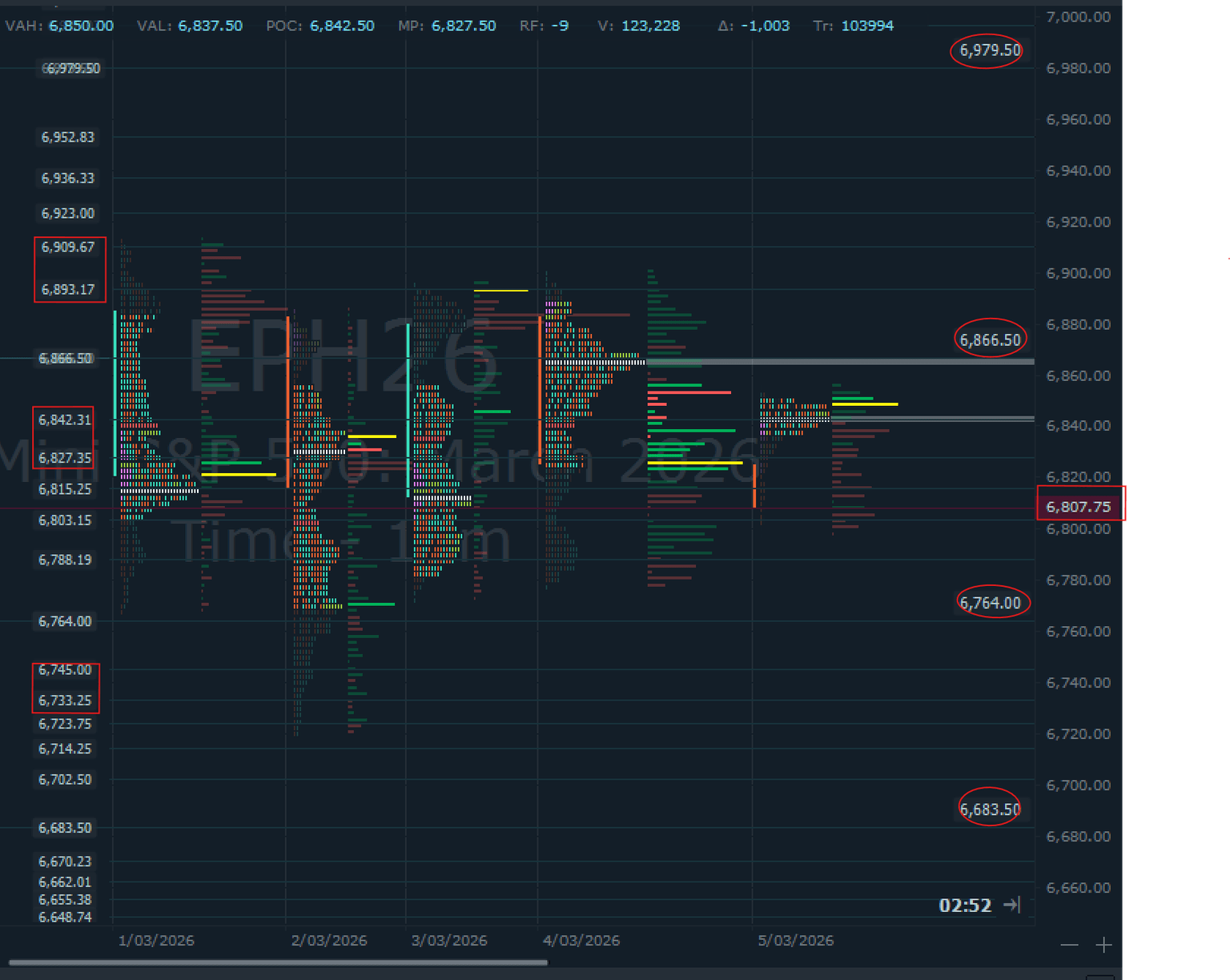
S&P 500 futures are trading lower through the London session, down around 0.29%, with price sitting below the TPO POC (6,842), below the VPOC / balance reference (6,847), and below the central pivot at 6,866. The market is also trading beneath the lower gate at 6,842–6,827, which keeps the structure under pressure and points back toward the lower range.
The current positioning reflects the same route seen in yesterday’s trade: weakness below the lower gate, failed recovery into balance, and continued pressure toward the lower structure. For any recovery attempt to develop, ES first needs to reclaim the lower gate and then work back toward the pivot. Until that happens, the downside remains active.
The 6,837–6,850 zone should be treated as the current value/demandValue/demand band. Reclaiming that band would suggest the market is trying to rotate back toward balance. Remaining below it keeps the auction heavy and leaves sellers in control.
ES is weaker than balance but not yet at full downside expansion unless 6,764 gives way.
MacroStructure levels
UR: 6,979.
UG: 6,893–6,909.
CP: 6,866.
LG: 6,842–6,827.
LR: 6,764.
Next lower gate: 6,745–6,733.
Lower pivot: 6,683.
Value/demand inflexion band: 6,837–6,850.
Key decision zones + best tell
The key decision zone into New York is the lower gate at 6,842–6,827. This is the first nearby area that ES must recover if the market wants to repair yesterday’s sell-off.
Best tell: Watch whether price can reclaim and hold above 6,827–6,842, then build back into the 6,837–6,850 value band. If that happens, the next test becomes CP at 6,866. If the market remains trapped below the gate, the path stays open toward 6,764.
Value read
ES is trading below the TPO POC, below the VPOC, and below the session value band. That keeps the market out of balance and suggests that buyers have not yet regained control of the auction.
The 6,837–6,850 band is the key value reference. Reclaiming that area would be the first sign that ES is trying to stabilise and rebuild balance. Failure to get back into that zone keeps the structure weak and leaves the lower range exposed.
State read
LR – LG – LR
Price has rotated from the lower range into the lower gate and has failed to hold there, slipping back toward the lower structure. This keeps ES in a weak rotational state below the pivot, not yet a confirmed recovery.
This also keeps ES in a weak continuation structure, with recovery only possible if price reclaims LG and starts building back into value.
Decision ladder
- Accepted above LG – reclaim value band (6,837–6,850).
- Accepted back into value – test CP (6,866).
- Rejected at CP – rotate back to LG (6,842–6,827).
- Accepted below LG – test LR (6,764).
- Accepted below LR – expand to 6,745–6,733.
- Failure at 6,745–6,733 – 6,683 comes into focus.
NY open trade plan
Primary plan
If price reclaims and holds the lower gate at 6,842–6,827 into the New York open, ES can attempt a repair move back into the 6,837–6,850 value band and then toward CP at 6,866. A clean recovery above the pivot would bring balance back into play and reopen the path toward the upper structure.
Secondary plan
If price stays below 6,827 and sellers remain in control at the open, the downside continuation remains the cleaner path. In that case, the first target is LR at 6,764, followed by 6,745–6,733 if the lower range gives way.
Tertiary plan
If ES rotates between LG and the underside of value without clear acceptance back above the gate, the market is likely to stay choppy. In that environment, the cleaner opportunities remain at the edges rather than in the middle of the range.
Opening script (First 5–30 Minutes)
At the open, the first question is whether ES can recover the lower gate. If buyers step in and reclaim that zone, the market can rotate back into the 6,837–6,850 value band and test whether balance can be rebuilt toward 6,866.
If ES opens below LG but quickly reclaims it, watch for a squeeze back into 6,837–6,850 before CP is tested. If sellers keep price pinned below the gate, the lower range remains the cleaner downside target.
The key is to let the opening auction confirm whether LG is being accepted or rejected rather than forcing the middle.
Open checklist
- Is price opening above or below 6,842–6,827?
- Is the opening auction reclaiming 6,866, or rejecting it?
- Is price getting back into the 6,837–6,850 value band, or staying below it?
- Does volume begin building back above the lower gate, or remain heavy underneath?
- Does VPOC start migrating upward, or stay trapped below balance?
POC migration note
If VPOC stays below 6,842, sellers still control the auction. If it lifts back through the lower gate, recovery has more credibility.
Execution note
The cleanest trade is at LG or LR. Avoid forcing entries in the middle unless value clearly shifts.
Bottom line
S&P 500 futures remain structurally weak into New York. The market is trading below value, below the lower gate, and below the central pivot, which keeps pressure on the downside unless buyers can recover lost ground quickly.
The lower gate is the immediate battlefield. Reclaim it, and ES can try to rotate back into value and toward 6,866. Stay below it, and the focus remains on 6,764, then 6,745–6,733, with 6,683 below that if weakness expands.
For now, the cleaner approach remains the same: trade the edges and avoid the middle.
Nasdaq Futures (NQ) — March 6
Market snapshot
Current price: 24,946.
TPO POC: 25,100.
VPOC / CP: 25,100.
VAH / VAL: 25,125 / 25,050.
Context
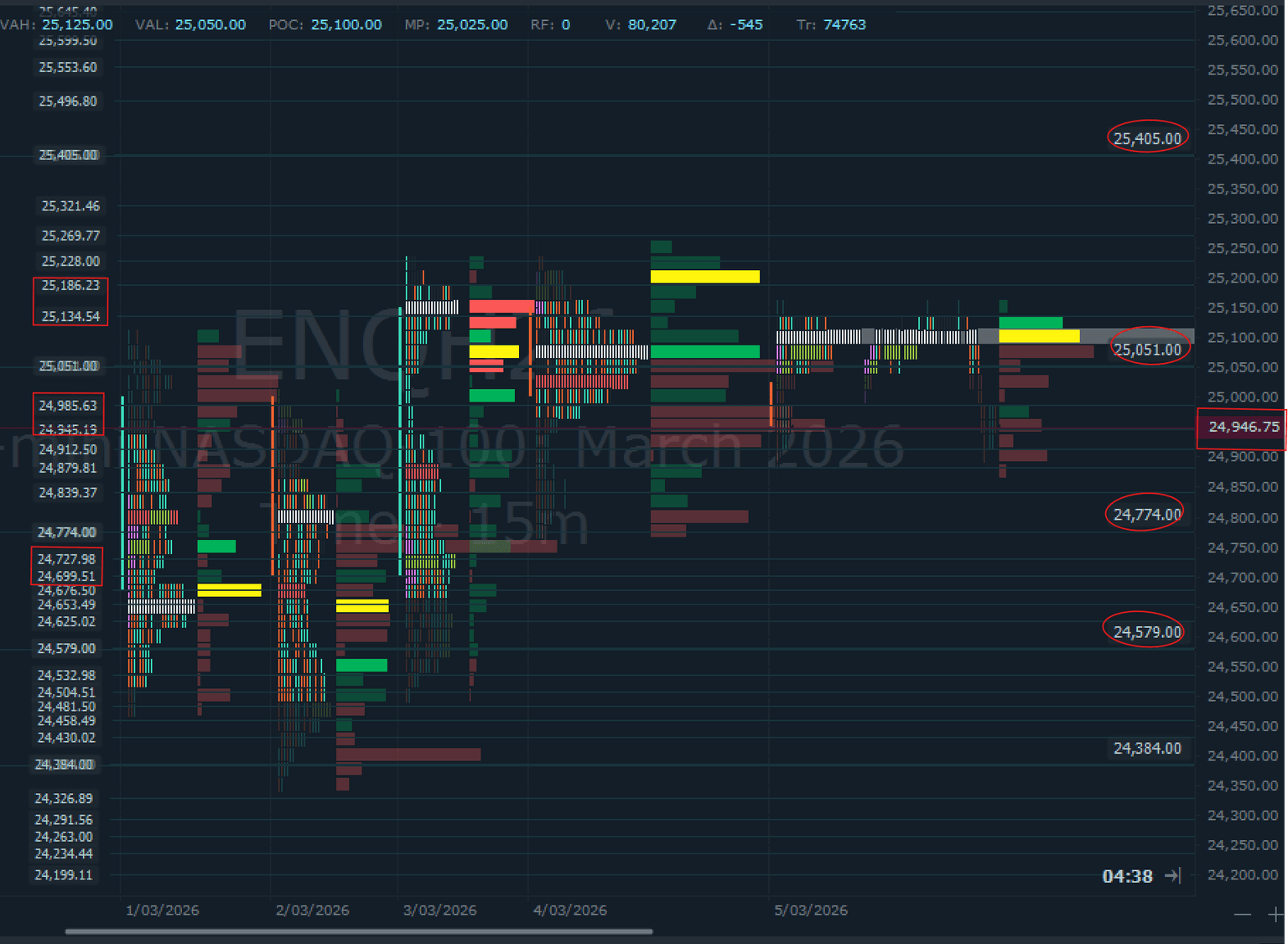
Nasdaq futures are trading lower through the London session, down around 0.21%, with price sitting below the TPO POC (25,100), below the VPOC / balance reference (25,100), and below the central pivot at 25,051. Price is also pressing just under the lower gate at 24,985–24,945, which keeps the market leaning on the lower edge of structure into New York.
The current positioning reflects the same rotational path seen in yesterday’s trade: lower range → lower gate → central pivot → upper gate → back to lower gate. That tells us the map is still active and price is once again sitting at an important decision point. If the lower gate holds, Nasdaq can try to stabilise and climb back up the ladder. If it gives way, the focus shifts back toward the lower range and possibly deeper into the lower structure.
The 25,050–25,125 zone should be treated as the current value/demandValue/demand band. Reclaiming that band would suggest Nasdaq is moving back toward balance. Remaining below it keeps the auction weak and leaves sellers in control.
Nasdaq is weaker than balance but not yet in full downside expansion unless 24,774 gives way.
MacroStructure levels
UR: 25,405.
UG: 25,134–25,186.
CP: 25,051.
LG: 24,985–24,945.
LR: 24,774.
Next lower gate: 24,727–24,699.
Lower pivot: 24,579.
Value/demandinflexion band: 25,050–25,125.
Relative read
NQ remains the most responsive index on the board. If the lower gate fails, Nasdaq is likely to lead downside momentum again. If it reclaims the gate and value, it can also lead the repair move.
Key decision zones + best tell
The main decision zone into New York is the lower gate at 24,985–24,945. This is the nearest support area that Nasdaq needs to defend if the market wants to rebuild from the current weakness.
Best tell: Watch whether price can reclaim and hold above 24,985–24,945, then build back into the 25,050–25,125 value band. If that happens, the next test becomes CP at 25,051 and then the upper gate at 25,134–25,186. If price stays pinned below the gate, the path remains open toward 24,774.
Value read
Nasdaq is trading below the TPO POC, below the VPOC, and below the value band. That keeps the market out of balance and tells us buyers have not yet regained control of the auction.
Price is not just below value — it is sitting below both the lower gate and the lower edge of value. That means buyers still have work to do before any recovery has real structure behind it. As long as NQ stays below 25,050, recovery remains only an attempt, not a confirmed shift back to balance.
The 25,050–25,125 band is the key reference area. Reclaiming that zone would be the first signal that Nasdaq is trying to stabilise and rotate back toward balance. Remaining below it keeps the structure heavy and leaves the lower range vulnerable.
State read
LR – LG – CP – UG – LG
Price rotated from the lower range through the lower gate, reclaimed the central pivot, tested the upper gate, and has now come back down to the lower gate again. This keeps Nasdaq in a weak rotational state below the pivot, not yet a confirmed recovery.
The important point here is that the market has already shown it can travel the full ladder in both directions. Now that price is back at LG, this zone becomes the battlefield again. Hold it, and Nasdaq can rebuild. Lose it, and the structure shifts back toward the lower range.
This keeps NQ in a weak continuation structure unless buyers can reclaim LG and build acceptance back into value.
Decision ladder
- Accepted above LG → reclaim value band (25,050–25,125).
- Accepted back into value → secure CP (25,051).
- Accepted above CP → test UG (25,134–25,186).
- Accepted above UG → focus shifts to UR (25,405).
- Rejected at value band → rotate back to LG (24,985–24,945).
- Rejected at LG → pressure back to LR (24,774).
- Accepted below LG → test LR (24,774).
- Accepted below LR → expand to 24,727–24,699.
- Failure at 24,727–24,699 → 24,579 comes into focus.
NY open trade plan
Primary plan
If price holds and reclaims the lower gate at 24,985–24,945 into the New York open, Nasdaq can attempt a repair move back into the 25,050–25,125 value band. If balance is rebuilt there, the next upside test becomes CP at 25,051, followed by UG at 25,134–25,186. A clean break through that upper gate would then reopen the path toward 25,405.
Secondary plan
If price stays below 24,945 and sellers remain in control at the open, the downside continuation remains the cleaner path. In that case, focus shifts first to LR at 24,774, followed by 24,727–24,699 if the lower range gives way.
Tertiary plan
If Nasdaq rotates around LG without clear acceptance back into value, the market is likely to stay noisy between the lower gate and the underside of balance. In that environment, the cleaner trades remain at the edges rather than in the middle.
Opening script (First 5–30 Minutes)
At the open, the first question is whether Nasdaq can defend the lower gate. If buyers step in and reclaim that zone, the market can squeeze back into the 25,050–25,125 value band and test whether balance can be rebuilt toward 25,051 and the upper gate beyond.
If NQ opens below LG but quickly reclaims it, watch for a fast repair move back into value before the pivot is tested. If sellers keep price pinned below the gate, the lower range remains the cleaner downside target.
If NQ opens below LG and cannot reclaim it quickly, avoid chasing the first flush into LR unless the auction confirms acceptance below the gate.
The key is to let the opening auction confirm whether LG is being accepted or rejected rather than forcing the middle.
Open checklist
- Is price opening above or below 24,985–24,945?
- Is the opening auction reclaiming 25,051, or rejecting it?
- Is price getting back into the 25,050–25,125 value band, or staying below it?
- Does volume begin building above the lower gate, or remain heavy underneath?
- Does VPOC start migrating upward, or stay trapped below balance?
POC migration note
If VPOC stays below 24,985, sellers still control the auction. If it lifts back through the lower gate and into value, recovery has more credibility. If VPOC reclaims 25,051 and holds, that would be the first meaningful sign that buyers are rebuilding intraday control.
Execution note
The cleanest trade is at LG or LR. Avoid forcing entries in the middle unless value clearly shifts.
Bottom line
Nasdaq futures are sitting at another important edge into New York. Price is below value, below the pivot, and leaning directly on the lower gate, which makes this zone the immediate battlefield.
Hold 24,985–24,945, and NQ can try to rebuild through the value band, secure 25,051, and retest 25,134–25,186. Lose it, and the focus shifts back toward 24,774, then 24,727–24,699, with 24,579 below that if weakness expands.
Among the three indices, NQ remains the cleaner momentum signalthe .
For now, the cleaner approach remains the same: trade the edges and avoid the middle.
Cross-index summary and rank
The broad picture across all three indices is aligned: below value, below pivot, and leaning on lower structure. That gives the session a consistent downside bias unless buyers can force a recovery back through the gates and into balance early in New York trade.
The main difference is in responsiveness. Nasdaq remains the clearest momentum tell, S&P 500 is structurally weak and cleanly positioned below balance, while Dow is sitting at a key edge but may be slightly more rotational than the other two if support holds.
Relative strength/weakness rank
1. Nasdaq (NQ) — clearest momentum tell, most responsive at the lower gate.
2. S&P 500 (ES) — weak continuation structure below LG and value.
3. Dow (YM) — weak, but slightly more rotational than NQ and ES near support.
Cross-index read
If NQ loses LG and drives toward LR, ES and YM are likely to follow.
If NQ reclaims LG and value early, that would be the first signal that the broader index complex may attempt a repair move.
For now, the tape still favours edge-to-edge decision making, not middle-of-range guessing.
Glossary
TPO (Time price opportunity):
A market profile view showing how much time price spent at each level. It helps identify balance, acceptance, and areas of rejection.
POC (Point of control):
The price level with the most activity in the profile. It often acts as a magnet when the market is balancing.
VPOC (Volume point of control):
The price level with the highest traded volume. This is a key reference for where participation has concentrated.
VAH (Value area high):
The upper boundary of the value area. It marks the top of the session’s accepted value.
VAL (Value area low):
The lower boundary of the value area. It marks the bottom of the session’s accepted value.
CP (Central pivot):
The central reference in the MacroStructure map. It acts as the core balance point between the upper and lower gates.
UG (Upper gate):
The first upper decision zone above the pivot. Acceptance above it shifts focus higher into the upper range.
LG (Lower gate):
The first lower decision zone below the pivot. Acceptance below it shifts focus lower into the lower range.
UR (Upper range):
The projected upper destination if the market secures the upper gate and expands.
LR (Lower range):
The projected lower destination if the market loses the lower gate and expands.
Acceptance:
When price holds and builds trade around a level, showing that the market is comfortable doing business there.
Rejection:
When price tests a level and quickly moves away, showing that the market is not accepting that price.
Value band /demand band:
The area where price would need to return in order to suggest balance is being rebuilt. Staying below it keeps the structure heavy.
POC migration:
The movement of the TPO POC or VPOC during the session. A rising POC can support recovery; a falling POC can confirm continued weakness.
Trade the edges, avoid the middle:
A structure-first reminder to focus on the key decision zones rather than forcing entries in noisy mid-range trade
This desk report documents a structure-first process, observing how price accepts or rejects predefined levels over time. It is for informational and educational purposes only and does not constitute financial advice. Trading involves risk, and past performance is not indicative of future results.
Protect the method first. Profits are the byproduct of staying consistent.
Structure defines context; price reveals response.value/demand
Read the full article here