

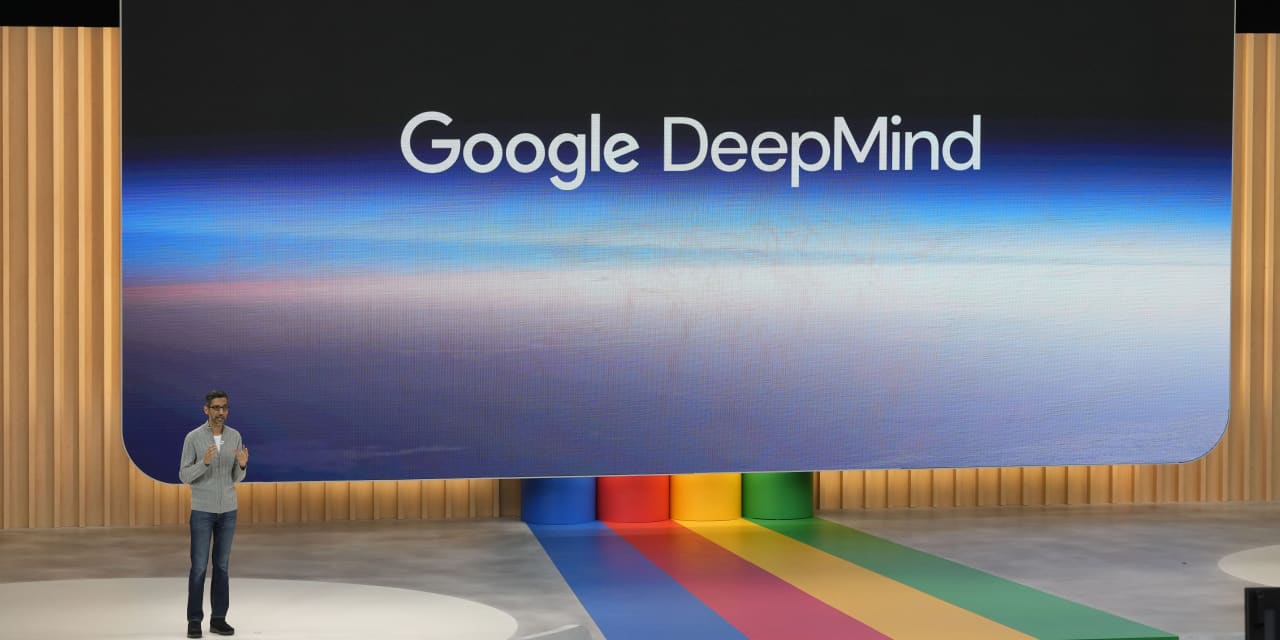
Alphabet Inc.’s Google wants to make a splash with its most ambitious generative-AI model, Gemini. In the artificial-intelligence world, it already is.
Shares of the company
GOOGL,
GOOG,
were popping more than 5% Thursday, a day after the debut of its much-hyped answer to OpenAI’s ChatGPT.
Google is typically understated in its product and financial news, but didn’t hold back in introducing Gemini as the company’s “largest and most capable AI model” — one designed to supercharge everything from Google’s consumer apps to Android smartphones.
“This new era of models represents one of the biggest science and engineering efforts we’ve undertaken as a company,” Google Chief Executive Sundar Pichai said in a blog post. Google, which is synonymous with search engines and cloud computing, has deemed this iteration the “Gemini era,” underscoring its seismic shift to AI.
To that end, Google’s proprietary AI chatbot, Bard, has been upgraded with a version of the Gemini model, and the company plans to add Gemini to Google’s search engine and Chrome web browser, which are used by billions of people worldwide.
“I suspect it will be quite powerful; the amount of innovation will be staggering,” C3.ai Chief Executive Tom Siebel said in a phone interview, assessing Gemini.
Siebel wondered if Google was “the winner” in the AI race, adding, “I don’t know. It could be OpenAI, Anthropic, Google or someone else. It will take three to four years to shake out.” [Siebel pointed to the success of companies like Microsoft Corp.
MSFT,
Intel Corp.
INTC,
Amazon.com Inc.
AMZN,
and others that “came out of nowhere” to become dominant vendors.]
For now, many investors are betting on Google’s bold stroke, which some analysts are saying has thrust the search-engine powerhouse squarely in the genAI race.
“We believe Google has delivered more innovative AI products, exceeding Microsoft and OpenAI’s output, particularly after having a late start in the AI wars and completing a somewhat disruptive re-org in April this year, merging Google Deepmind, Google Research, and Google Cloud divisions,” Rohit Kulkarni, an analyst at Roth-MKM, said in a note Thursday.
Read the full article here