

Unlock the Editor’s Digest for free
Roula Khalaf, Editor of the FT, selects her favourite stories in this weekly newsletter.
Iranian stocks have sold off sharply as rising anxiety about the risk of a US attack on the country adds to a bleak economic outlook.
The main index TEDPIX dropped for the third consecutive day on Monday, posting an 8.3 per cent decline in one week.
The downturn reflects heightened fears of confrontation as the US has deployed military assets to the region, as well as concerns about inflation and the declining value of the national currency.
Iran has been reeling from political and economic instability after widespread anti-regime protests this month, with officials saying that thousands of protesters were killed.
Iranian officials put the death toll at above 3,000 and blamed “terrorists” trained and funded by Israel and the US for the bloodshed. But human rights organisations overseas suggest the number is much higher.
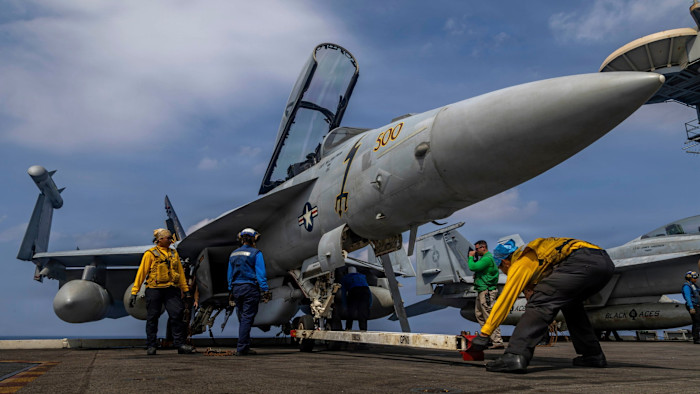
US President Donald Trump said last week that he had sent an “armada” of naval forces towards Iran, “just in case” he had to take action against Tehran.
It was one of several conflicting messages from Trump since unrest broke out in December, from assuring protesters that “help is on the way’’, to later suggesting that the Islamic republic had spared more than 800 people from execution and even raising the possibility of diplomacy with Tehran.
“The tightening of sanctions, an increasingly warlike environment and the deployment of the USS Abraham Lincoln aircraft carrier to the Persian Gulf, further fuel market concerns, even if no direct action ultimately takes place,” said Albert Boghzian, an economist and Tehran university professor.
The UAE reiterated on Monday that it would not allow its airspace, territory or waters to be used in any strike against Iran, calling for ‘‘dialogue, de-escalation, adherence to international law and respect for state sovereignty’’ in a foreign ministry statement.
The US briefly joined Israel’s 12-day war against Iran last June to bomb Iranian nuclear sites.
The latest sell-off was also exacerbated by the authorities having plunged Iran into a total internet shutdown 18 days ago as they sought to disrupt the flow of information during the protests.
Trading volumes on the exchange were below $50mn on Monday and have averaged just over $150mn during the past three days, versus more than $210mn last week, according to Maciej Wojtal, chief investment officer at Amtelon Capital, an Amsterdam-based manager that has a rare licence to invest in Iran’s stock market from abroad.
Industry activists estimate the internet disruptions have caused losses of more than $20mn per day to digital platforms and online businesses. Local media reported that business corporations were allowed roughly 30 minutes of “strictly supervised” internet access at the Chamber of Commerce in Tehran.
Tehran Stock Exchange also suffered a sharp downturn after the June war. Over the months following the conflict, the market gradually recovered as the initial panic subsided.
But persistently high inflation, an inefficient subsidy system and systemic corruption have weakened Iran’s economy over the years. US and international sanctions have throttled the economy by restricting oil exports, cutting the country off from global banking networks and reducing foreign investment.
Year-on-year consumer inflation rate reached 60 per cent this month, the highest in more than a decade, according to the Statistical Center of Iran.
Food prices have risen after the Iranian government removed the official subsidised foreign currency rate for importers of basic goods earlier this month, increasing the cost of production and imports.
Analysts say without reducing tensions and restoring economic stability, investor confidence cannot return. “There is no clear government strategy for price control or inflation management, both of which are essential to creating the stability needed to encourage investment in the capital market,” Boghzian said.
Investors are seeking safer places to preserve their assets, with capital continuing to flow towards gold and foreign exchange markets.
“Funds that would typically be invested in equities are increasingly moving into gold funds,” said Peyman Molavi, a wealth manager and financial author in Tehran. Given the stock market’s limited growth prospects, “investors choose to temporarily park their capital in parallel markets”.
Additional reporting by Joseph Cotterill in London and Ahmed Al Omran in Jeddah
Read the full article here