

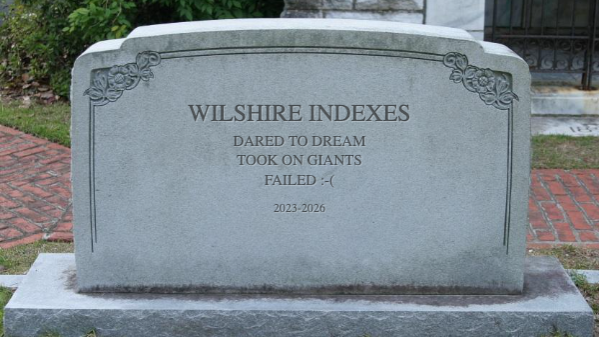
Incumbency is a powerful force in most industries. Despite all the “disruption” chatter, many have a clear and entrenched club that dominates. Perhaps no industry is that truer for than the business of financial indices.
That was the first thought that sprung to Alphaville’s mind as we were perusing LinkedIn on Saturday night — just all real champs do — and came across this:
NB, Mark Makepeace, the CEO of Wilshire Indexes, appears to have subsequently deleted the post, and there’s nothing on the company’s website on it yet.
But ETF Stream has reported that the UK bit of Wilshire Indexes has entered administration, several senior people at the company are putting #OpenToWork on their profiles (and being reshared by Makepeace), and some parts of this have been press released elsewhere, so we’re assuming that it’s all true, and was just prematurely announced.
Alphaville has pinged both Makepeace and Wilshire Indexes to clarify the situation. All we got was a not terribly clear statement from the latter about the “Wilshire OpCo UK” and “Wilshire TopCo Limited” being put into administration, but it did confirm the sale of “key company assets”. So we feel confident in saying:
This makes the 1/4 of Alphaville that cares about indexing a little sad. There’s something about being dismembered and sold for parts that really hammers certain things home in a way that more vanilla, traditional, quiet divestments “at an undisclosed price” don’t.
Namely: indexing is a really tough biz these days if you don’t happen to be called S&P Dow Jones Indices, MSCI or FTSE Russell (or are synonymous with hot US tech stocks in a ebullient era for hot US tech stocks).
Most people might not be familiar with Wilshire, but it is a pedigreed player in the world of financial indices, having launched an innovative “total stock market” index all the way back in 1974. In other words, something that aimed to measure the whole US equity market, rather than a semi-representative slice.
At the time the main indices were the Dow Jones Industrial Average and the S&P 500, but both had some flaws. The Dow was particularly badly designed — it’s narrow, and weighted by the nominal stock price rather than the size of the company — while the S&P 500 only encompassed roughly a tenth of all listed companies at the time. That still captured the vast majority of the stock market’s overall value, but excluded a lot of tiny stocks that would, in the future, become giant ones.
The Wilshire 5000 might have been somewhat grandiosely named (it only included about 4,700 stocks when it was born) but it was therefore the first proper benchmark for the whole US stock market. The Russell 2000 index of smaller stocks only launched two decades later, so this was a genuinely cutting-edge development for the era.
It was designed by a pioneering quant called Dennis Tito, who had founded Wilshire Associates a few years earlier to analyse stock market return patterns (the name comes from the street of the company’s first office). In 2001, Tito later became famous as the first space tourist, having paying a reported $20mn to get a ride on a Russian flight to the International Space Station.
It has always remained in the shadow of the more famous DJIA and S&P 500, but a new potential trajectory opened up when Vanguard’s Jack Bogle in the early 1990s told the company’s index fund head Gus Sauter that they should “stop messing about” and do what the financial theory suggested would be a proper passive fund that captured the entire market. The index they chose was the Wilshire 5000.
The Vanguard Total Stock Market Index Fund is now comfortably the single biggest investment fund on the planet, with $2.1tn of assets. This alone might have been enough to sustain Wilshire’s indexing business, but the association ended before it could be turned into a gold mine. As Allan Sloan wrote in a brief history of the Wilshire 5000 in Barron’s a few years ago:
In April 2004, Dow Jones took over running the index, and the Wilshire 5000 became the Dow Jones Wilshire 5000. It retained that name until March 31, 2009, when Dow Jones and Wilshire parted ways, and the index returned to being the Wilshire 5000. Dow Jones, the parent of Barron’s, declined to discuss why the partnership with Wilshire was created or why it ended. Current Wilshire management said it doesn’t know.
In 2005, in yet another example of how the financial world has changed, Vanguard ditched the Wilshire 5000 and began using Morgan Stanley Capital International’s total market index. That’s because MSCI offered lots of other indexes that Vanguard could use as benchmarks for other index funds. (Since 2013, Vanguard has been using the CRSP U.S. Total Market Index, created by the Center for Research in Security Prices.)
Meanwhile, Wilshire gradually lost mindshare to market metrics such as the S&P 500, the Nasdaq Composite, and various Russell indexes, and lost market share to other total market indexes.
OK, that’s probably enough obscure indexing history. The central important point is that the de facto demise of Wilshire Indexes shows just how tricky it is to find a valuable niche among the Big Three, let alone take them on.
That’s not for want of trying. In 2021 Tito sold his company to private equity firms, and Makepeace — who had built FTSE Russell into one of the indexing industry’s Big Three — came in to spin out Wilshire Indexes and try to turn it into an industry heavyweight (full disclosure: the FT and our owner Nikkei invested in the Wilshire Indexes spinout).
Morningstar is also trying hard to make the Big Three into a Big Four or Five, last year acquiring CRSP and its Vanguard-favoured indices for $375mn. There are several relatively successful midsized players that have managed to carve out a profitable sectoral or geographical niche, like Stoxx, Nasdaq, Hang Seng Indexes and Cboe. In fixed income the indexing industry looks every different, given how banks used to dominate those benchmarks.
The interest is understandable. After all, successful index businesses can be incredibly lucrative.
Nasdaq alone made $827mn of revenues from its benchmark family last year, and the margins are in many cases insanely high — in the 60-70 per cent range, Alphaville previously calculated. Given how easy it is to construct and maintain indices these days you’d think the space is primed for disruption. There are over 3mn public market indices out there, but no one has really nailed private market indices, for example.
However, even at a time when many software, data and analytics companies are supposedly facing an existential threat from AI, it’s hard to see how the Big Three will become anything but the Even Bigger Three.
The oligopoly is now just far too entrenched, and enjoys several mile-wide moats made up of not just tech and data, but more ephemeral factors like institutional inertia, sticky systems and brand (ugh).
Most companies that pay for benchmarks are wary of using one of the smaller, less reputable index providers, given how regulators are more likely to slap them around than indexing companies (which in the US still enjoy a “publishers’ exemption”). So the safe choice is always to go with one of the Big Three, just like how no allocator was ever sacked for handing money to BlackRock, Blackstone or Bridgewater.
In fact, it’s far more probable that one of MSCI, S&P or FTSE Russell gobbles up one of the smaller players to increase their dominance (or expand into new territory) than that one of them will somehow be leapfrogged by an upstart.
The Wilshire 5000 index itself will undoubtedly survive in some form back with its original owner Wilshire Advisors (though it’s unclear whether the newish association with the world’s premier bisque-coloured business paper will continue). VettaFi’s opportunistic acquisition of Wilshire’s GLIO business shows how there’s still a lot of interest in the business of benchmarks.
But the indexing industry looks weirdly static and immune to disruption, as one of its own pioneers has now shown.
Further reading:
— Index providers are massively dull — and massively profitable (FTAV)
— Index regulation is tricky but necessary (FTAV)
Read the full article here