

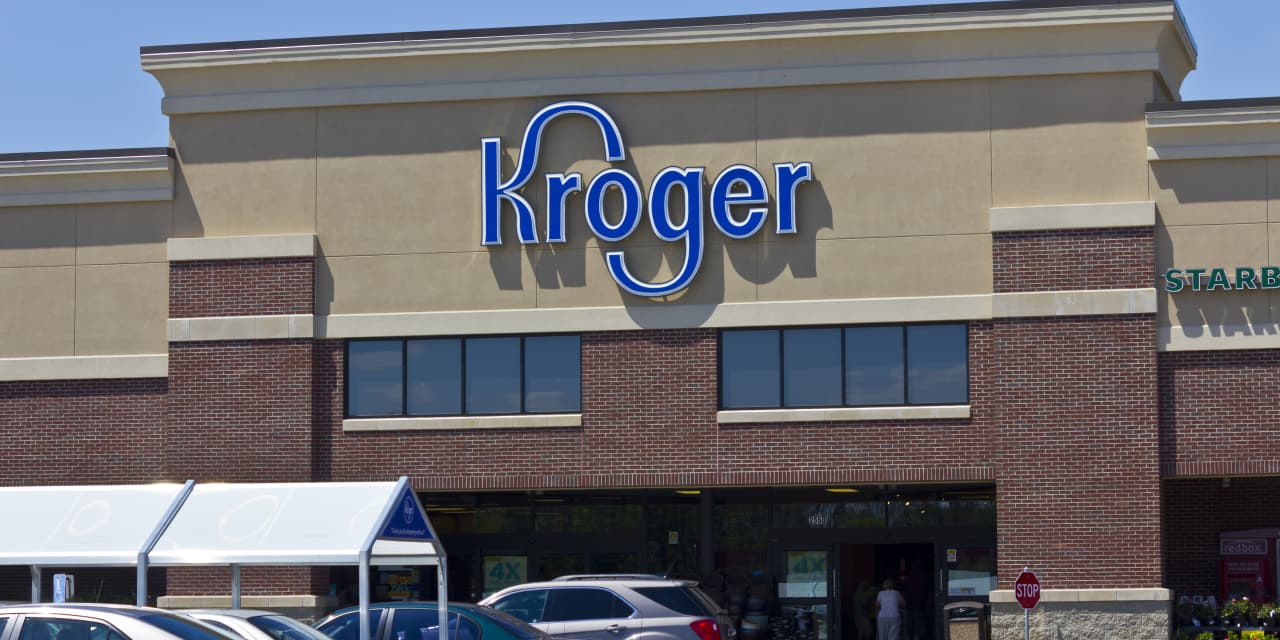
The Federal Trade Commission on Monday sued to block a proposed $25 billion merger between
Kroger,
the nation’s largest grocery operator, and rival
Albertsons.
The FTC cited concerns about reduced competition and higher prices for consumers. The companies say costs would be reduced, resulting in lower prices. The reality is much more layered.
Investors shrugged off the expected news.
Kroger
stock dropped 1.5% on Monday, while
Albertsons
share are up 0.5%.
The deal would lead to higher food prices as well as lower wages for workers, the FTC said in the lawsuit filed in federal court in Oregon. The companies’ plan to divest from hundreds of stores in concentrated markets won’t solve the problem, the agency said.
Big-box chains like
Walmart
and
Costco Wholesale
have been gaining market share in food retail as they leverage their size for cheaper prices. Meanwhile, e-commerce competitors like
Amazon.com
have disrupted the brick-and-mortar business, making store pick-up and home delivery nearly a necessity for grocers to stay competitive.
Following the FTC’s decision, Kroger said in a statement that blocking the merger would harm consumers, who would most likely see higher prices and fewer grocery stores at a time when shoppers are facing food inflation.
“Kroger has reduced prices every year since 2003, resulting in $5 billion invested to lower prices and a 5% reduction in gross margin over this period,” the company said. “This business model is immediately applied to merger companies.”
Blocking the deal also would allow non-unionized retailers like
Walmart,
Costco and
Amazon.com
to further dominate the grocery industry, said Kroger.
Mergers don’t always lead to higher prices. Larger companies are usually more efficient since they can share costs for administration, technology, and marketing. In markets with enough competition, they’ll likely pass those savings costs to consumers.
When a market has few options for consumers, however, it can be problematic. Further consolidation in these areas could reduce competition, allowing dominant players to jack up prices.
A 2018 paper from the FTC examined how consumer prices changed following 14 mergers in the supermarket industry. The paper found that mergers are likely to result in price increases—roughly 2%—in highly concentrated markets with less competition, but the mergers tend to lead to price decreases in less concentrated markets.
The challenge for regulators like FTC, is to determine which markets are too concentrated and which mergers could lead to reduced competition.
The combined Kroger-Albertsons would become a much larger company with 5,000 stores and $228 billion in annual sales. Still, with a combined market share of 15% to 20%, it would be smaller than Walmart, which has more than 5,200 U.S. locations and makes up over a quarter of sales in the grocery market.
Write to Evie Liu at [email protected]
Read the full article here