

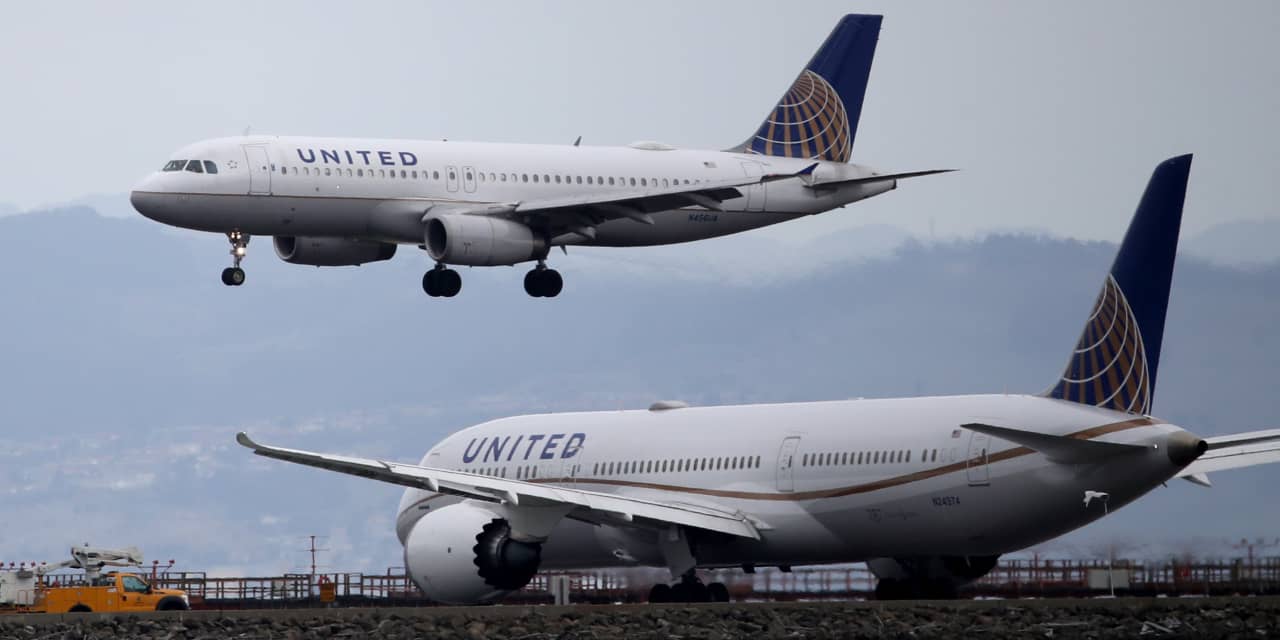
It’s been a turbulent start to the year for airline stocks, and the seat belt sign is still very much on.
United Airlines
’ earnings Monday, and a number of other carriers’ results later in the week will determine whether the pressure facing the sector will get any worse.
The bad start to 2024, however, does mean there’s some scope for positive surprises to kick-start a recovery. The
U.S. Global JETS
exchange-traded fund is down 4.3% in 2024 through Thursday, after climbing 11% last year.
United’s results could be that catalyst, but the impact of the
Boeing
MAX 9 grounding may well overshadow its earnings. The carrier is one of two major U.S. airlines, along with
Alaska Air,
that operate MAX 9 jets–the aircraft that has been grounded for more than two weeks following an emergency incident onboard an Alaska Airlines flight.
United has canceled 11% of its scheduled flights from the day after the incident through Thursday, while Alaska Airlines, due to report Jan.25, has canceled 22%.
But the MAX 9 issue is specific to those airlines. If United or
American Airlines
or
Southwest Airlines
later in the week are to trigger a sector-wide recovery, earnings need to show cost pressures facing the industry aren’t as bad as they seem. Higher labor costs as a result of new pilot pay deals and rising fuel prices as well as supply-chain issues have threatened to pressure airlines’ profitability this year.
Therefore, United’s 2024 full-year guidance is likely to be in focus, particularly after
Delta Air Lines
lowered its long-term target earlier this month and there was a selloff. Delta said it now expects earnings per share of between $6 and $7 this year–missing its long-held target of more than $7.
For United, the number to watch is $9.53 per share, which is what analysts polled by FactSet are expecting. For the fourth quarter, Wall Street is expecting earnings per share of $1.70 on revenue of $13.5 billion in the fourth quarter.
The decision, by a federal judge, to block
JetBlue Airways
’ proposed $3.8 billion merger with
Spirit Airlines
should ultimately help the Big 4—Delta, United, American and Southwest. The deal would have created the fifth-largest U.S. airline and a larger low-cost competitor to challenge the quartet’s dominance.
While this is a positive in the long-term, it is not a catalyst for now and in the near-term the airlines will need to look elsewhere.
Write to Callum Keown at [email protected]
Read the full article here