

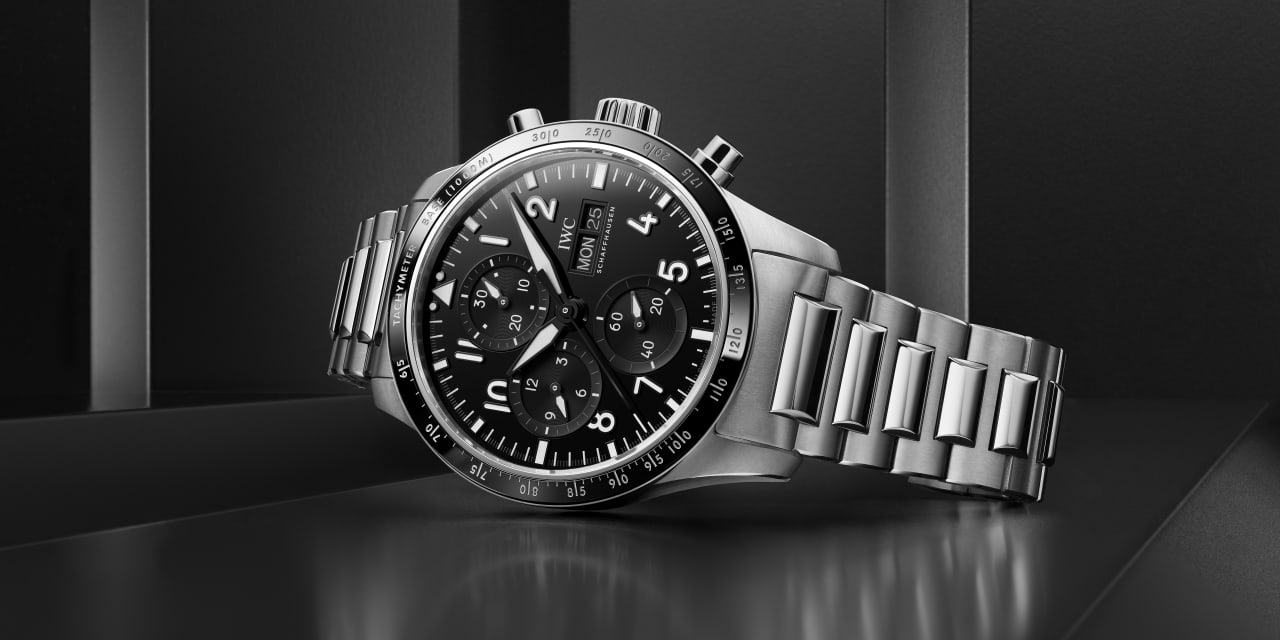
As the Formula 1 circuit revs up Sin City this weekend for the Las Vegas Grand Prix, the penultimate race of the 2023 season, IWC has launched some motorsport-y chronographs to take the sting out of a disappointing season for its Formula One partner, Mercedes-AMG Petronas.
Rather than go with a souped-up version of its recently revamped Ingenieur Automatic 40, IWC turned to its iconic Pilot’s Watch collection to launch a pair of high-octane Pilot’s Watch Performance Chronograph 41s that paying tribute to its longtime motorsport partners. IWC first teamed up with Mercedes-AMG, the performance car subsidiary of Mercedes-Benz, in 2004. The brand became the official engineering partner of the Mercedes-AMG Petronas Formula One Team 2013.
The Pilot’s Watch Performance Chronograph 41 AMG (US$9,800 on black rubber strap/US$11,700 on titanium H-link bracelet) is fully crafted in lightweight brushed titanium—from the case to the crown to the pushers. IWC was among the first to use the robust space-age metal in 1980, when it produced the first titanium chronograph designed by the legendary F.A. Porsche for Porsche Design.
The watchmaker worked closely with the French aerospace company Aérospatiale to develop the specific skills needed for machining the tough material, which boasts the highest strength-to-density ratio of any metal and is frequently used in manufacturing high-performance automotive engines. The rigid grade 5 titanium alloy used for the Pilot’s Watch Performance Chronograph 41 case is approximately 45%lighter than steel.
Its sibling, the Pilot’s Watch Performance Chronograph 41 Mercedes-AMG Petronas Formula One Team (US$13,700 on black rubber strap/US$19,900 on Ceratanium bracelet) offers a more futuristic take with a case made of Ceratanium, a proprietary alloy developed by IWC that fuses the lightness and structural integrity of titanium with hardness and scratch-resistance similar to ceramic.
Case components are machined from bars then finished by hand and fired in a high-temperature kiln. During the firing process, the material’s surface transforms to become similar to ceramic with a matte black finish.
In a nod to their F1-inspired spirit, ceramic bezels feature a tachymeter scale that can be used to calculate average speed in relation to the distance traveled. Activate the chronograph to start timing, then stop it upon reaching a kilometer. The central chronograph seconds hand will point to a number on the rotating tachymeter scale, corresponding to the average speed in kilometers per hour.
The slick, polished black ceramic bezels are complemented with glossy black dials that are fitted with rhodium-plated hands. IWC’s characteristic vertical sub-dial arrangement displays the stopped minutes at 12 o’clock for optimal readability. Recessed chronograph totalizers and applied indices and numerals are filled with Super-LumiNova that lights up the dials in low-light conditions.
Humming underneath the hood, the IWC-manufactured automatic 69385 caliber movement is engineered for robustness, reliability, and precision. The column-wheel chronograph mechanism ensures crisp action when activating, stopping, and resetting the chronograph timing sequence. The movement also employs a bi-directional pawl winding system to generate a power reserve of 46 hours. After assembly and regulation, all movement functions are tested automatically over 12 days in the FIM (final inspection movement) cell developed by IWC.
Read the full article here