

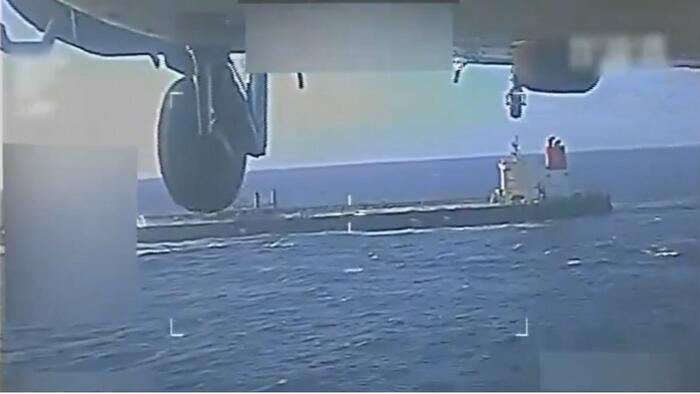
The weird saga of the US-sought third tanker off Venezuela which was nearly boarded by US forces before fleeing into the Atlantic continues, after US officials have newly revealed more information.
US attempts to intercept the oil tanker Bella 1 in the Atlantic have been complicated after the ship’s crew painted a Russian flag on its hull. It has avoided and evaded the US Coast Guard for more than ten days after refusing to comply with an interception near Venezuela on December 21.
Reports based on US officials describe that the crew got creative in their evasion efforts, as they’ve added a Russian tricolor to the side of the vessel and so are now claiming it is operating under Russian jurisdiction.
This has created new complications, given Washington had secured a court order authorizing the ship’s seizure due to its alleged involvement in transporting Iranian crude. But now with the newly displayed flag Russian flag, this has made enforcement more difficult under international maritime law.
The tanker was traveling toward Venezuela without any cargo at the time that US Coast Guard forces tried to board it – and then it fled into open sea, after which US assets continued shadowing the ship.
Under the UN Convention on the Law of the Sea, authorities are allowed to board vessels that are flying false flags or lack proper registration – but in the scenario that Russia has officially registered the Bella 1, a forced boarding could risk diplomatic fallout and an international incident.
The tanker in question has been under US Treasury sanctions since 2024, as it has long been accused of transporting Iranian oil on behalf of Hezbollah, the Houthis, and Iran’s elite Islamic Revolutionary Guard Corps (IRGC).
The vessel is owned by Louis Marine Shipholding Enterprises, which is based in Turkey, and most of the crew are believed to be Russian, Indian, and Ukrainian.
The now apparently stymied attempt to apprehend the vessel comes soon on the heels of President Trump having ordered the US military to enforce a two-month “quarantine” of Venezuelan oil, signaling an intensification of gunboat diplomacy aimed at fostering regime instability in Caracas, with potential spillover effects that could ripple across the Caribbean into Cuba.
“While military options still exist, the focus is to first use economic pressure by enforcing sanctions to reach the outcome the White House is looking (for),” a US official told Reuters earlier this month.
The oil tanker Bella 1 is fleeing U.S. forces after the U.S. Coast Guard tried to intercept it in the Caribbean.
During the pursuit, the crew painted a Russian flag on the ship and now claim Russian status.
The tanker is under U.S. sanctions for carrying Iranian oil and was… pic.twitter.com/WOAMA35aRp
— Clash Report (@clashreport) December 30, 2025
“The efforts so far have put tremendous pressure on Maduro, and the belief is that by late January, Venezuela will be facing an economic calamity unless it agrees to make significant concessions to the U.S,” the U.S. official told Reuters.
According to analytics firm Kpler, Caracas has shipped nearly 900,000 barrels per day this year and relies on 400 dark-fleet tankers to transport the crude, much of which is bound for China.
Loading recommendations…
Read the full article here