

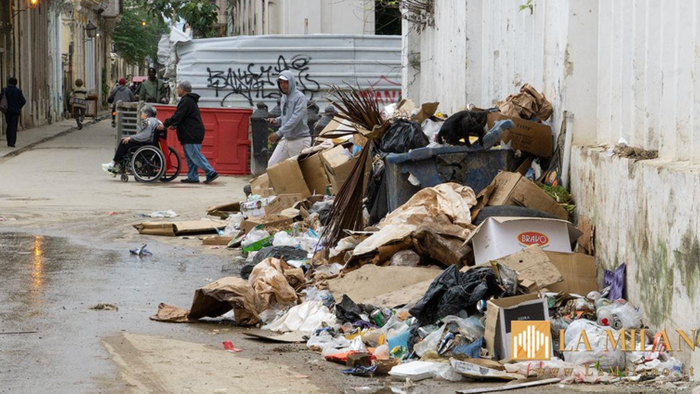
President Trump’s pressure campaign on Cuba is gaining serious momentum as the Caribbean island’s energy crisis deepens, unleashing rampant fuel shortages and prolonged power blackouts. The government rolled out new conservation measures late Friday to preserve energy, but large parts of the economy are already imploding.
Bloomberg reports that Trump’s move to curb fuel shipments to Cuba is spilling over into the tourism sector, with energy shortages forcing two large beach resorts to shut down as early as this weekend.
Here’s more from the outlet:
At least two large beach resorts on Cayo Coco, on the northern coast of the Caribbean nation, will be closing as soon as this weekend due to gasoline shortages, employees reported Friday.
A worker at Mojito Cayo Coco said the resort was shutting down because there wasn’t enough fuel for employees to get to work. Instead, about 200 guests will be transferred to Sol Cayo Coco about 30 miles away.
The worker, who asked not to be identified for fear of retaliation, blamed Trump’s sanctions and said many of his colleagues were losing their jobs. In more than two decades at the hotel, he said he’d seen temporary shutdowns for multiple hurricanes but never for non-weather-related disasters.
On Friday night, Cuba’s government warned that its entire tourism sector was under a “consolidation plan” amid fuel supply disruptions that are rocking the island’s economy.
“Cuban authorities have unilaterally decided to regroup certain travelers in hotels with higher occupancy levels to help ensure service continuity and overall service quality,” Canadian airline and vacation provider Transat AT wrote in a statement. “They have confirmed that these properties remain operational and continue to meet their usual standards.”
Canada recently updated its travel guidance on Cuba to “exercise a high degree of caution,” warning, “The situation is unpredictable and could deteriorate, disrupting flight availability on short notice.”
Havana has drastically reduced public transportation services, shortened the workweek (Monday through Thursday), and moved university classes online.
As of Friday night, the projected total power output for the nation’s grid covered less than half of peak demand (3,100 MW).
Last month, Venezuelan-born political commentator Eduardo Menoni said Cuba’s power grid “has completely collapsed in Havana after more than 20 hours of blackouts.”
Menoni said, “Cuba’s electrical system has completely collapsed in Havana. Communism is a shitty deal.”
🇨🇺 | URGENTE — Cacerolazo masivo en la zona sur de La Habana, Cuba.
Esto es ahora mismo en Arroyo Naranjo. pic.twitter.com/gfMsIZsUGl
— Agustín Antonetti (@agusantonetti) February 6, 2026
With an economic crisis compounded by an energy crunch clearly worsening, Cuban President Miguel Díaz-Canel was likely forced, due to growing risks of social instability, to begin negotiations with the Trump administration late in the week.
“Cuba is willing to engage in dialogue with the United States,” Díaz-Canel announced on Thursday. He made clear it can be a “dialogue on any topic… but without pressure or precondition.”
What piqued our interest about a week ago was a sanctioned Russian Ilyushin Il-76, operated by Aviacon Zitotrans, touching down at a Cuban military airfield. The jet can carry up to 50 tons of cargo or roughly 200 personnel, but there has been no official word on its cargo.
This leaves us with a report from the Russian-military-focused Telegram channel Rybar on Tuesday that only suggests that Cuban Missile Crisis 2.0 could be in the making.
Trump recently said, “We’re starting to talk to Cuba,” and explained his view that “It doesn’t have to be a humanitarian crisis. I think they probably would come to us and want to make a deal. So Cuba would be free again.”
Loading recommendations…
Read the full article here