

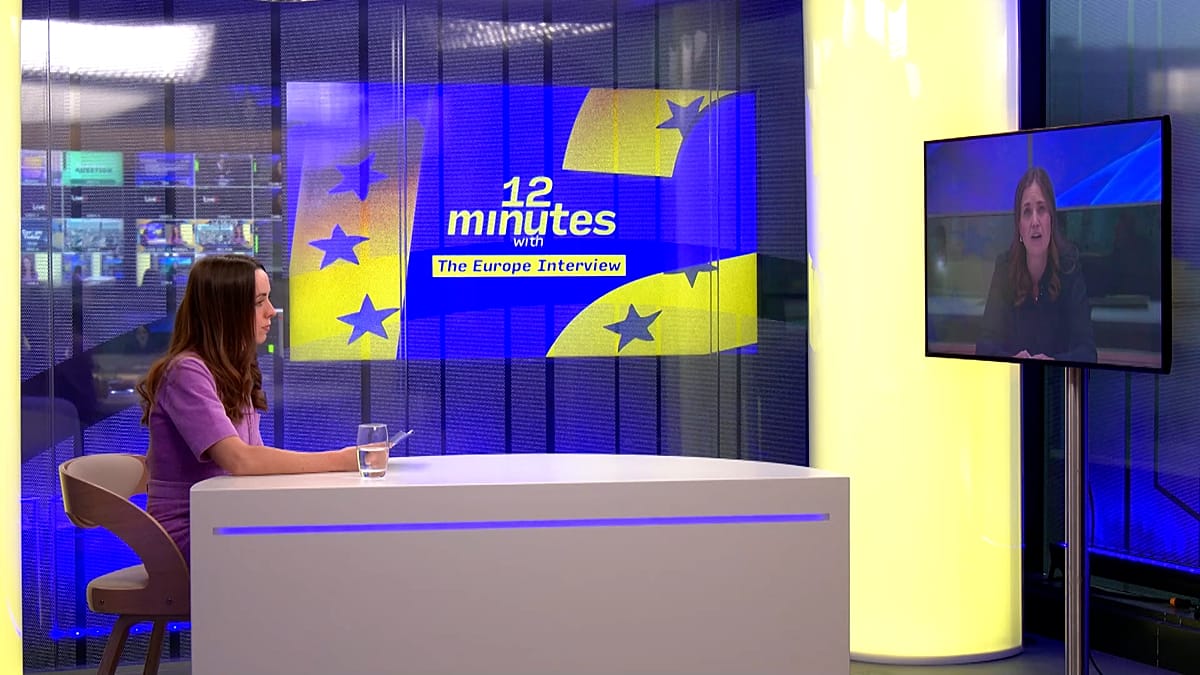
The European Union, under the helm of the Danish Presidency, made notable progress on policies considered priorities for Copenhagen, the country’s European Affairs Minister Marie Bjerre said on Euronews’ flagship interview programme 12 Minutes With.
The Danish government has held the rotating Presidency of the Council of the EU since 1 July 2025, allowing it to set the agenda in Brussels. One of its priorities was tackling “bureaucracy” and “over-regulation” in a bid to restore the EU’s competitive edge, faced with China and the US.
“We said from the beginning that we wanted a stronger Europe in terms of security and defence, and also competitiveness, which was the second theme. And we really managed also to deliver a result here,” Bjerre told Euronews.
In 2025, the Commission proposed ten so-called simplification packages, or Omnibus proposals, stripping back EU regulation in a range of areas, from agriculture to defence and digitalisation.
“During our presidency, we have been able to agree on three of the Omnibus packages with the European Parliament,” Bjerre said, adding that she was “especially satisfied” that the EU Parliament approved the Omnibus I package earlier this month, agreeing to slash sustainability reporting and due diligence requirements.
“This will ease the burdens on our companies, and it is a good first step for moving on and making it easier to do business in Europe, something we really need if we want to have better competitiveness in Europe,” Bjerre said.
Deregulation needed for growth
Bjerre challenged claims made by climate advocates that some simplification packages weaken key sustainability laws under the European Green Deal.
“On the contrary, if we don’t strengthen our competitiveness, we will not be able to solve the climate challenges we are faced with,” she said, adding that for this purpose, the EU needs a strong economy with new green technologies.
“They cannot thrive if we don’t have a good economic environment where it is easy for businesses to scale and to grow, to find investment. So I really see those things going hand in hand.”
Bjerre also welcomed the EU’s Digital Omnibus Package, aiming to make digital businesses competitive. Critics say this rolling back of Europe’s goal of becoming a trailblazer on tech legislation is a result of US President Donald Trump’s threats to impose tariffs against countries that he accuses of attacking US tech companies.
“I think it is quite a strange argument to me,” Bjerre said. “Europe needed better competitiveness, whether we had Trump or not.” She said this was evidenced by last year’s report, penned by former president of the European Central Bank, Mario Draghi, which highlighted overregulation as a major hurdle for digital growth.
Danish model
The Danish Presidency also led the negotiations on important developments when it comes to migration policy, notably reaching a deal on the “safe third country” concept to allow external processing in “return hubs” and advance returns.
“This has also been part of our presidency priorities, and it is a part of making Europe more secure,” Bjerre said. “We need to have better control of migrants coming to Europe, and we need to be better at sending irregular migrants back.”
Denmark’s once heavily criticised “hardline” immigration policies — known as the Danish model — are now being embraced and influencing broader EU policy. However, according to Bjerre, this is not being done to a sufficient extent.
“I can see that more and more countries agree with our approach in Denmark about this, and it’s very good that we made these agreements, but we still have a lot of problems. We still have conventions saying that we have to give criminal immigrants better protection than our own citizens,” she said, referring to the European Convention on Human Rights (ECHR).
Several EU countries, including Denmark, are pushing to reinterpret this convention to make it easier to deport criminals and irregular migrants. “It is also about trust and trust in our democracy. If the convention and judges are making our laws instead of elected politicians, we will lose trust in our democracy, so this is something we have to take seriously,” Bjerre added.
When asked what Cyprus, which will hold the EU Presidency from 1 January 2026, should focus on, Bjerre stated the key European issues should be top of the agenda: security and defence and competitiveness. “I really hope that the Cyprus Presidency will do its best on this. I’m sure it will.”
Read the full article here