

Authored by Chase Smith via The Epoch Times,
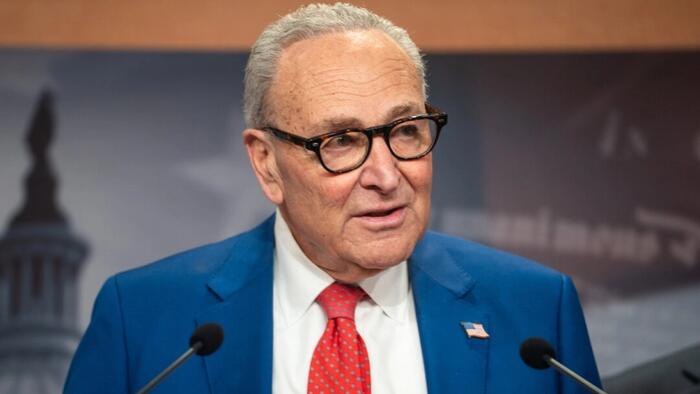
Senate Minority Leader Chuck Schumer (D-N.Y.), Sen. Chris Murphy (D-Conn.), and Rep. Jason Crow (D-Colo.) on Jan. 14 introduced the No Political Enemies Act, or the NOPE Act, a bill they said would protect Americans and organizations from politically motivated federal investigations, prosecutions, and enforcement actions.
In a Wednesday press call announcing the legislation, Murphy said it was necessary because, in his view, the Trump administration is trying to use federal power to punish critics.
“This is a White House that is out of control, seeking to use the Department of Justice to try to censure and censor American citizens … to try to make those who tell the truth pay a grave price.”
The White House responded to the criticism and introduction of the bill in an emailed statement to The Epoch Times.
“The Biden Administration repeatedly weaponized the Department of Justice against their political enemies, including using the Department of Justice to spy on GOP lawmakers—all while the media looked the other way,” said White House spokeswoman Abigail Jackson. “The Trump Administration is restoring integrity to our justice system and holding criminals accountable.”
Jackson’s statement referenced past FBI activity that Republicans have described as politically motivated, and their efforts to remedy it. Rep. Elise Stefanik (R-N.Y.) said in December that a provision in the annual defense policy bill would include language requiring the FBI to inform federal candidates if it opens a counterintelligence probe that involves them.
Stefanik framed the provision as a response to “illegal weaponization of the deep state,” pointing to “Arctic Frost,” an FBI-related probe tied to challenges to the 2020 election that she said included Trump and eight Republican senators among those investigated.
Stefanik also cited the FBI’s earlier “Crossfire Hurricane” investigation of Trump’s 2016 campaign and its alleged links to Russia.
Murphy and other speakers on the Wednesday call pointed to recent developments involving Federal Reserve Chair Jerome Powell.
Murphy said there were “revelations in the last few days that the president is threatening to throw in jail the chairman of the Federal Reserve, [Jerome] Powell, simply because of a policy disagreement between the president and the chairman over interest rates.
“But, of course, we have already seen how this administration has gone after the Attorney General of New York, the former director of the FBI, and members of the United States Senate, with threatened criminal charges. This isn’t what happens in a healthy democracy. This is what happens in a totalitarian state,” he said.
Schumer made a similar argument about the Powell investigation in floor remarks earlier Wednesday.
“Launching a criminal investigation to coerce the Federal Reserve is a dangerous crossing of the Rubicon,” Schumer said. The Fed “must always operate free of coercion,” he said, warning that “when there’s chaos in the Fed, interest rates go up,” and that could raise borrowing costs for housing, car loans, and credit cards.
Also on the call was Justin Vail, counsel for Protect Democracy, which helped draft the legislation.
“For years, members of each political party have accused presidents of the opposing party of improperly weaponizing government,“ Vail said. ”Well, now is the time for Congress to act in a bipartisan fashion … and ensure that no president, Democrat or Republican, can use the government to punish people or organizations for what they say or believe.”
Some Republicans have also criticized the Justice Department’s probe involving Powell.
Sen. Lisa Murkowski (R-Alaska) said she spoke with Powell on Jan. 12 and called the investigation “an attempt at coercion,” while Sen. Thom Tillis (R-N.C.) said on X on Jan. 11 that the probe raised fresh concerns about the Fed’s independence.
Meanwhile, the Trump administration and federal prosecutors have defended the inquiry as a response to the Fed’s handling of questions about renovation cost overruns and Powell’s June testimony.
U.S. attorney Jeanine Pirro said on X on Jan. 13 that outreach to the Fed was “ignored, necessitating the use of legal process—which is not a threat.”
“The word ‘indictment’ has come out of Mr. Powell’s mouth, no one else’s,” she said.
Pirro said her office “makes decisions based on the merits—nothing more and nothing less,” while Trump told reporters on Jan. 13 that Powell was “billions of dollars over budget” and “so, he either is incompetent, or he is crooked. I don’t know what he is, but he certainly doesn’t do a very good job.”
On the other side, Trump and his allies have argued for years that investigations and cases involving him amount to politically motivated “lawfare.”
Trump pleaded not guilty in the federal special counsel cases and said the prosecutions were “politically motivated attempts to harm his reelection campaign.”
In a separate civil legal fight in New York, a spokesman for Trump’s legal team called the E. Jean Carroll litigation and others “Witch Hunts” and said the president would keep “winning against Liberal Lawfare,” after Trump recently asked the Supreme Court to take up his defamation case.
Former special counsel Jack Smith has rejected the claim that his prosecutions were political. In a deposition transcript and video released by the House Judiciary Committee, Smith said the “decision to bring charges against President Trump was mine,” and said the basis for nine of the charges “rests entirely with President Trump and his actions, as alleged in the 10 indictments returned by grand juries in two different districts.”
What the NOPE Act Would Do
The NOPE Act would establish a prohibition on certain executive branch officials initiating or directing an investigative, regulatory, or enforcement action that is “substantially motivated by” a person’s “protected speech or participation,” according to the bill text. The bill defines “protected speech or participation” as “all constitutionally protected speech,” including criticism and dissent.
The legislation would create an affirmative defense that defendants could raise in federal criminal prosecutions or civil enforcement actions when they argue that protected speech was a motivating factor. If a covered person presents “substantial evidence” of political motivation, the bill says a court would order expedited discovery related to government motivations, with procedures for reviewing privileged materials.
The government would then bear the burden of proving by “clear and convincing evidence” that legitimate grounds unrelated to protected speech justified the action and that it was not substantially motivated by protected speech.
The bill directs courts to dismiss the claim or provide appropriate relief if the government does not meet that burden.
The bill also would allow a person to bring a civil action seeking an injunction against a covered federal official and agency when a covered government action is alleged to be substantially motivated by protected speech.
It would create a civil damages action against a covered federal official who “knowingly initiated or directed” a covered government action substantially motivated by protected speech, when constitutional rights are violated in connection with that action. The bill restricts indemnification by the United States in those cases unless certain conditions are met.
Separately, the bill would allow courts to order the United States to pay reasonable attorneys’ fees and costs in certain proceedings tied to covered actions or claims. The bill would also amend the Anti-Deficiency Act to bar obligating or spending federal funds for covered actions or claims substantially motivated by protected speech, and it would allow a civil action for injunctive or equitable relief for alleged violations.
Crow said on the press call that legislation like this was needed to create “a bulwark against this runaway presidency.”
“None of us will back down and be cowed and intimidated,” he added.
Murphy noted in the call that it would be hard to get buy-in from his GOP colleagues in both chambers, adding, “But we have no chance at trying to build a bipartisan coalition around saving our democracy if we don’t even offer these new ideas.”
Loading recommendations…
Read the full article here