

On Thursday, President Donald Trump fired Department of Homeland Security Secretary Kristi Noem and tapped Sen. Markwayne Mullin of Oklahoma as her replacement, marking the first administration shake-up of Trump’s second term. Democrats had been demanding her ouster for months, but they’ve made it quite clear that the move changed nothing in their eyes, and the standoff over DHS funding continues.
The DHS partial shutdown – now stretching into its third week – was already the product of Democratic demands for sweeping restrictions on Immigration and Customs Enforcement and Customs and Border Protection. Those demands didn’t soften with the personnel change. They hardened.
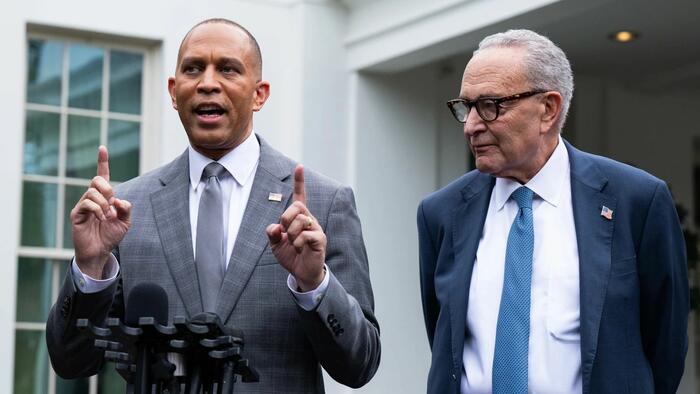
“A change in personnel is not sufficient,” House Minority Leader Hakeem Jeffries told reporters. “We need a change in policy.”
Jeffries added, “It’s not like Kristi Noem was involved in negotiating anything. She was a corrupt lackey. So we’re dealing with the White House and we’re going to continue to deal with the White House at this point.”
Senate Minority Leader Charles E. Schumer made it clear he’s not interested in administrative adjustments or good-faith assurances. He wants legislation that fundamentally changes how immigration law is enforced. “We have to change them by legislation because I don’t trust any one person being in charge of this agency as long as Trump is president, given the policies he’s espoused, given how ICE has been structured,” Schumer insisted. And then, with the rhetorical flourish of a man who has already made up his mind: “The rot is deep.”
Sen. Christopher S. Murphy of Connecticut, the ranking Democrat on the Senate Homeland Security Appropriations Subcommittee, was equally unmoved. “Changing the name plate on the door doesn’t change the fact that they are committed to using DHS to terrorize communities and migrants in this country,” Murphy said.
Despite Democrats being the ones holding up funding, Schumer then blamed Republicans for the ongoing impasse. “They’ve been stonewalling us on the most important issues, and those have to change, and they have to change them,” he told reporters.
However, Senate Majority Leader John Thune disputes Schumer’s characterization. “Senate Democrats are not engaging,” he said. “And furthermore, I would say, beyond not engaging, they are just flat rejecting any chance to sit down and actually talk about it. And that seems to be coming from the top.” Thune then made his second attempt in as many months to bring a House-passed DHS funding bill to the Senate floor, fully anticipating Democrats would block it again. They did. The procedural vote came in at 51-45 — nine short of the 60 needed to advance.
The impasse began in January, when anti-ICE protestors assaulted federal agents in Minnesota, resulting in their deaths. Renee Good attempted to run over an ICE agent with her vehicle, prompting the agent to fatally shoot her. Weeks later, Alex Pretti assaulted Border Patrol agents while armed with a loaded gun and was shot in the process of attacking the agents.
Democrats used the incident to push for a package loaded with ridiculous restrictions that would have put agents at risk and severely hampered their ability to enforce the law. Among other provisions, their requested rules included banning agents from wearing masks, requiring judicial warrants for entry onto private property, mandating identification and body cameras, and prohibiting enforcement near schools, churches, hospitals, and polling places.
But, Republicans pointed out that unmasking agents exposes them to doxing and harassment, and that a blanket warrant requirement would drown the courts — effectively neutering the administration’s immigration agenda.
One area of agreement was on body cameras. Yet, Democrats later backtracked on that demand.
Meanwhile, the shutdown’s collateral damage is becoming harder to ignore. ICE and CBP have kept their lights on, covered by the $75 billion Congress funneled to immigration enforcement through last summer’s budget reconciliation law. But TSA, FEMA, the Coast Guard, and the Secret Service have no such backstop and are beginning to feel the financial squeeze.
Mullin is set to take over on March 31, pending Senate confirmation. Whether he can unlock a deal to end the standoff remains entirely unclear, but so far it looks unlikely.
Loading recommendations…
Read the full article here