

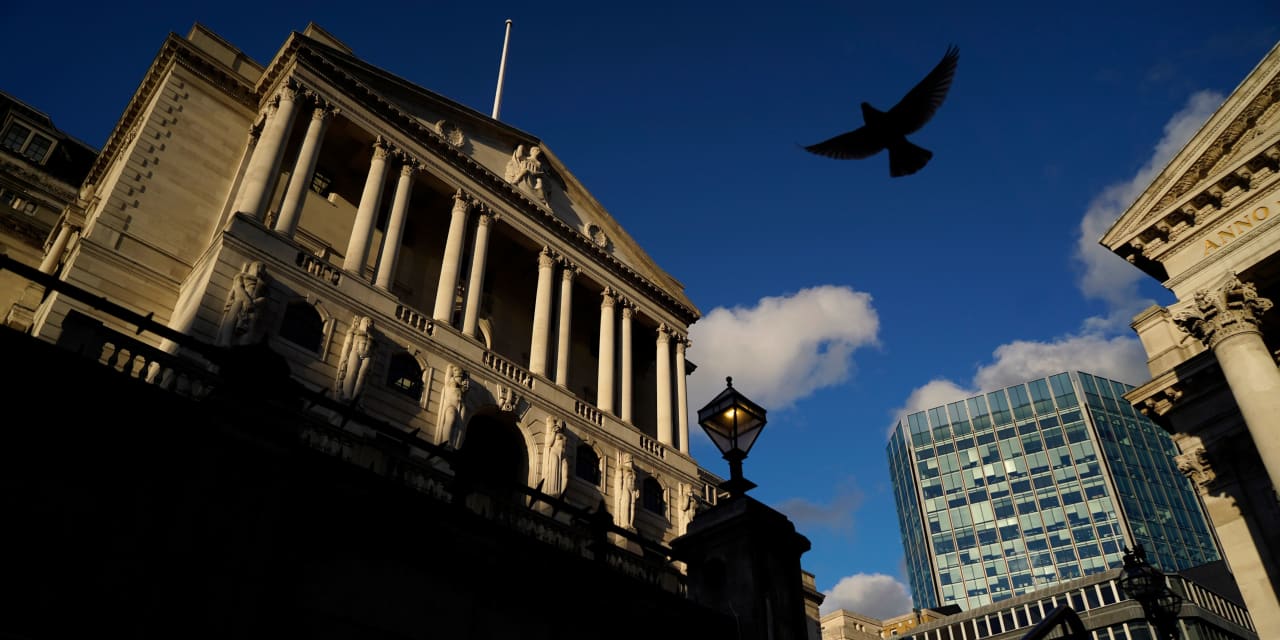
The European Central Bank kept its key interest rates unchanged on Thursday, following the Federal Reserve and the Bank of England.
The ECB maintained its main refinancing rate at 4.5% and its deposit rate at 4%. Earlier in the day, Bank of England officials left its benchmark at 5.25% in their final policy decision of the year. The Fed decided Wednesday to keep the federal-funds rate at a range of 5.25% to 5.5%.
The BOE and the ECB have spent much of 2023 following in the wake of the Fed’s moves, lifting borrowing costs but not going quite as far as their U.S. counterpart. The question now is how their paths might diverge in 2024.
Like the Fed, the ECB gave some dovish signals. It downgraded its forecasts for inflation for this year and next, predicting the rate could fall back to its target in the next few years. But President Christine Lagarde also said there was “no discussion, no debate” about lowering interest rates at this meeting.
The BOE appears to be the most likely central bank to raise interest rates again, or to maintain high rates for longer. Three BOE policy makers voted for a quarter-point increase this month, and the rate-setting committee said risks to consumer prices are still to the upside.
Policy will need to be restrictive “for an extended period of time” to bring inflation back to target, the bank said in a statement. “We still have some way to go,” BOE Governor Andrew Bailey said in a letter to the U.K. Treasury published with the rate decision.
The U.S. economy looks stronger than Europe’s. U.K. output unexpectedly contracted in October, data showed Wednesday. Germany’s economy—the biggest among the 20 nations that use the euro—shrank in the third quarter, while France’s expanded by just 0.1%. By contrast, the U.S. economy grew at its fastest pace in nearly two years in the July-September period.
Inflation rates are dropping rapidly across all three economies, but to varying degrees. In the U.K., it stood at 4.6% in October—well above the 3.1% U.S. rate. In the euro zone, it’s 2.9%. The Fed, the ECB, and the BOE all share a similar goal of keeping inflation at around 2%.
At Wednesday’s decision, the Fed kept its options open. Chairman Jerome Powell said officials “believe that our policy rate is likely at or near its peak for this tightening cycle.” Its forecasts suggest three quarter-point rate reductions next year. Markets are pricing in the first Fed cut around March.
Write to Brian Swint at [email protected]
Read the full article here