

Authored by former CIA officer Larry Johnson
Iran’s air defense system succeeded on Friday, April 3, in downing a US F-15E over Iran. There is some dispute and confusion about the exact location (more about that later). The pilot and the WSO (i.e., Weapons System Officer) both successfully ejected but were separated. The pilot was quickly rescued by the Combat Search and Rescue (i.e., CSAR) and the two Pave Hawk helicopters ferrying him back to safety were hit, but managed to make it to Kuwait — despite trailing visible black smoke.
The WSO was not so lucky. He reportedly landed 5 miles northwest of where he was ultimately rescued. I do not deny that he was recovered by US Special Operations forces on a ridge on a mountain — The red circle on the left hand side of the photo is the reported location of the pilot, the red circle on the right hand side of the photo is the airfield where the US Special Forces landed.
There are some real oddities about this story. The WSO is normally a Lieutenant or a Captain… This WSO is a Colonel who is the Vice Wing Commander at Muwaffaq Salti Air Base (MSAB) in Jordan. This helps explain the large number of assets devoted to finding and rescuing him. A variety of press reports claim he suffered a broken leg or a broken ankle. This raises a legitimate question… How did a man with a broken leg walk five miles and then climb a mountain? I’m not suggesting it is an impossible task, but it does raise some questions about the accuracy of the US military’s account of events.
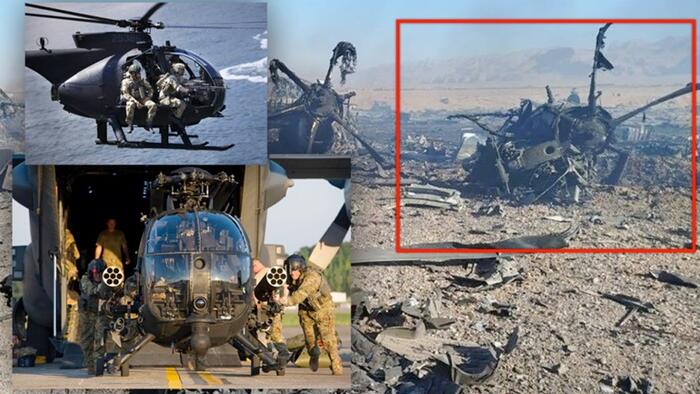
Now here is the kicker… The geolocated wreckage of the C-130s which were apparently using a local “agricultural airstrip” (see the photo above) just happens to be right over a mountain, about 35km (21 miles) away, from Isfahan’s nuclear facility, where Iran’s ‘near-weapons grade’ enriched uranium is alleged to be stored. Was this whole affair a botched raid by US Special Operations forces to seize Iranian uranium for the Isfahan facility?
Before giving you my opinion, I want you to consider some other accounts that are circulating. The first up is Simplicius’ Substack article: It’s Official: US Boots-On-Ground Deep Inside Iran Amidst Another Day of Humiliating Losses. Simplicius claims that a large-scale US rescue operation for the second crew member (weapons systems officer) of a downed F-15E Strike Eagle has effectively confirmed the first official U.S. “boots on the ground” inside Iran. What the US presented as a straightforward combat search-and-rescue (CSAR) mission involved significant special operations forces penetrating deep into Iranian territory, resulting in heavy US losses of aircraft according to Iranian reports and open-source evidence.
Simplicius argues the “rescue” narrative may have served as cover or coincided with a broader objective: the operation was centered precisely in the area where Iran stores significant enriched uranium and nuclear-related materials. He suggests this marks a dangerous escalation, with US special operations forces now operating deep inside Iran — the first acknowledged “boots on the ground” in the current conflict.
Anthony Aguilar, a retired Special Operations officer, has a slightly different take. He offers the following hypothesis:
The rescue operation expanded to become the desired Delta Force, JSOC, SOF, ST-6 high-risk operation to ALSO seize the uranium in Iran; hence the need for so many operators, support, aircraft, etc. This WAS intended to be that operation. It failed. So what happened to the aircraft. I do not believe that they were “stuck”. I have seen MC-130Js plow through dirt, mud, snow, gravel, etc. I doubt they were stuck. It is more likely that the aircraft took hits upon entry and also likely took hits and damage while on the ground at the hasty FARP at the old airfield in Isfahan, “conveniently” close to where the suspected uranium may have been stored.
The there is Greg Bagwell, who is currently President UK Air & Space Power Association, a Podcaster, a RUSI Distinguished Fellow and a former RAF Senior Commander. He wrote the following on X:
Some may be wondering why the US flew 2 x MC-130 into a landing zone in Iran rather than use other types available. The clue is in the use of the Night Stalker AH-6 Little Bird Helicopters, which were also destroyed at the forward landing site. The WSO was located a few hundred kms inside Iran and it was probably considered too risky to fly Helos all the way in and out after so much prior warning had been given, and after the hits sustained when extracting the pilot on Day 1. But, the location of the WSO high up in the mountains and with what sounds like an injury, still needed the sort of assistance that only a Helicopter could provide. Step up the Night Stalker AH-6 Little Bird.
It’s transportable by C-130 and can be readied for flight in minutes from off loading. So all that was needed was somewhere to land a C-130 far enough away from trouble, but close enough to the downed airman. Meanwhile the AH-6 Little Bird Helicopters would have picked up the downed airman and brought him back to the airstrip. Unfortunately, the surface of the runway appears to have been unable to support a C-130. As a result, some De Havilland Canada Dash 8s (yes the irony!) were sent in to extract personnel, but these could not have carried the AH-6 Little Birds. So the only option was to destroy both the MC-130 and the AH-6 helicopters, rather than risk flying the latter out. So that’s why we didn’t see a V-22 Osprey or a Sikorsky MH-60/HH-60 Pave Hawk be involved – it was a calculation based on risk and utility. Some will see parallels with the Desert One strip disaster on Operation Eagle Claw in 1980, but this was a calculated risk that worked.
Now let me tell you what I think happened. The shoot down of the F-15E was not a ruse to disguise a planned Special Ops raid on the nuclear site in Isfahan. It was an unlucky event for the pilot and the WSO. Given the rank of the WSO — and the highly classified knowledge he has about US operations in the Gulf and in Iran — recovering him became a top priority. The urgency of the situation resulted in the JSOC unit (I’m assuming they are based in Kuwait) being alerted to join the CSAR effort. The two C-130Js probably were already loaded with two AH-6 Little Birds. I think it was pure serendipity that the missing WSO was located northwest of the rudimentary air strip that the JSOC unit had been planning to use to stage its raid on Isfahan. Their familiarity with the area, based on their prior planning for the Isfahan raid, resulted in them being tasked to recover the WSO in lieu of the designated CSAR unit, which is manned by Pararescue Jumpers aka PJs (who, in my opinion, are the baddest asses in Special Ops).
We still do not know why the C-130s were not able to take off and that two planes from the 427th Special Operations Squadron flying C295s were summoned to carryout the extraction of the US forces, including the WSO.
This whole fiasco may be a blessing in disguise. The loss of a number of key air assets and the exposure of the remote airfield within shouting distance of Isfahan may compel the US commanders to cancel the planned raid to capture nuclear material from Iran.
A lot of skepticism has emerged surrounding the downed pilots narrative…
As i wrote yesterday, the Americans were trying to create FARP (Forward Arming & Refueling Point) near that mountain which happens to be 25 Kms south of Iran’s Isafahan Nuclear Facility Tunnels at 32.585522° N, 51.814933° E.
In an article just last month, Rafael Grossi stated… https://t.co/7uiHaqHKqW pic.twitter.com/b6rqbxTD0P
— Navroop Singh (@TheNavroopSingh) April 6, 2026
While the US forces, like chess pieces, had been assembled and were in place on Friday, April 3rd, to carry out the mission against Isfahan, the Commanding Admiral at CENTCOM may be having second thoughts and is communicating his concerns about the Op-Sec compromise to the Chairman of the Joint Chiefs of Staff.
I only know one thing for certain — we are not yet getting the truthful story about the rescue of the WSO on Saturday.
Read the full article here