
First Two Ships Pass Through Strait Of Hormuz Since Ceasefire As Iran Demands Payment In Crypto

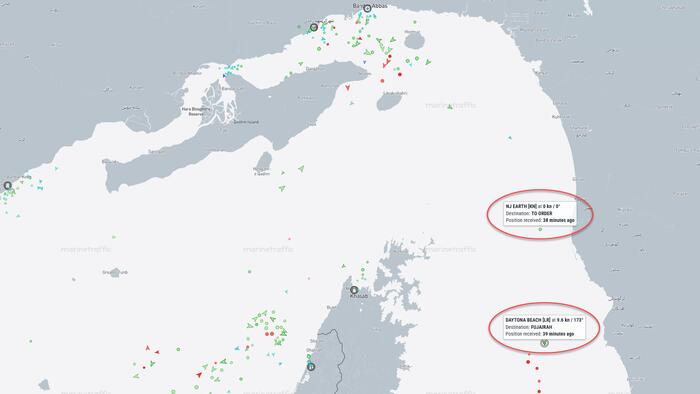
Last night we reported that no less than 800 ships were still trapped in the immediate aftermath of the US-Iran ceasefire agreement, unsure what the fine print of the deal meant for transits. This morning we are down to ~798, after the first two cargo vessels have crossed the Strait of Hormuz since the ceasefire, according to ship tracking data.
The Liberia-flagged Daytona Beach, destined for the United Arab Emirates, crossed just before 8am UK time, while the Greek-owned NJ Earth followed about two hours later, with its destination undisclosed, the tracking platform Kpler showed.
The ships are the first large vessels to transit the critical waterway since the agreement of a two-week ceasefire, under which Iran has claimed it would maintain control of the strait. It was unclear if they paid any tolls to make the crossing. Around 175 million barrels of crude and refined products are currently loaded on to 187 tankers in the Gulf, according to Kpler data — which could now start to move, depending on what happens in the strait.
Regarding Hormuz transit, Iran said it will demand that shipping companies pay tolls in cryptocurrency for oil tankers passing through the Strait of Hormuz, as it seeks to retain control over passage through the key waterway during the two-week ceasefire, the FT reported.
Hamid Hosseini, a spokesperson for Iran’s Oil, Gas and Petrochemical Products Exporters’ Union, told the FT on Wednesday that Iran wanted to collect tolling fees from any tanker passing and to assess each ship.
“Iran needs to monitor what goes in and out of the strait to ensure these two weeks aren’t used for transferring weapons,” said Hosseini, whose industry association works closely with the state. “Everything can pass through, but the procedure will take time for each vessel, and Iran is not in a rush,” he added.
Decisions on the conditions for passing the strait are taken by Iran’s Supreme National Security Council. Hosseini’s remarks suggest Iran will require any tankers to use the northerly route close to its coastline, raising questions over whether western or Gulf state-linked vessels will be willing to risk transit.
Hosseini said that each tanker must email authorities about its cargo, after which Iran will inform them of the toll to be paid in digital currencies.
He said that the tariff is $1 per barrel of oil, adding that empty tankers can pass freely.
“Once the email arrives and Iran completes its assessment, vessels are given a few seconds to pay in bitcoin, ensuring they can’t be traced or confiscated due to sanctions,” Hosseini added.
Speaking to CBS this morning, Trump said that there may be a joint US-Iran venture for Hormuz tolls.
Tankers in the Gulf on Wednesday received a radio broadcast that warned they would be targeted with military strikes unless they first gained approval from Iranian authorities.
“If any vessels try to transit without permission, [they] will be destroyed,” said the broadcast, which is in English, according to a recording shared with the FT.
The fate of transit through the strait is one of the thorniest issues facing negotiators as they try to turn a temporary ceasefire into a prolonged peace, with Iran’s desire to retain leverage over the key waterway clashing with fierce opposition from the US’s allies in the Gulf.
A statement from Iran’s Supreme National Security Council listed 10 points that form the basis for negotiations with the US, including a new “protocol for secure passage” through the strait in co-ordination with Iran’s armed forces.
Western ship owners said on Wednesday they were taking a cautious approach while waiting for details on how and whether the strait might reopen, with no vessels currently braving the transit apart from two linked to Iran.
Maersk, the world’s second biggest shipping line, said it is “working with urgency” to clarify the terms.
“The ceasefire may create transit opportunities, but it does not yet provide full maritime certainty,” the company said, adding that it would continue to take a “cautious approach” with cargoes and was not yet making changes to specific services.
Allowing Iran to continue to control the crucial waterway is likely to be highly unpalatable to Gulf states including Saudi Arabia, Qatar and the UAE. The Omani Minister of Transport said that Oman’s position is clear regarding the Strait of Hormuz: Oman has signed all international maritime transport agreements. The Strait of Hormuz is a natural passage, created without human intervention, and therefore fees cannot be imposed on it according to the international agreements signed by the Sultanate.
🚨وزير النقل العُماني:
بالنسبة لمضيق هرمز، موقف عُمان واضح، عُمان وقّعت على جميع الاتفاقيات الخاصة بالنقل البحري دولياً.
مضيق هرمز معبر طبيعي، لم يتدخل الإنسان في خلقه، ولذلك لا يمكن فرض رسوم عليه حسب الاتفاقيات الدولية التي وقّعت عليها السلطنة. pic.twitter.com/G8cE4mhDaA— الأحداث العالمية (@NewsNow4USA) April 8, 2026
It also raises questions for Opec+, the oil producers’ group, with analysts warning that handing Iran control of Hormuz could fundamentally alter the balance of power within the organisation by giving Tehran a potential veto over rival members’ exports.
Ali Shihabi, a commentator close to the Saudi royal court, said the kingdom would demand “unimpeded” access to global markets.
“Allowing Iran any form of control over the strait would be a red line,” Shihabi said. “The priority has to be unimpeded access through the strait.”
On Wednesday Saudi Arabia’s key East-West pipeline, which the kingdom has been using to reroute oil exports to the Red Sea, was struck by a drone according to people familiar with the matter, despite the ceasefire.
Several traders said they thought the situation in the coming days would resemble the system that has developed over the past fortnight, in which a handful of ships that have been approved by Iran are allowed to pass on a specific route. During the conflict this was largely limited to vessels that had generally done business with Iran and that were not connected to the US, Israel or Gulf states that had provided staging for attacks.
Martin Kelly, head of advisory at maritime intelligence group EOS Risk, said that there was “no way” that the backlog of ships waiting to get out could be cleared in two weeks.
Around 10 to 15 ships might be able to transit the strait per day as the process was “quite time-consuming”, he said, down from 135 ships before the war.
Read the full article here