

Authored by Jonathan Turley,
This week, thousands of workers are receiving pink slips. They are not being let go due to inflation or outsourcing to foreign countries. To the contrary, they are being fired because booming sectors of the economy no longer need them. Indeed, it is an economy that may need fewer and fewer humans.
Amazon this week announced further job cuts due to robotics and AI. Recently, Jack Dorsey, the co-founder of Twitter, announced that his company Block would be laying off 40 percent of its employees. He cited AI as reducing the need for human employees.
In my book, “Rage and the Republic: The Unfinished Story of the American Revolution,” I discuss not just the economic changes unfolding due to AI and robotics but also the political implications of those changes for the American republic.
These economic changes are unfolding all around us. We are looking at one of the greatest job losses in history.
In a free-market system, such technological changes tend to offset losses with new jobs in emerging industries. And there will be such growth with the AI and robotic revolutions. But it is also likely that we are looking at a static class of unemployed and practically unemployable citizens as this new revolution unfolds.
“Low-skill jobs are the most likely to be replaced by a robotic workforce,” I write in the book.
“Amazon warehouses are now entirely mechanized with twelve different types of over seven thousand robots moving rapidly to collect and direct goods where hundreds of people were once employed.”
But what is most notable about the Amazon announcement is that these were white-collar jobs. The impact of AI is not confined to factory workers and truck drivers.
The danger is that politicians will react predictably and try to subsidize jobs that are no longer viable and industries that are being dramatically downsized. At the same time, they are likely to expand model programs in Democratic cities for universal basic or guaranteed income.
Democrats have moved forward with more than 60 bills creating such programs, and this week, Cook County, Ill. (the second-largest county in the U.S.) made permanent the universal basic income program it had originally launched with federal COVID-19 relief funds.
The problem is the creation of what I call a “kept citizenship” in a republic designed for people who are economically and politically independent from the government.
That system is seriously undermined by a large percentage of citizens living off the government dole.
The solution cannot be an “arts-and-crafts” population kept entertained by government programs to learn glassblowing and pottery-making.
A different type of citizen would emerge that is unlikely to be sufficiently free of the government to counter its excesses or failures.
“Rage and the Republic” lays out what I call a “liberty-enhancing economy.” It notes that this is not just the 250th anniversary of the Declaration of Independence but the 250th anniversary of the release of Adam Smith’s Wealth of Nations. The founders immediately embraced Smith’s economic theories as the perfect companion for their political theories. They believed that true freedom requires economic independence from government.
That means accepting the economic changes and the loss of certain jobs. AI and robotics will largely wipe out certain jobs from taxi drivers to radiologists to warehouse workers. Meanwhile, we need to focus on homocentric jobs. In the book, I called these “Guinan jobs” after the bartender on the starship Enterprise in “Star Trek: The Next Generation.” As a kid, I was always confused by Guinan (played by Whoopi Goldberg), who would mix a drink next to a replicator that could produce the perfect Romulan cocktail every time without fail or variation. Customers clearly wanted Guinan to make the cocktail, even if it is not perfect every time.
The question I ask is, how many “Guinan jobs” are out there. There are many, including teachers, psychiatrists and lawyers, who will be affected but likely not eliminated by AI. We will still want humans in these positions.
All governments will face this existential crisis in the 21st Century. It will create growing instability globally. Although AI and robotics will make goods cheaper and more widely available, they are also likely to have a dramatic effect on populations. For example, as production costs drop with the new technology, there will be less advantage to moving factories to other countries with cheaper labor forces, such as China and Mexico.
Companies may choose to build near consumer markets to save on transportation costs while utilizing higher-skilled worker populations to maintain robotic and AI systems. That could produce massive unemployment in certain countries with low-educated, low-income populations. That in turn could destabilize governments and increase the chances of war in countries with large populations of unemployed young men.
I also do not feel great optimism for global governance systems like the European Union. The EU has largely eviscerated the elements I identify in the American Revolution as producing the oldest and most stable democratic system. Although global governance is likely to increase, it could fail spectacularly due to its inherent instabilities.
In the U.S., this period of economic change is likely to fuel calls for socialist policies. Socialism has always thrived on economic upheavals. Indeed, socialists often use their own failures to further collectivize or centralize economies.
Our republic is uniquely situated to not only survive but to thrive in the 21st Century. It was conceived in and designed for changing economic conditions. But if we are to survive, we must remain faithful to the constitutional structure that has afforded us stability for more than two centuries. Despite calls to trash the Constitution, pack the Supreme Court and change our political system, these protections are the very things that can get us through this century intact.
The Founders designed our Republic to prevent the tendency of democracies to become what one called a “mobocracy.” They knew that political and economic instability could create a form of “democratic despotism” in which democracies devoured themselves.
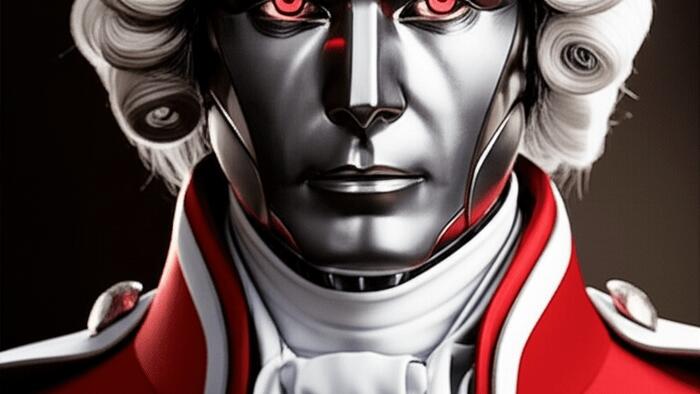
We have a system that has overcome challenges — from redcoats to robots — that have crushed other countries. However, we must remember who we are. Our nation, created in the winds of change by a free and industrious people, need not fear change. It is a system designed for bad times, not good times. The true crisis is a crisis of faith being fueled by some in academia and in the media.
This republic will survive so long as it does not die by our own hand.
Jonathan Turley is a law professor and the author of the New York Times bestselling “Rage and the Republic: The Unfinished Story of the American Revolution.“
Loading recommendations…
Read the full article here