

By Michael Every of Rabobank
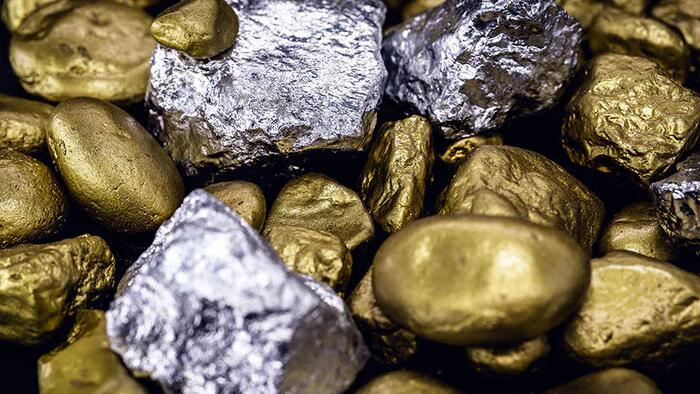
Markets have shrugged off heavy metal(s) even though their plunge Friday was staggering. We are up around 5% in gold this morning following reports of queues of Singaporeans buying the dip yesterday. Yet note that this happened to an asset seen as a “safe-haven”, and as the foundation of a new global system – even as nobody anywhere is close to demanding gold as payment for exports, or is able to do so if needed. Indeed, there are whispers that a key driver of, and much of the worst damage from, the pump-‘n’-dump was centered in China (whose neo-mercantilism is ironically a key reason for fractures in fiat currency and the liberal world order). One wonders how long generic ‘markets’ can stay calm in a world in which so many people are so unenamoured of fiat FX; and how metals can cope with “because markets!” HFT speculation that make them trade like an NFT or meme stock.
Then again, markets seem to have put the extraordinary recent volatility in JGBs behind them when nothing has been resolved there. PM Takaichi seems set for a landslide victory on 8 February that will lead us back to where we were – save the US suggesting there’s no bailout from it coming for Japan. That leaves the world’s third largest economy, the $7.8 trillion JGB market, and JPY all on edge as Tokyo deals with rising geopolitical tensions with China over Taiwan.
Going back to Friday, a meme is that metals were heavy as Fed Chair nominee Warsh was seen as a hawk: yet there’s as much likelihood of that being true as that he was picked for his looks. US rates are going to fall, but Warsh just looks hawkish. Moreover, a hawk/dove framing is arguably now irrelevant. What I dub ‘reverse perestroika’ implies a shift to a Treasury- not Fed-centric system and to industry from financialisation: logically that implies different interest rates by sector, so hawkish and dovish. As @mnicoletos puts it, it means changes to encourage banks to lend more into productive sectors. And as @ctindale points out, it requires abandoning abstract economist models of aggregate supply and demand — useless vs shocks like rare earths — to address specific material constraints in each sector, e.g., funding stockpiles to release rather than raising rates. If Warsh wants a ‘regime change’ at the Fed (as do Bessent and Trump), then that’s the form it will take, comrades, not just ‘hawk/dove’.
That’s too late for those who ended up having to raise rates after cutting them, i.e., the RBA. Australia’s property-addled economy and Reserve Bank are the first to U-turn on “because (property) markets” rate cuts, hiking to 3.85%, because of “materially” higher inflation, rather than the low inflation their abstract model had told them was looming. It looks like another hike is also going to have to follow. As the Aussie financial press put it, “Chalmers and Bullock both messed up on inflation – the RBA is finally trying to fix its inflation mistakes. When will the federal government follow suit?” Equally, when will abstract models follow suit? And when will markets grasp that is what logically follows on from all of this?
Oil slumped 4.5% Monday on the view Iranian threats of regional war are overblown. The US and Iran will talk Friday, yet the US wants a deal to end its nuclear program, which it bombed last year, and its ballistic missile program and support for terrorist proxies; Iran may float handing over enriched uranium, but says it will only act within its “national interests.” Don’t just read the financial press: follow the logistical build-up of US military power; consider reports Trump favors regime change following as many as 30,000 Iranian protestor deaths; and see there is no geostrategic logic in the US moving weapons into place then allowing Iran to carry on (including selling oil to China).
That’s also as the START US-Russia arms control agreement STOPS on Thursday, kick-starting a new nuclear arms race. Europe might have to join this time. In which case, the politics are very complex –as Draghi called for an EU “federation” to avoid being “picked off one by one” by the US and China— and as a nuclear trifecta could cost from hundreds of billions to a trillion euros. Add it to the Strategic Autonomy bill, as Europe finds that: it’s struggling to coordinate defence efforts; even replacing the US-backed internal communication system for defence data will take until at least 2030; and as it was warned that its efforts to diversify critical minerals supplies have “incomplete foundations” due to their “nonbinding” targets.
By contrast, President Trump will launch Project Vault –$12bn in seed capital, $1.7bn private, the rest from a 15-year US Export-Import Bank loan– to build a US strategic critical minerals stockpile. This is separate from the Pentagon’s and is for the civilian economy. The intention is to insulate it from wild price swings in key inputs –something China has long done for key goods, but which the West has eschewed because of its brilliant intellectual conceit of “because markets” as the answer to everything — as well as economic coercion – which China has again been able to threaten in rare earths “because markets.”
Trump also struck a trade deal with India, reducing reciprocal tariffs to 18% and dropping the additional 25% after claiming India would stop buying Russian oil in favor of Venezuelan, showing how geopolitics links up. This isn’t the FTA the EU just signed, but let’s see which proves more important over time: as a well-placed Indian source noted to me, there‘s no growth in Europe vs. the US. The fact the US will insist on the same no-transshipment rules for Chinese goods that it has with other trade partners is a blow to Beijing; equally, it blows up European hopes of building a trade coalition without the US (and in India frictions will continue, i.e., the EU agreed on green tech collaboration with Delhi, but the US said it is going to sell it more coal). The defense component will also be key. Europe now has a strategic partnership with India in that regard, but national governments hold sway there: will they want to see their defense industries moved to South Asia(?) By contrast, the US is able to move faster, though we shall see what they are prepared to share with India. Delhi at least gets to play both sides off against the other.
Loading recommendations…
Read the full article here