

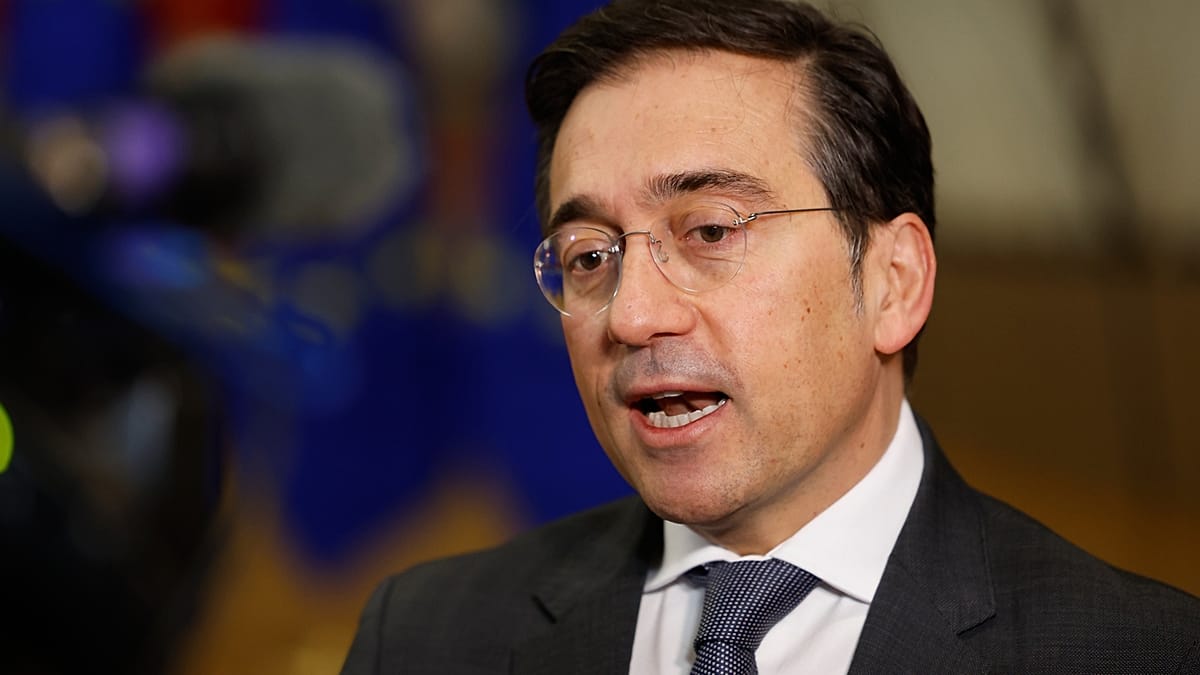
Securing passage through the Strait of Hormuz exceeds NATO’s remit, Spanish Foreign Affairs Minister José Manuel Albares Bueno said after US President Donald Trump vented his frustration over the alliance’s lack of action on the vital waterway.
ADVERTISEMENT

ADVERTISEMENT
“NATO has no involvement in this war. We, the allies, have not been informed or consulted,” Albares said on Friday while addressing the Spanish Senate.
“The Middle East is not within NATO’s sphere of action, and therefore, not only us, but many allies have expressed the same sentiment: NATO will not participate in this war.”
The comments fit in with Spain’s critical position on the US intervention against Iran, which the country has labelled a blatant violation of international law. Last month, the left-wing government closed its airspace to American planes linked to the war.
Spain, however, did sign a joint leaders’ statement earlier this week pledging to “contribute to ensuring freedom of navigation in the Strait of Hormuz”.
It comes as NATO Secretary General Mark Rutte tries to prod allies into putting together a special mission that can guarantee free and safe passage through the narrow shipping lane, currently under Tehran’s tight grip.
The near-total closure, which continues after the ceasefire deal, has disrupted global supply chains, sent energy prices soaring and fuelled fears of stagflation. An estimated 2,000 ships and 20,000 seafarers remain trapped in the Persian Gulf.
Trump has repeatedly lashed out at NATO allies for refusing to deploy military assets to Hormuz, whose complex geography favours Iran’s asymmetrical warfare tactics and drastically increases risks for sailors, ship-owners and insurers.
In recent days, Trump has revived his threat to pull the US out of the 77-year-old transatlantic alliance and seize Greenland from Denmark.
“NATO wasn’t there when we needed them, and they won’t be there if we need them again. Remember Greenland, that big, poorly run, piece of ice!!!” he wrote on Truth Social, using all caps.
In a bid to diffuse tensions, Rutte met with Trump at the White House on Wednesday.
The meeting, which was unusually closed to the press, was described as a “very frank, very open discussion” by Rutte. A NATO spokesperson later said that the Secretary General was “in contact with allies” about securing Hormuz.
“It’s clear that the United States expects concrete commitments and action to ensure freedom of navigation in the Strait of Hormuz,” the spokesperson said.
A NATO mission would require the consensus among its 32 member states, a threshold that opposition from Spain, and possibly others, would make impossible. Turkey’s Trade Minister, Ömer Bolat, told Euronews that NATO allies are not obliged to assist.
Although NATO’s treaty only covers European, North American and Turkish territory, as well as islands under their jurisdiction, the organisation has in the past set up operations in Afghanistan, Libya and Iraq, proving its scope can be broadened in practice.
German Chancellor Friedrich Merz has said his country would help reopen Hormuz on the condition of an international mandate. But an attempt this week to pass a resolution in the UN Security Council was thwarted by the vetoes of China and Russia.
Meanwhile, the UK is amassing a coalition of the willing, with over 40 countries from around the world, to restore freedom of navigation in the critical waterway. This informal grouping could help bypass NATO’s stricter framework.
British Prime Minister Keir Starmer spoke with Trump on Thursday about “the need for a practical plan to get shipping moving again as quickly as possible,” Starmer’s office said. London, however, has not released any details on what this plan would look like.
Read the full article here