

President Trump on Sunday warned Tehran to “Open the Strait” and make a deal by the end of Tuesday, or the U.S. military would “blow everything up” and “take over the oil.” Meanwhile, Iran rejected Trump’s ultimatum to reopen the Hormuz chokepoint, saying it would only reopen the critical waterway once damage from the war is compensated.
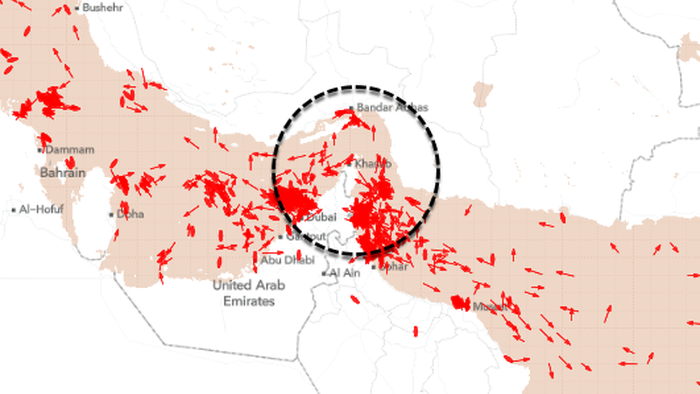
There was some good news overnight after Iran’s semi-official Fars News Agency reported that 15 vessels had passed through the Hormuz chokepoint over the last 24 hours. Still, that remains only a tiny fraction of pre-conflict tanker traffic.
Separately, the Islamic Revolutionary Guard Corps Navy warned that the waterway will “never return to its previous condition,” particularly for the U.S. and Israeli-linked vessels, and added that it is completing preparations to enforce a new security order across the Persian Gulf.
The question some military analysts are likely asking about the IRGCN’s statement is: with what naval fleet? Still, the IRGCN’s asymmetric warfare around Hormuz can be enforced with suicide drones, naval mines, and missiles.
Map: Tanker Tarffic Hormuz
In a separate report, Bloomberg’s Stephen Stapczynski tracked two LNG tankers, Al Daayen and Rasheeda, loaded in Qatar that appeared to be traversing part of the Hormuz waterway.
However, Stapczynski noted early Monday that the two tankers appeared to “pause [their] attempt to exit Hormuz.” There was no indication why both tankers abruptly turned around.
“The ships have now slowed and pulled back slightly after earlier heading eastward toward the Hormuz opening. It isn’t immediately clear at this stage if the tankers will abandon the journey,” he said.
UPDATE: QATAR LNG SHIPMENTS APPEAR TO PAUSE ATTEMPT TO EXIT HORMUZ 🚨🚨
The ships have now slowed and pulled back slightly after earlier heading eastward toward the Hormuz opening. It isn’t immediately clear at this stage if the tankers will abandon the journey https://t.co/xRTBpnAluQ pic.twitter.com/oAlPczCUDs
— Stephen Stapczynski (@SStapczynski) April 6, 2026
The two LNG tankers are being closely watched by Wall Street analysts because a successful transit would mark the first LNG exports to buyers outside the Gulf region since the conflict broke out in late February. Any successful passage would be a breakthrough for Qatar, which supplied nearly 20% of global LNG last year, even though its Ras Laffan export plant has been shut for over a month after IRGC drone and missile attacks. Reviving Qatar’s pre-conflict LNG export flows could take $20 billion and years to fix.
Goldman analyst Yulia Zhestkova Grigsby showed clients last week that energy flows from the Gulf remained muted (read the full report).
Also on Sunday, Axios reported that Iran and regional intermediaries are quietly exploring a 45-day ceasefire as part of a two-phase deal to end the conflict.
Read the full article here