

Authored by Andrew Korybko,
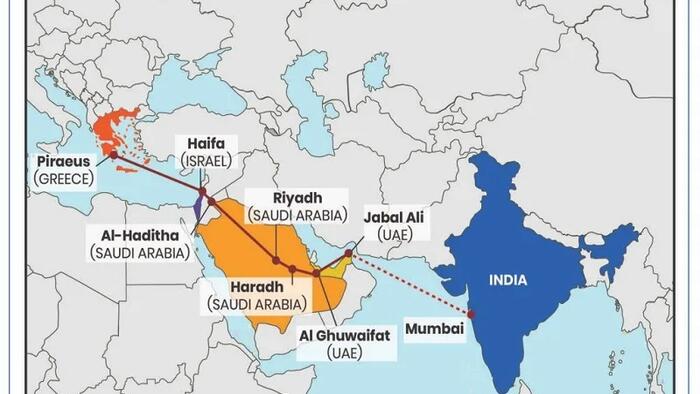
The India-Middle East-Europe Economic Corridor (IMEC), which was envisaged as a game-changing geo-economic megaproject when it was announced in September 2023 at the G20 Summit in Delhi, was abruptly frozen by the Gaza War that broke out a month later and the West Asian War that followed.
The end of those conflicts then gave rise to optimism that Saudi Arabia would normalize ties with Israel like it reportedly planned to do prior to their outbreak as the political prerequisite for building IMEC.
After all, without the normalization of Israeli-Saudi ties, there can be no logistical connection between IMEC’s Emirati and Israeli Mideast anchors across the West Asian landmass.
Saudi Arabia requires Israel at least making superficial concessions on Palestinian independence, however, which Israel under Prime Minister Benjamin Netanyahu is opposed to doing after the latest wars.
This dilemma might therefore derail IMEC yet again unless the US mediates a creative compromise or gets one of them to back down.
That’s difficult to imagine as a result of three fast-moving developments in December.
The first was Israel’s recognition of Somaliland’s 1991 redeclaration of independence as a sovereign state. Saudi Arabia fiercely opposes this, and while it was argued here that Israel was motivated more by its rivalry with Turkiye than its one with Iran (whose Houthi allies still control North Yemen), a related motivation could have been to ensure the security of maritime trade with India in the absence of IMEC.
That’s reasonable if Israel tacitly accepted by then that the normalization of ties with Saudi Arabia won’t happen as a result of pressure upon it by the international Muslim community (Ummah) over the humanitarian consequences of the Gaza War.
Shortly afterwards, Saudi Arabia militarily aligned with the Muslim Brotherhood’s Yemeni branch against UAE-backed South Yemen despite considering the group as a whole to be terrorists, after which South Yemen was swiftly conquered by the Saudis’ Yemeni allies.
Israel just finished a war with the Brotherhood’s Palestinian branch, Hamas, so the aforementioned development would have understandably led to a further deterioration of trust in the Saudis.
In parallel, the Saudis demanded that the UAE withdraw from South Yemen within 24 hours, which it did. That ultimatum also described the UAE’s actions in South Yemen as a threat to Saudi national security. Even though they didn’t come to blows in South Yemen, trust between them is now absolutely destroyed.
Accordingly, even if Israeli-Saudi ties were to normalize in spite of Saudi anger at Israel over its recognition of Somaliland, new Israeli distrust of the Saudis over their military alignment with the Muslim Brotherhood in Yemen, the Ummah’s pressure on Saudi Arabia, and new Saudi-Emirati tensions would still undermine tangible progress on building IMEC.
India’s trade with Israel and Europe will therefore remain reliant on traditional maritime routes since IMEC’s future is once again in doubt.
In fact, given how serious Saudi Arabia’s problems with the UAE and Israel are, IMEC might never get off the ground at all.
India might then strengthen its ties with those two afterwards since it could consider them to be more reliable partners, especially after Saudi Arabia’s mutual defense pact with India’s Pakistani nemesis last September that Turkiye now wants to join too.
The end of IMEC might then result in an Emirati-Indian-Israeli bloc formed in opposition to the emerging Saudi-Pakistani-Turkish one.
Loading recommendations…
Read the full article here