

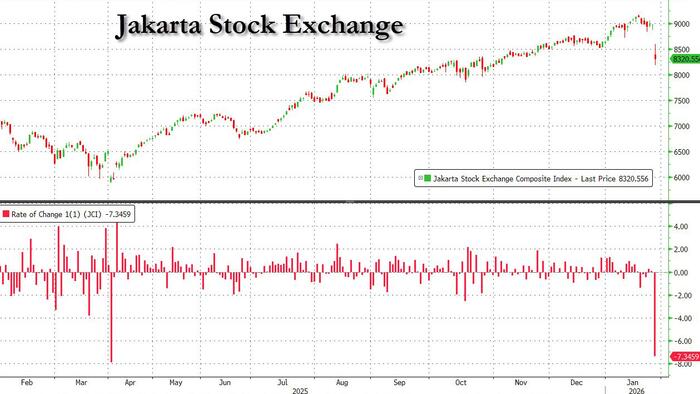
Indonesian stocks tumbled after MSCI raised concerns about their investability and warned of a potential downgrade to frontier-market status.
The benchmark Jakarta Composite Index plunged 7.4% on Wednesday, its biggest one-day slide in over nine months; earlier in the day it crashed as much as 8.8%, triggering a 30-minute market halt, after MSCI said it would immediately pause some index changes, including additions, until regulators address concerns over tightly-held ownership of listed firms.
According to Bloomberg, concerns around free float, or the number of shares available for trading, have emerged as a flashpoint in Indonesia’s $976 billion market in recent years, as investors lament that the nation’s biggest companies are thinly traded and controlled by a handful of wealthy individuals. MSCI’s decision is due to “fundamental investability issues” and investor worries over coordinated efforts to distort prices, it said in a statement on Wednesday.
“MSCI’s freeze is a warning shot, not a verdict,” said Tareck Horchani, head of prime brokerage dealing at Maybank Securities in Singapore. “Markets have already started pricing some probability of a negative outcome, which explains the pressure we’ve seen on index-heavy Indonesian names.”
Indonesia’s exchange operator told reporters on Wednesday that it is committed to meeting the index compiler’s call for greater transparency and will work with the firm to reach a consensus. It also plans to consult market participants on ideal free-float levels, according to I Gede Nyoman Yetna, director of listing at the Indonesia Stock Exchange.
If Indonesia fails to make sufficient progress on transparency by May, MSCI will reassess the country’s market accessibility status – a move that could lead to a reduction in weighting for all Indonesian companies in the MSCI Emerging Markets Index and even a potential downgrade to frontier-market status, which would lead to further capital outflows and another major selloff.
Global investors sold a net $192 million worth of local stocks in the week ended Jan. 23, the first outflow in 16 weeks. The selling has continued this week, with the exchange reporting 3 trillion rupiah ($180 million) of net outflows Wednesday morning. Among the biggest decliners on the day were shares widely expected to enter MSCI’s gauges in next month’s review, including PT Bumi Resources, PT Petrosea and PT Pantai Indah Kapuk Dua, all of which were down by the 15% limit.
The decision comes after months of consultation following MSCI’s proposal to tighten the definition of free float for Indonesian securities. The firm said it was considering an alternative data source, the Indonesia Central Securities Depository, also known as KSEI, to assess actual tradable shares. If companies are found to have even smaller figures than reported, passive funds would be forced to cut existing positions.
The exchange added it would work with the KSEI to provide a clearer breakdown of shareholder types, including sovereign wealth funds or hedge funds.
Regulators have already tried to ease worries about thinly traded stocks, with plans to raise minimum float levels to 10%-15% from the current 7.5% level. The longer-term goal is 25%, though no timeline has been set. That compares to Hong Kong and India’s 25% rule and Thailand’s 15%.
Worries about price dislocation were evident last year when the JCI outperformed the MSCI Indonesia Index by a record margin. With so many JCI members thinly traded, passive fund managers say the benchmark has been effectively untrackable, pushing them instead toward the more stringent MSCI Index. Prior to Wednesday’s rout, Indonesian stocks trailed their Southeast Asian peers at the start of the year as the benchmark rose 2.7% compared to MSCI Asean Index’s 5.3% surge
If Indonesia is downgraded, the impact on passive flows would be significant, according to Yiping Liao, portfolio manager at Franklin Templeton Global Investments. “Foreign participation in the Indonesian market has reduced significantly because of concerns about macro and policy. Not assuming any other sort of changes around it, it’s certainly not positive.”
Not surprisingly, what happens in the market has political implications as well: the latest move also deepens worries about Indonesia’s economic trajectory, with investor confidence already fragile following President Prabowo Subianto’s efforts to steer fiscal and monetary policies toward his growth goals. Markets were rattled earlier by the dismissal of long-serving Finance Minister Sri Mulyani Indrawati last year and Prabowo’s growing sway over the central bank.
Coordinating Minister for Economic Affairs Airlangga Hartarto said he will meet with financial regulators on Thursday to discuss MSCI’s asks, adding that Indonesia can look to mechanisms enforced in other countries to improve transparency in the local bourse.
For now, some investors are opting to stay on the sidelines until there’s more clarity. “The risk is Indonesia won’t do enough. And if it gets downgraded to frontier there will be panic selling,” said John Foo, founder of Valverde Investment Partners. “We are underweight on Indonesia with almost zero exposure.”
Loading recommendations…
Read the full article here