

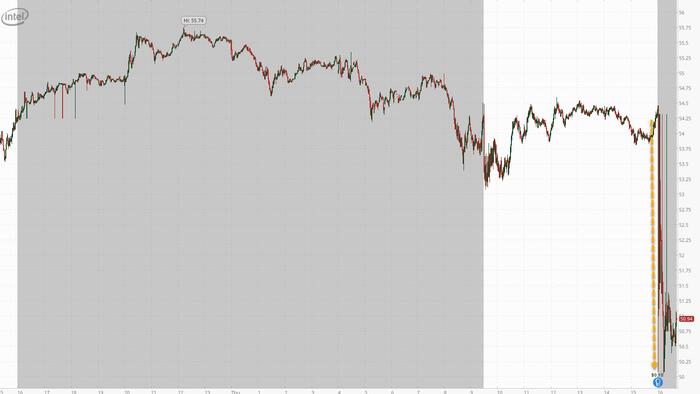
Intel is back to its old bag of post earnings rugpull tricks.
The stock, which for some bizarre reason is up 50% in 2026 and almost 3x higher since August (it’s actually not bizarre at all, with Trump pumping it at every opportunity but ultimately the fundamentals have to take over), tumbled after hours on an earnings release which was a tale of two parts.
First, the historical data which was not terrible, but certainly not great. This is what the once glorious chipmaker reported for Q4:
- Revenue $13.67 billion, down -4.1% y/y, but beating sandbagged estimates of $13.43 billion
- Intel Products revenue $12.93 billion, -1.4% y/y, beating estimate $12.79 billion
- Client Computing revenue $8.19 billion, -6.6% y/y, missing estimate $8.3 billion
- Datacenter & AI revenue $4.74 billion, +8.9% y/y, beating estimate $4.42 billion
- Intel Foundry revenue $4.51 billion, +3.8% y/y, beating estimate $4.36 billion
- All Other revenue $574 million, -48% y/y, missing estimate $658.9 million
- Intersegment eliminations revenue -$4.34 billion, -0.6% y/y
- Intel Products revenue $12.93 billion, -1.4% y/y, beating estimate $12.79 billion
- Adjusted gross margin 37.9% (down sharply from 42.1% y/y) but beating estimate 36.5%
- R&D expenses $3.22 billion, -17% y/y, berow estimate $3.31 billion
- Adjusted operating income $1.21 billion, -12% y/y, estimate $878.8 million
- Adjusted operating margin 8.8% vs. 9.6% y/y, estimate 6.29%
- Adjusted EPS 15c vs. 13c y/y, beating estimates of 8.7c
But while beating on most income statement items may sound good, stepping back to look at the historical results the trends is, well, meh at best.
But if the historical numbers were fine, it was the company’s forecast that was once again the weakest link, and what sent the stock tumbling after hours. Here is what the company said to expect for Q1, a quarter in which everyone is – if one believes the rumors – buying any and every chip and tech component that isn’t nailed down. Apparently every, except for Intel’s that is:
- Sees revenue $11.7 billion to $12.7 billion, the midpoint missing estimates of $12.56 billion
- Sees adjusted EPS $0, missing estimates of 8c (and that’s even with a projected tax rate of 11%, below the estimate 12%).
- Sees adjusted gross margin 34.5%, missing estimate 36.5%
And the cherry on top: the company may be dragging on sales but at least it’s overly generous in how it gets there:
- Sees adjusted operating expenses about $16 billion, estimate $15.93 billion
So what happened and why was the guidance once again so piss poor? Apparently, it’s not us, it’s them, or some other excuse – according to Intel, supply shortages have made it harder to meet customer demand. But wait, what supply: doesn’t Intel control its own supply chain. Why yes, yes it does.
As Bloomberg notes, Intel is struggling with its manufacturing yields — the percentage of usable chips coming out of its factories — hampering a comeback bid, or rather making a mockery of the stock surge which took place in a vacuum, completely disconnected from the fundamentals which are the same old.
Demand is “quite strong,” and the company is working hard to fix its manufacturing problems, CEO Lip-Bu Tan said in an interview. But Intel used up much of its inventory in the fourth quarter, he said.
“Our yield and production manufacturing are not up to my standards,” Tan said. “We need to improve that.”
Which is amazing because Intel has now been a ward of the US state for almost six months: how it couldn’t have improved that until now is a mystery, but one thing is certain – if it hasn’t improved by now, it won’t. Unless Trump takes (without paying) another 10% of the company’s equity.
Remarkably, Intel stocks has unjustifiably soared in recent months, rising 3x since its decade lows in August, and riding a wave of Wall Street enthusiasm. Investors poured money into the stock in recent months, betting that new products would further bolster finances.
That has not happened… and it probably never will: Intel’s annual revenue of $53 billion last year was roughly $25 billion shy of the company’s peak revenue, achieved in 2021.
Intel also attracted high-profile investments from the US government, Nvidia and SoftBank. Those, also, have not helped.
Earlier this month, Intel announced that the Panther Lake design for processors was now available in devices — with Tan touting their capabilities at the CES trade show in Las Vegas. Intel is locked in a race with rival Advanced Micro Devices Inc. and would-be interlopers such as Qualcomm Inc. for leadership in what they hope is a new era of AI-capable personal computers.
The only problem: with memory prices now at nosebleed levels, who needs the latest and greatest CPU if they can only afford half (or less) of the RAM they needed before. Maybe it’s time for Wall Street analysts to finally flow that through their income statement models
As Bloomberg concludes, “the once-dominant semiconductor company has spent years trying to restore its technological edge and recover from market share losses, and this is one more setback.”
Ultimately, Intel faces an execution challenge, Tan said in the interview. “We are laser-focused as a team to improve that,” Tan said. “To be candid, its just our execution needs to improve.”
And the stock agrees: Intel shares fell 5% after hours following the report. And unless something materially improves, they have a long way to go.
Loading recommendations…
Read the full article here