

While Iran’s decision to close the Straits of Hormuz in response to the US-Israeli bombing campaign was understandable, after all it’s the biggest point of leverage the IRGC-controlled nation has left (it is certainly more understandable than bombing all of its Gulf neighbors in the process pushing them from being on the fence to being staunchly anti-Iran), there was always a bit of a glitch in Tehran’s calculus: as we showed the day the war broke out, the biggest clients of Gulf exporting nations by far are China, India, Korea and Japan, namely Asian countries which – with the exception of Japan – are hardly allies of the US. Therefore, the countries that would be hit the hardest were those Pacific rim nations that would buy millions of barrels of oil daily from Gulf countries before the war, and now find that oil indefinitely blocked behind the Strait.
While prices are fungible, the biggest loser from a Hormuz closure in terms of actual physical oil is China which is the main destination of the 13.1mm barrels of oil that passes through the Strait every day https://t.co/FwWVsHiwpZ pic.twitter.com/ozXwXpo2El
— zerohedge (@zerohedge) March 1, 2026
Nowhere has this asymmetric impact been more evident than in the price of Asian-basin grades such as Dubai and Oman, which hit a record $170 on Thursday before retracing modestly to $160, while at the same time Europe-heavy Brent has been trading around $110, and WTI crude which primarily feeds the US is trading just below $100.
As a result, it’s hardly a surprise that while ideologically they may support Iran, Asia’s largest Gulf clients are suddenly finding themselves facing crashing stock markets and a brutal stagflation.
It’s also why while the world’s attention has been focused on the escalating daily attacks in the Gulf, which last week crippled global LNG supplies for years – in the process once again hammering Asian supply chains far more than the US which for years has been swimming in natural gas – there has been a furious backchanneling operation to allow passage for tankers belong to said Asian countries.
To wit, late on Friday, Iranian Foreign Minister Abbas Araghchi said the nation was prepared to facilitate passage for Japanese vessels through the Strait of Hormuz after consultations between the countries’ officials, according to Kyodo News.
“We have not closed the strait. It is open,” Araghchi said in a telephone interview with Kyodo News on Friday. He also stressed that Iran, which was attacked by the United States and Israel in late February, is seeking “not a cease-fire, but a complete, comprehensive and lasting end to the war.”
Araghchi said Iran has not closed the strategic waterway but has imposed restrictions on vessels belonging to countries involved in attacks against Iran, while offering assistance to others amid heightened security concerns. He added that Iran is prepared to ensure safe passage for countries such as Japan if they coordinate with Tehran.
Japan relies on the Middle East for over 90 percent of its crude oil imports, most of which travel through the strait.
Araghchi made the comments in an interview with the Japanese news agency on Friday, Kyodo said. Japan relies heavily on the Middle East for its oil-import needs. The war in Iran prompted the Asian nation to release oil from its reserves this month.
Araghchi, a former ambassador to Japan, has held phone talks with Motegi twice since the attacks on Iran were launched on Feb. 28. The top Iranian diplomat said he had discussed the passage of Japanese ships through the strait with Motegi.
In their most recent conversation earlier in the week, Motegi urged Iran to ensure the safety of all vessels in the strait.
In Tokyo, a Foreign Ministry official said Japan will carefully assess Araghchi’s remarks, adding even if Japanese vessels are able to sail through, the surge in energy prices will remain.
A Japanese government official said that “directly negotiating with the Iranian side” is the “most effective way” to lift the blockade of the strait, while noting the need to avoid provoking the United States.
The potential de-escalation comes as Japan has also been under pressure from US President Donald Trump to help secure the strait. At an in-person meeting with the president earlier this week in Washington, Japanese Prime Minister Sanae Takaichi explained to him the legal limits to Japan’s involvement in such efforts. At the same time, she highlighted areas of agreement, including a pledge to import more oil from the US and to cooperate on missile development.
But it’s not just Japan. In recent days, vessels from countries such as India, Pakistan and Turkey have also passed through the strait.As a reminder, all ships that fly Chinese national flags are free to pass the Strait of Hormuz as Beijing remains Tehran’s only financial lifeline.
In another indication that Iran’s stance on the Hormuz blockade is softening, the Iranian Navy guided an Indian liquefied petroleum gas tanker through the Strait of Hormuz last week, allowing the ship to pass on a pre-approved route following diplomatic engagement by New Delhi, according to a senior officer onboard the vessel.
As Bloomberg reports, the officer asked for anonymity, as the crew of his vessel — one of two Indian ships that made the crossing — were not permitted to talk to the media. His account appears to confirm analysts’ views that Tehran is trying to impose a traffic control system through the strait, permitting safe passage for friendly vessels while leaving others fearful of attack.
Over the past week, several ships have transited via a narrow gap between the Iranian islands of Larak and Qeshm, and tracked close to the Iranian coast.
CONFIRMED – Iran is allowing select vessels transit the SoH after verfication
At least 4 vessels have transited outbound voa the Strait of Hormuz in the past 24hrs with a short diversion via the Larak-Qeshm Channel.
This appears to be a verification process whereby Iran… pic.twitter.com/csriocNo1h
— Martin Kelly (@_MartinKelly_) March 16, 2026
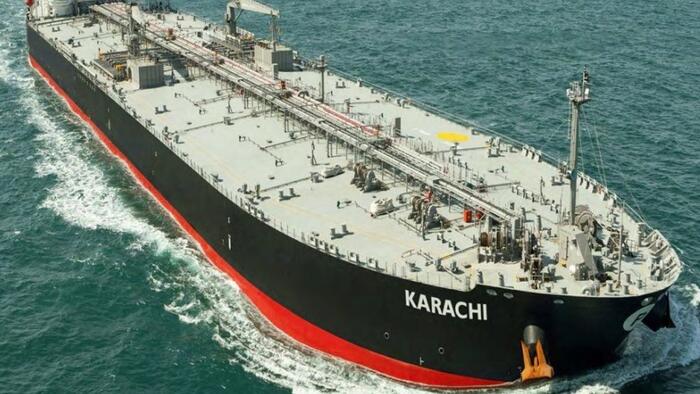
They include two bulk carriers that had called at Iranian ports, and a Pakistani-flagged vessel, the Karachi.
The officer on the Indian LPG ship declined to give specific details of their route. They traveled with their automatic identification system, or AIS, system switched off, according to the officer and AIS data analyzed by Bloomberg, turning it back on after they were safely out into the Gulf of Oman. The officer said the ship was also unable to use GPS, which has been subject to widespread interference since the beginning of the conflict. That meant the crossing took hours longer than usual.
During the crossing, the officer’s ship was in contact with the Iranian navy by radio, he said. The Iranians took details of the ship’s flag, name, origin and destination ports, and the nationality of the crew members – all of whom were Indian – and guided them on an agreed course.
Before they entered the strait last week, sailors onboard the LPG tanker prepared their life rafts, the officer said. They had been anchored in the Persian Gulf for around 10 days when they were told on the morning of Friday March 13 that they had been granted permission to make the transit that night. On the far side of the strait, Indian Navy ships were waiting to escort them, with the national flag flying higher than usual, the officer said. The vessel has since sailed on to India.
Anil Trigunayat, a former Indian ambassador in Jordan and Libya, said that the fact India was able to secure safe passage shows that diplomacy is possible. “Iran also would not want to burn bridges with everyone at this juncture,” he said. “India, if needed, can also play the role of an interlocutor. These factors have collectively led to India getting this window.”
On Saturday, the WSJ reported that Indian Prime Minister Narendra Modi said he reiterated the importance of keeping international shipping lanes open during a call with Iranian President Masoud Pezeshkian. Modi said in a social-media post on Saturday that he condemned attacks on critical infrastructure in the region, which he said threaten stability and disrupt global supply chains. He also “reiterated the importance of safeguarding freedom of navigation and ensuring that shipping lanes remain open and secure,” said the post.
Spoke with President Dr. Masoud Pezeshkian and conveyed Eid and Nowruz greetings. We expressed hope that this festive season brings peace, stability and prosperity to West Asia.
Condemned attacks on critical infrastructure in the region, which threaten regional stability and…
— Narendra Modi (@narendramodi) March 21, 2026
While two India-flagged tankers passed through the Strait about a week ago, India is now negotiating for more ships to be able to cross, Indian maritime government officials have told The Wall Street Journal, and indeed overnight we received reports that two additional LPG tankers had crossed the strait with Indian navy protection.
BREAKING: Two more LPG tankers are transiting the Strait of Hormuz under Indian Navy protection. Two Indian naval task forces have been deployed to escort India-bound vessels, ensuring the safe passage of crude oil and gas shipments bound to India amid rising tensions. pic.twitter.com/VPD11PTrlV
— Baba Banaras™ (@RealBababanaras) March 21, 2026
Iran’s threats to ships passing through the strait give the government in Tehran leverage over global energy markets, pushing up prices and creating fears of shortages of oil, natural gas, cooking fuel and fertilizer. Around a fifth of the world’s oil normally passes through the channel. Since the beginning of the war in late February, several ships have been struck by missiles or drones in the strait, at least two seafarers have died, and insurance costs have soared. There have been reports that Iran has mined the waterway.
“It seems that Iran is allowing select vessels to transit Hormuz after verification which takes place during the ships’ transit inside Iranian waters,” said Martin Kelly, head of advisory at EOS Risk Group. “While ships are being allowed to transit, it is mostly only to the benefit of Iran.”
Which is to be expected until some sort of ceasefire deal is reach, or the Iran government capitulates. But even if passage remains limited, recall again that the primary shippers through the Strait are already nations that are viewed as either openly friendly to Iran, such as China, or quasi friendly, such as India and now, Japan. Which means that a significant percentage of the ships that would otherwise be blocked by Iran, can pass through, and the actual limitation to oil and LNG passage is much less than the mainstream media reports.
Read the full article here