

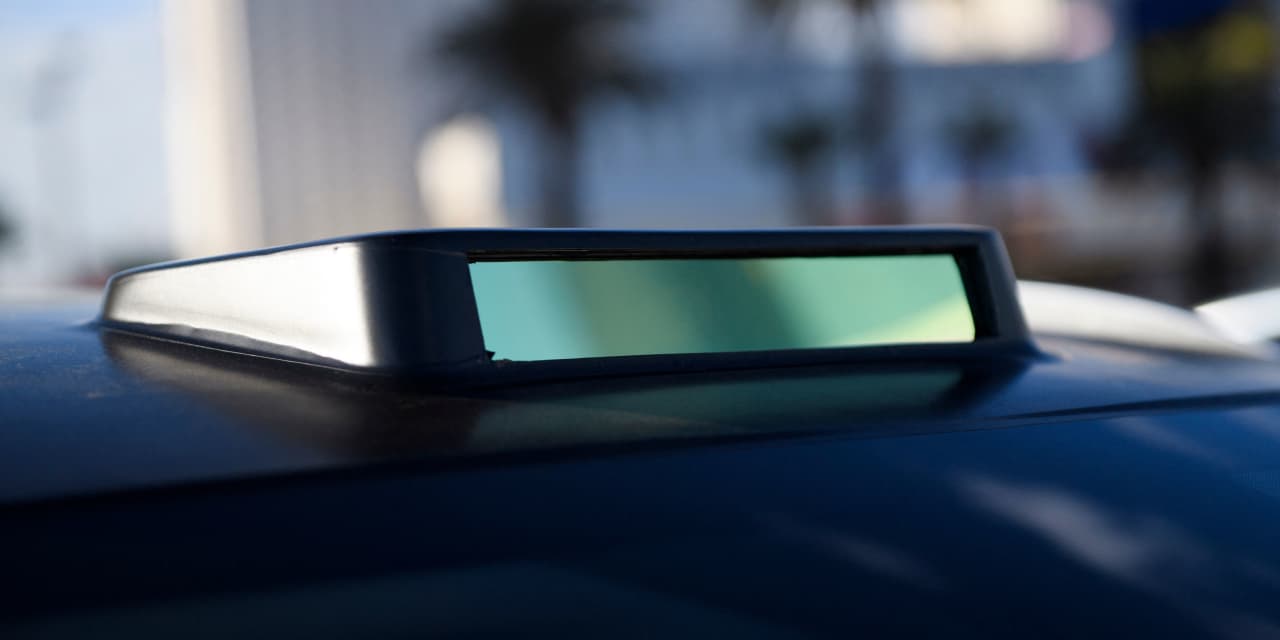
Shares of Lidar markers are falling in Tuesday trading. There aren’t any earnings reports, or ratings changes from Wall Street analysts. The Federal government may be to blame this time.
Lidar is essentially laser-based radar, and can be a set of eyes for self-driving cars or other equipment. Lidar is generally more expensive than other sensors, but has advantages such as seeing longer distances with better resolution.
Tuesday, several members of Congress on the House Select Committee on Strategic Competition between the United States and the Chinese Communist Party called on Treasury Secretary Janet Yellen, Defense Secretary Lloyd Austin, and Commerce Secretary Gina Raimondo to investigate Chinese Lidar makers.
“Lidar is a critical technology used in autonomous systems and robotics but is currently not subject to U.S. export controls or government procurement restrictions, which raises several concerns,” reads part of the letter from the House committee.
The committee wants to ensure that U.S. technology tech secrets don’t end up in China. It also wants to make sure that Chinese lidar makers, backed by the Chinese government, have an unfair advantage in the U.S. market.
That doesn’t sound all that bad for U.S. lidar makers, but investors are worried about something.
Luminar Technologies
stock was down almost 10% in midday trading.
Innoviz Technologies
shares were down more than 7%.
Ouster
stock dipped as much as 4% but recovered since then and was down slightly. The
S&P 500
and
Nasdaq Composite
were both about flat.
Stock in
Hesai,
which is a U.S.-listed China-based Lidar maker, is up about 2.5%.
All of those stock reactions seem to point to the idea that investors would like U.S. lidar makers to have access the Chinese market, and they fear the letter could lead to some retaliation from Chinese authorities. China is the world’s largest market for new cars.
Cars are a growing market for lidar technology. Auto makers use lidar to help develop driver-assistance systems that enhance safety, and can one day lead to fully self-driving cars.
Still, the Hesai stock reaction feels odd. It generated roughly $180 million in sales in 2022, about four times as large as Luminar’s. Almost 60% of that revenue was generated in China. About 30% is generated in North America.
Roughly 10% of Luminar’s 2022 sales were generated in the Asian-Pacific region.
Lidar stocks have had a rough period lately. Luminar, Innoviz, and Ouster shares are off about 68%, 66%, and 57%, respectively, over the past 12 months. Rising interest rates and a slowing economy have sapped some investor enthusiasm for shares of start-up companies that don’t generate profits.
Wall Street doesn’t expect American lidar makers to have profitable years until 2026 at the earliest.
Write to Al Root at [email protected]
Read the full article here