

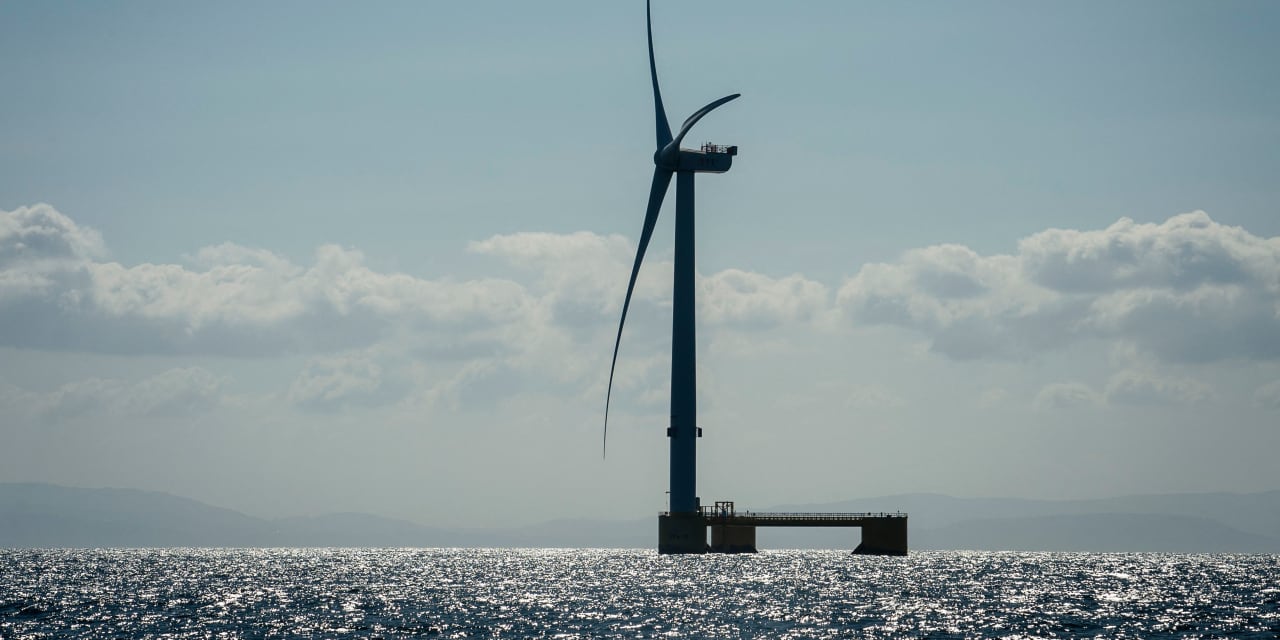
Ørsted,
the world’s largest offshore-wind developer, said late Tuesday that it will stop work on two projects in New Jersey that were expected to provide enough power for about one million homes.
The Danish company says it had “no choice” because high interest rates, supply-chain problems, and delays have made the projects unworkable. It also took a charge from a New York wind project after the state refused to increase the value of a contract the company had already signed. Ørsted (ticker: DNNGY) will book at least $4 billion in impairments related to its wind projects. Its American depositary receipts fell 20% in early trading on Wednesday.
Offshore wind is a key part of America’s plans to decarbonize. In 2021, President Biden announced a goal of installing 30 gigawatts of offshore-wind power by 2030, enough to power 10 million homes and avoid 78 million metric tons of carbon-dioxide emissions. He has projected that the U.S. could install 110 gigawatts of offshore-wind power by 2050, up from less than 1 gigawatt installed today. But inflation in the cost of materials to build those turbines, including raw materials such as steel, has hurt their economics.
In addition, the supply chain to construct them still hasn’t been built out in the U.S., so developers are competing over a limited number of vessels and other equipment. Some states have agreed to adjust contracts in a way that will likely lead to higher electricity prices for consumers, but others have rejected those requests.
“Macroeconomic factors have changed dramatically over a short period of time, with high inflation, rising interest rates, and supply-chain bottlenecks impacting our long-term capital investments,” said David Hardy, CEO Americas at Ørsted, in a statement.
Barron’s warned investors in July that wind developers were likely to face impairments in the months ahead, and that Biden’s 30-gigawatt goal was starting to look unattainable. Ørsted isn’t the only company confronted by these issues.
BP
(BP) and
Equinor
(EQNR) also said on Tuesday that they were writing down the value of offshore-wind developments in New York by a collective $840 million, though the companies haven’t decided yet if they will abandon the projects. The state had rejected their requests for better rates.
Ørsted did announce one piece of positive news for its U.S. wind portfolio. It plans to move ahead with a project in Rhode Island called Revolution Wind. Still, that project is expected to produce less than half as much power as the ones that Ørsted is walking away from.
Write to Avi Salzman at [email protected]
Read the full article here