

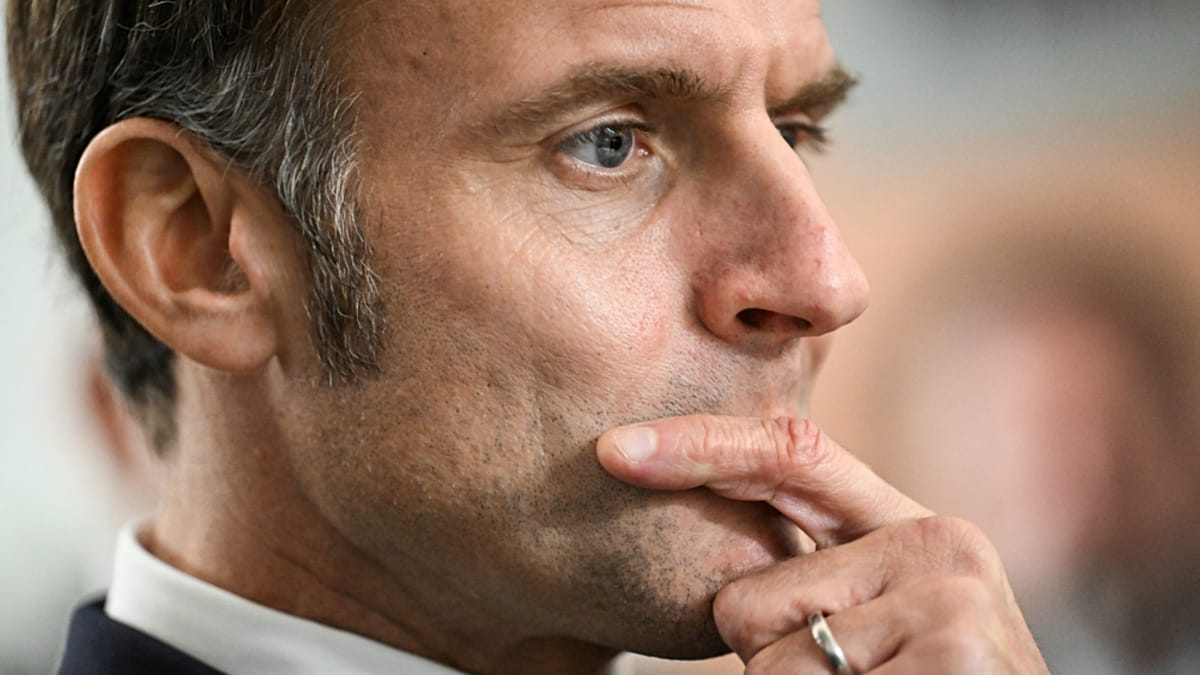
France’s President Emmanuel Macron discovered news of his own supposed overthrow, after he received a message of concern, along with a link to a Facebook video.
“On Sunday [14 December] one of my African counterparts got in touch, writing ‘Dear President, what’s happening to you? I’m very worried’”, Macron told readers of French local newspaper La Provence on 16 December.
Alongside the message, a compelling video: showing a swirling helicopter, military personneland crowds gathering, as a woman — who looks just like a news anchor —goes on to deliver a piece to camera.
“Unofficial reports suggest that there has been a coup in France, led by a colonel whose identity has not been revealed, along with the possible fall of Emmanuel Macron. However, the authorities have not issued a clear statement,” she says.
Except, nothing about this video is authentic: in reality, it was created with AI.
After discovering the video, Macron asked Pharos — France’s official portal for signalling online illicit content — to call Facebook’s parent company Meta, to get the fake video removed.
But that request was turned down, as the platform claimed it did not violate its “rules of use.”
The French president then decided to take it upon himself to secure its removal.
“I tend to think that I have more power to apply pressure than other people,” Macron said. “Or rather, that it’s easier to say something is serious if I am the one calling, but it doesn’t work.”
“These people are mocking us,” he added. “They don’t care about the serenity of public debates, they don’t care about democracy, and therefore they are putting us in danger.”
So, who is behind these fake videos?
The original video, which rapidly racked up more than 12 million views was originally posted by a Facebook account called “Islam”, which despite its name, does not post religious content.
The teenager running the account is based in Burkina Faso and makes money running courses focusing on how to monetise AI.
He eventually took the video down more than a week after its initial publication, due to political — and public — controversy.
Euronews’ fact-checking team, The Cube, tried to reach out to him through the number listed on his Facebook account on multiple occasions, but so far, our calls have gone unanswered.
In some videos, AI-generated news anchors can be seen holding a microphone bearing the logo of Radio France Internationale (RFI), the international arm of the French public radio.
Some videos bear the “Sora” watermark, suggesting that much of this content was likely produced using this technology.
Sora 2, a technology created by OpenAI — the same company that founded Chat GPT — allows users to generate 10-second-long hyper-realistic videos from text prompts.
Although other videos don’t display this logo, it is possible to remove it during post-production.
Since its launch in October, the technology has provoked controversy, leading to a proliferation of highly sophisticated and difficult-to-discern AI videos on social media.
Read the full article here