

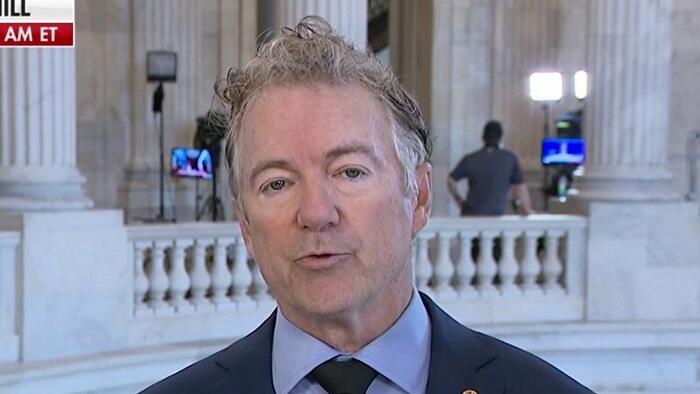
Sen. Rand Paul (R-Ky.), a leading voice for non-interventionism within the Republican Party, warned Tuesday that prolonged U.S. military action against Iran could spell disaster for Republicans in the 2026 midterm elections.
In an interview on Fox Business with host Maria Bartiromo, Paul downplayed internal party divisions as the main risk, instead pointing to economic fallout from the conflict, which began with joint U.S.-Israeli strikes on February 28.
“How worried are you that a split Republican Party will only mean losses in the midterm elections?” Ms. Bartiromo asked. “How are you expecting the midterms to play out?”
“I don’t think split party is the problem. I think high oil prices will be a problem. I think the 2026 election’s already – we are behind the eight ball as far as the electoral process,” Mr. Paul replied. “I think if you add in high gas prices, high oil prices, and if we are still bombing Iran with kinetic action – people don’t want to call it war – but if there’s still kinetic action that causes oil to be over $100, I think you’re gonna see a disastrous election.”
Rand Paul: “The 2026 elections, already we are behind the 8 ball. If you add in high gas prices, high oil prices, and if we’re still bombing Iran with kinetic action — people don’t want to call it war — I think you’re gonna see a disastrous election.” pic.twitter.com/lILcS0TUaa
— Aaron Rupar (@atrupar) March 10, 2026
In what should set off alarm bells in the White House and the House Speaker’s Office, Polymarket’s “Balance of Power: 2026 Midterms” market shows Democrats have a 44% of sweeping Congress in the midterms.
The U.S.-Israel strikes killed Iranian Supreme Leader Ayatollah Ali Khamenei in the opening wave, along with dozens of senior Islamic Revolutionary Guard Corps officials and other regime figures. Iranian sources reported 1,255 deaths and more than 12,000 injured. U.S. and Israeli assessments put Iranian military deaths at around 3,000. Iranian retaliatory missile and drone strikes killed 7 U.S. military personnel and 13 people in Israel.
The joint campaign has inflicted extensive damage on Iran’s military infrastructure, including the sinking of over 30 naval vessels, destruction of ballistic missile launchers and production facilities, airfields, drone sites, key IRGC bases, and residual nuclear-related structures at sites such as Natanz and Isfahan. Air defenses were heavily degraded, limiting Tehran’s ability to mount sustained retaliation, while allied proxy groups like Hezbollah sustained further losses.’
On Monday, President Donald Trump suggested that the war could end soon, describing the operation as a “short-term excursion” that was “very complete, pretty much.” Yet, the president warned of harsher military action should Iran attempt to disrupt oil flows through the Strait of Hormuz. The oil markets welcomed Trump’s dovish overtures as crude oil prices plunged as much as 10% on Tuesday morning, with Brent sliding around 8% to $91 a barrel and U.S. crude dropping 8.1% to roughly $87.
Read the full article here