

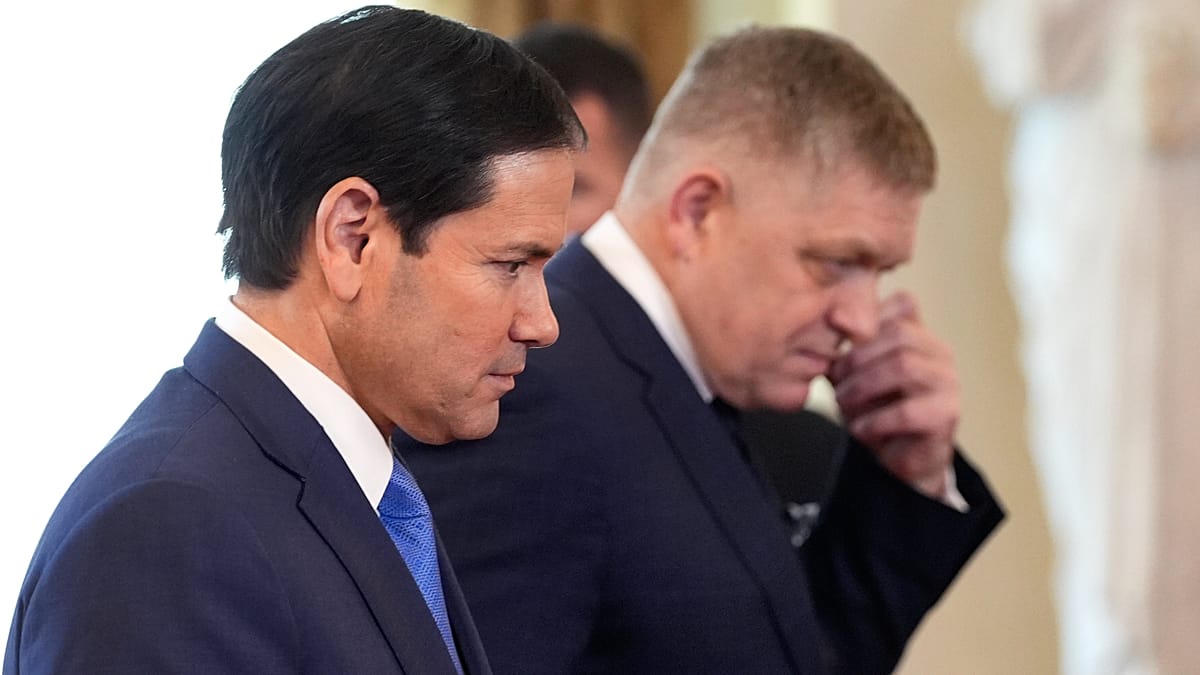
US Secretary of State Marco Rubio said America is not asking European allies to be vassals, but they need to be less dependent on Washington. Rubio made the remarks in a joint press conference in Bratislava after holding talks with Slovakian Prime Minister Robert Fico.
ADVERTISEMENT

ADVERTISEMENT
Slovakia is the first stop on Rubio’s two-state tour of central Europe, which he began on Sunday after attending the Munich Security Conference the last few days.
He is set to travel to Hungary after Slovakia, where he will meet with Prime Minister Viktor Orbán, to discuss bilateral relations and bolster ties with Trump allies in the region.
Both Fico and Orbán are key allies of the Trump administration in Europe, aligning with the anti-immigration policies of Washington and sharing Trump’s vision to end the war in Ukraine.
Rubio downplays troop redeployment concerns
Answering a reporter’s question, the top US diplomat played down the recent US decision to pull back a limited number of US troops from the continent.
“We’re not leaving NATO, we may move a couple of thousand troops from one country to another, but this has always been the case,” Rubio told reporters.
“We don’t want Europe to be dependent on us, we’re not asking Europe to be a vassal of the United States. We want to be your partner. We want to work with Europe. And our point is: the stronger you are, the stronger the members of NATO are, the stronger NATO is.”
On Saturday, in his address to the Munich Security Conference, Rubio said the US and Europe share a common destiny but warned that Europe’s cultural and economic decline must be reversed and that mass migration must be stopped.
In January, many EU leaders expressed concern that US President Donald Trump’s ambitions to seize Greenland could undermine NATO. This week, the EU Defence Commissioner said that Brussels should prepare to replace US troops on the continent.
Rubio refused to discuss in detail his recent negotiations with Denmark about Greenland. He also played down Slovak criticism of the US military raid in Venezuela that led to the arrest of Nicolás Maduro.
In January, Robert Fico said the raid was a violation of sovereignty and international law.
“A lot of countries didn’t like what we did in Venezuela. That’s okay. That was in our national interest. I’m sure there’s something he’ll do one day that we don’t like, and we’ll say, hey, we didn’t like what you did. So what? That doesn’t mean we’re not going to be friends,” said the US Secretary of State.
Rubio also stressed that central Europe will be a key region for the incumbent administration’s engagement with Europe, during Trump’s second presidency.
Fico criticises EU support for Ukraine
Fico and Rubio discussed nuclear and military cooperation and ongoing peace efforts to bring an end to the war in Ukraine, which reaches its fourth anniversary later this month.
The Slovak premier criticised the EU’s approach, as it continues to financially and militarily support Ukraine.
Fico recalled that at the December EU summit, Slovakia, Hungary and the Czech Republic abstained when the EU approved a €90 billion support package for Ukraine.
“The EU grants a loan of €90 billion for Ukraine, and €60 billion is spent on weapons, and €30 billion is so that Ukraine can operate on its own,” he said.
“I am proud that we did not participate in this at the European Council,” Fico added, noting that continuing to financially support Kyiv will only prolong the war and increase the death toll on both sides.
“Do you know what will happen? In December, we will count the next 100,000 dead on the side of Russia and Ukraine. The only result will be that Russia will be deeper into Ukraine,” stressed the Slovak leader.
Fico also harshly criticised the European Union’s decision to phase out Russian fossil fuel imports by 2027, saying it carries disastrous consequences for his country and others.
“This will create great trouble, as we do not have any LNG terminals.”
Fico also discussed Ukraine’s EU ambitions and praised Hungary’s Prime Minister Viktor Orbán for speaking clearly about his rejection.
“We say that Ukraine can join the EU on the assumption they will meet all the necessary criteria. We cannot lie now to Serbia, Montenegro or Albania. Those countries are 100 times better prepared for accession than Ukraine,” said Fico.
The Slovak premier also slammed Kyiv for weaponising the issue of oil transfers to Hungary and his country for political blackmail.
Rubio to meet Orbán in Hungary
Marco Rubio will continue his central European tour in Hungary on Monday, where he will meet Prime Minister Viktor Orbán.
According to the US State Department, the talks will focus on “the peace process to resolve global conflicts” and on the US-Hungary energy partnership.
Orbán, also an outspoken critic of the European Union and a staunch Trump supporter, was the first European leader to declare his country’s membership in Trump’s Board of Peace initiative, which many have doubted is an attempt at replacing the UN and its role.
The US late last year gave Hungary a one-year exemption from secondary tariffs targeting countries importing Russian oil.
In December, Hungary signed a deal with the US energy giant, Chevron, to import 2 billion cubic metres of liquefied natural gas (LNG) from Washington.
Trump is also endorsing Prime Minister Orbán in Hungary’s general elections, where the incumbent premier faces his most difficult election in mid-April.
The opposition Tisza Party, led by centre-right Péter Magyar, is leading in opinion polls.
Read the full article here