

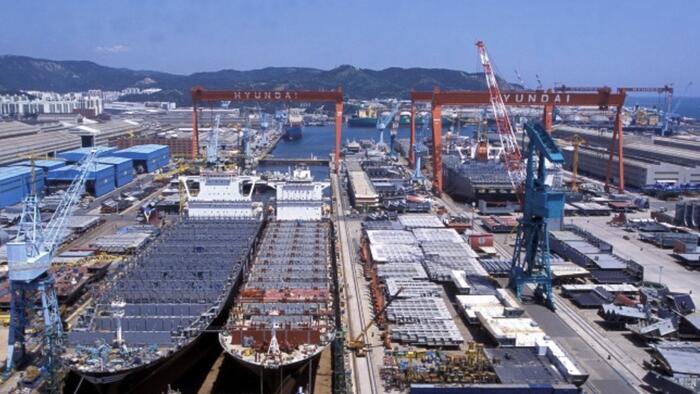
South Korea is tightening the race with China in global shipbuilding after U.S. plans to curb Chinese-built vessels disrupted order flows and redirected demand , according to Nikkei.
Worldwide new orders fell 27% in 2025 to 56.42 million compensated gross tonnage (CGT) — the first annual drop in two years — according to U.K.-based Clarksons Research.
China remained No. 1 but saw orders tumble 35% to 35.36 million CGT, shrinking its share to 62.7%. South Korea, ranked second, moved the other way: orders climbed 8% to 11.59 million CGT, lifting its share to 20.6%. Japan, in third, recorded a 53% plunge to 2.77 million CGT, with its slice slipping to 4.9%.
The shift followed a U.S. announcement last April outlining fees on Chinese-built ships entering American ports starting in October 2025. Although the policy was delayed for a year after a U.S.-China summit in late October, uncertainty had already prompted global shipping companies to hesitate on new Chinese orders.
A unit of China State Shipbuilding Corp. said it was disadvantaged in contract talks last summer, opening the door for South Korean yards to win more large container ship deals. HD Korea Shipbuilding & Offshore Engineering cited weaker demand for Chinese shipyards as a key reason for its recent surge in orders.
Nikkei writes that the company posted record results for the year ended December: revenue rose 17% to roughly 29 trillion won ($20.1 billion), while net profit doubled to about 3 trillion won.
Government-backed workforce initiatives have also supported the industry. Seoul opened a training center in Indonesia in 2024 to prepare skilled workers, including Korean language instruction, before dispatching them to local yards. Shipbuilders have raised wages and introduced AI tools to ease labor strain.
Foreign employment in South Korea’s shipbuilding sector hit a record 22,824 at the end of 2024 — about four times the level five years earlier — with foreigners making up more than 20% of the workforce.
Japan, meanwhile, has struggled to capture orders shifting away from China. Data from the Japan Ship Exporters’ Association show export contracts in 2025 fell 20% to 8.93 million gross tons, marking a fourth straight year of decline. Limited yard capacity, slipways booked through around 2029, and labor shortages have constrained growth and pushed up costs.
Looking ahead, global demand is expected to rebound in 2026 as stricter environmental rules accelerate orders for vessels powered by next-generation fuels such as hydrogen and ammonia. HD Korea Shipbuilding & Offshore Engineering has set a 2026 order target of $23.3 billion, up 26% from this year, citing steady demand for new builds and fleet replacements.
China is working to regain momentum. In December, Cosco Group placed 50 billion yuan ($7.23 billion) in orders with China State Shipbuilding Corp., underscoring coordinated support among state-owned enterprises.
Japan is also attempting a reset. Imabari Shipbuilding recently completed its acquisition of Japan Marine United to streamline operations. The government aims to double domestic shipbuilding capacity to 18 million gross tons by 2035, seeking to narrow the wide gap with South Korea and China.
Read the full article here