

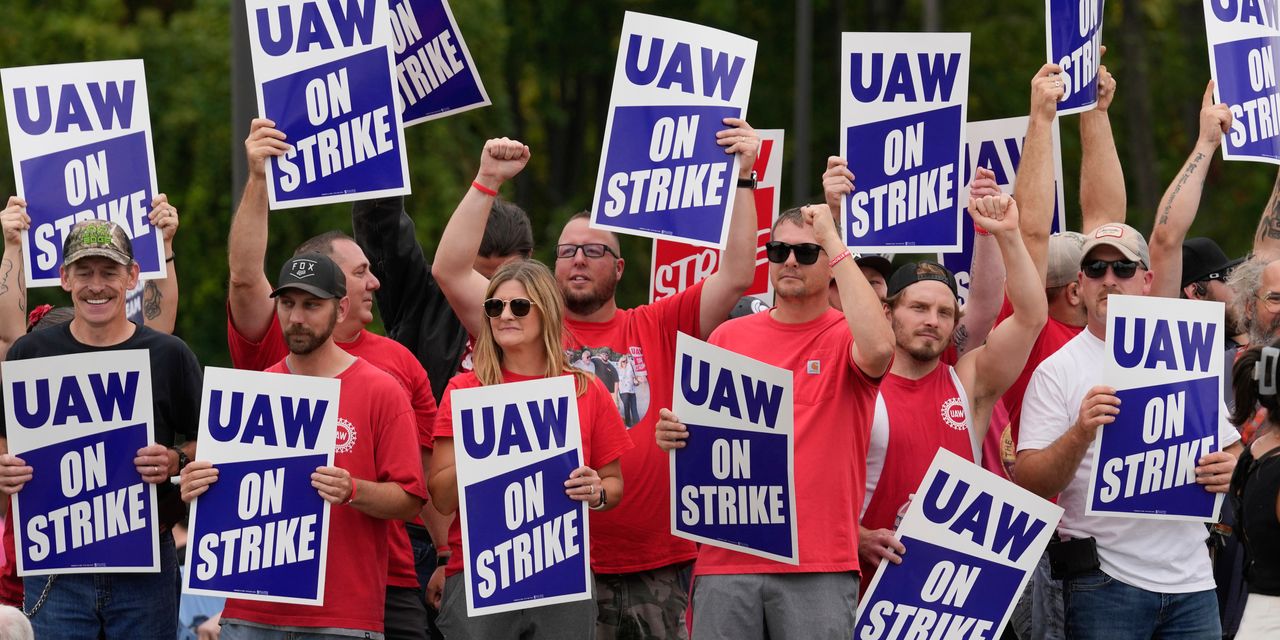
A majority of Americans support higher pay for automobile-industry workers who are on strike against Detroit’s Big Three car manufacturers, although approval of the workers’ other demands is more mixed, according to a poll from the Associated Press-NORC Center for Public Affairs Research.
The poll found that 36% of Americans sympathize with the workers in their dispute with the automobile makers, 9% support the car makers, and the rest back both or neither.
Support for the auto-industry workers fell short of the 55% support for striking Hollywood writers and actors in an AP-NORC poll conducted last month.
From the archives: UAW strike: Bernie Sanders insists union’s demands are ‘not radical’
Still, the new poll adds to evidence of U.S. support for labor unions during a year marked by strikes in Hollywood, a walkout that was narrowly averted by Teamsters at United Parcel Service, and now the picket lines outside auto plants.
“ More than half of Democrats say they support the workers over the automobile makers, while less than a quarter of Republicans feel that way. A majority of Republicans say they support both equally, or neither. ”
In the new AP-NORC survey, 51% say labor unions help U.S. workers while only 15% say they hurt working people. About one-third say unions help the U.S. economy, while 22% say they damage the economy.
A Gallup poll taken in August found that 67% of Americans approve of unions, down four points from 2022 but up from a low of 48% in 2009.
Rachel Collins, a fifth-grade teacher and union member in Chicago, hopes the UAW strike could help reverse a long decline in labor power and raise pay for workers across the economy, she said.
“For far too long, labor has been the backbone of what we do in this country but has never been compensated,” she said. “In the last 50 years we have seen the decline of the working class and the rise of this sort of billionaire class and corporations taking and taking and not giving anything to the workers.”
Chris Ross, a mechanical engineer from Oviedo, Fla., said he understands the workers’ desire for more money to cope with inflation. However, he thinks they are paid better than similar workers in other industries, and he fears that the union’s demands will drive the carmakers’ costs too high as they face lower-cost rivals including nonunion Tesla
TSLA,
“If they are burdened with high labor costs, I suspect that’s going to hurt them,” Ross said. “I’d like to see the Big Three have an ideal opportunity to compete. That’s better for the consumers.”
From the archives: Would a UAW strike provide an opportunity for Tesla and push up used-car prices?
The United Auto Workers went on strike Sept. 15 against Ford
F,
; General Motors
GM,
; and Stellantis
STLA,
which owns the Jeep, Dodge and Ram brands. The union is seeking large pay raises, a shorter work week, an end to lower-pay tiers for new workers and limits on the use of temporary workers.
Six in 10 people in the AP-NORC poll say they think better pay for the automobile-industry workers would be a good thing. Eight in 10 Democrats and just under half of Republicans say it would be a good thing if the workers got raises.
General sympathy for the workers also breaks along party lines. More than half of Democrats (55%) say they support the workers over the automobile makers, while only 22% of Republicans feel that way. A majority of Republicans say they support both equally, or neither.
Americans are less certain about the UAW’s specific demands beyond pay raises.
More than one-third (38%) think the union’s call for a four-day work week would be a good thing, while 21% think it’s a bad idea. The public is also somewhat more likely to say it would be a good thing than a bad thing to place limits on the car companies’ use of temporary workers and to require electric vehicles and parts to be made by union workers, but many are unsure or express no opinion either way.
President Joe Biden has openly supported the UAW and joined a picket line near Detroit on Sept. 26, telling the workers that they deserve significant raises.
The frontrunner for the Republican nomination, former President Donald Trump, spoke a day after Biden’s Michigan trip to a group of current and former union members at a nonunionized auto-supplies company nearby and said Biden’s support for electric vehicles — he signed a law last year that extended tax credits for buying EVs — would cost jobs.
Trump has, in past remarks, characterized China as invariably the runaway winner of a global shift away from internal-combustion cars and toward EVs.
Some automobile-industry workers who maintain share the view that EVs require fewer people to build.
The poll shows only 25% of Americans approve of Biden’s handling of the auto-industry dispute, while 34% disapprove. Trump’s ratings on the issue are worse, with 19% approving and 39% disapproving of his response to the strike.
Thirty-five percent trust Democrats more than Republicans when it comes to handling issues facing American workers, while 24% trust the GOP more.
From the archives: Biden gives pep talk about unions, with UAW strike possible next week
Also see: UAW strike: Ford, GM, Stellantis record profits haven’t been shared fairly with workers, Biden says
Plus: UAW strike exposes tensions between Biden’s goals of tackling climate change and supporting unions
Barbara Tubbs, a retired caregiver from Dallas, said Biden’s support for the strikers shows empathy for working-class people struggling to pay their bills. “He has said he knows what it’s like to be in hardship,” which makes him “willing to help with life situations and challenges we are dealing with today,” she said.
But Jim Grove, a retired teacher and guidance counselor in Sharon, Pa., wasn’t impressed by Biden’s visit to the picket line, saying, “If he gets a chance to pander to some special interest group, he does it.”
The poll of 1,163 adults was conducted Oct. 5-9, using a sample drawn from NORC’s probability-based AmeriSpeak Panel, designed to represent the U.S. population. The margin of sampling error for all respondents is plus or minus 3.9 percentage points.
MarketWatch contributed.
From the archives: Ed Yardeni’s worry: Labor strikes and contract settlements could stoke inflation
Read the full article here