

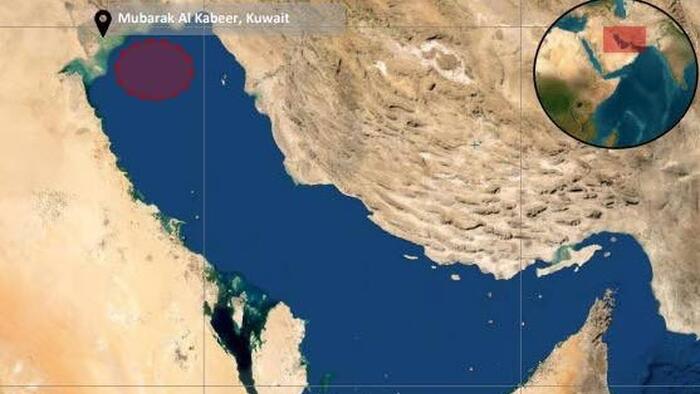
In the most dramatic escalation yet involving shipping in the Persian Gulf, the United Kingdom Maritime Trade Operations (UKMTO), a British naval authority responsible for monitoring shipping safety in high-risk areas, said it received a report that around 1040pm UTC, a “large explosion” took place 30 nautical miles south east off Mubarak Al Kebeer, on the coast of Kuwait. The report notes that “there is oil in the water coming from a cargo tank” which could have a disastrous environmental impact, especially if its reaches the desalinization plants that keep much of the Gulf population alive, literally.
The tanker, which was at anchor in the Khor al-Zubair lightering zone – a critical area for loading Iraqi heavy fuel oil exports – began taking on water following the blast. Oil was seen leaking from a damaged cargo tank into the surrounding waters, prompting concerns over potential environmental impacts. Despite the severity, no fires were reported, and all crew members remained safe and accounted for. Kuwait’s interior ministry later clarified that the incident took place outside the country’s territorial waters, at least 60 kilometers from the port
BREAKING A tanker was hit by a “large explosion” in the waters off Kuwait, causing an oil spill, British maritime security agency UKMTO said Thursday pic.twitter.com/i8mLJVn9bs
— AFP News Agency (@AFP) March 5, 2026
The targeted area off Kuwait is particularly significant as it lies within Iraq’s primary oil export corridor, a zone previously considered outside the main conflict perimeter. Iraq, not directly involved in the US-Iran war, has already reduced oil production due to storage shortages and loading delays caused by the broader disruptions. No group or nation has claimed responsibility for the Kuwait incident, but analysts suggest it could be linked to Iranian proxies or other actors exploiting the chaos.
The report, which was sourced to the Master of a tanker at anchor, comes as the fifth day of the conflict draw to a close, but no near end is in sight after Israel and the US hit Iran in joint strikes on several key sites on Saturday, February 28. Iran has retaliated by striking sites across the Middle East, and hitting several ships in the gulf as part of its blockade of the Straits of Hormuz.
UKMTO WARNING INCIDENT 014-026
Click here to view the full warning ⤵️ https://t.co/ygKSBOCLZi#MaritimeSecurity #MarSec pic.twitter.com/RPZXtz6RU7
— UKMTO Operations Centre (@UK_MTO) March 5, 2026
UKMTO said vessels are advised to transit with caution and report any suspicious activity to the maritime operation.
This incident is hardly isolated, and is part of a widening conflict in the Middle East. The Persian Gulf has become increasingly volatile since the outbreak of hostilities between the United States and Iran, with multiple attacks on commercial and military vessels reported in recent days. For instance, prior to the explosion, a US submarine sank an Iranian frigate near Sri Lanka, an Iranian corvette was set ablaze at Bandar Abbas, and Qatar’s LNG terminals suffered outages. These events have stranded hundreds of ships, including oil tankers, outside the Strait of Hormuz—a chokepoint for about 20% of global oil supplies.
Other recent maritime attacks in the region include a seafarer killed in an explosion off Oman on March 1 and a Russian-flagged LNG tanker sinking in the Mediterranean, blamed by Moscow on Ukrainian sea drones. These incidents underscore the expanding scope of the conflict, turning once-safe waters into high-risk zones for global trade.
The attack has immediate ramifications for energy markets. With Iraqi exports potentially hampered, oil prices could face upward pressure, exacerbating the disruptions already pricing in closures rather than mere interruptions. Shipping insurers and commodity traders are on high alert, as the Gulf’s transformation into a “hunting ground” without clear boundaries threatens further escalations.
Environmentally, the oil spill poses risks to marine life and coastal ecosystems in the Persian Gulf, a region already vulnerable to pollution from decades of oil activities. Cleanup efforts will likely be complicated by the ongoing security threats.
As investigations continue, the international community watches closely, with calls for enhanced maritime security to protect vital trade routes. This event serves as a stark reminder of how regional conflicts can ripple into global economic and environmental challenges.
Loading recommendations…
Read the full article here