

Going into Tesla earnings, we wrote in our preview that Morgan Stanley saw a “particularly wide dispersion in financial KPIs into the 4Q print and for 2026.” The bank said that the stock reaction will depend on the incrementality of updates around scaling robotaxi/Cybercab, launching Unsupervised FSD, Optimus Gen 3, and AI5 on the earnings call.
It is no secret, that the automotive business remains Tesla’s biggest challenge: vehicle deliveries have fallen sharply in the fourth quarter, and the loss of key tax credits, rising competition, and heavier use of discounts have all weighed on demand and margins. Analysts are closely watching automotive gross margin, excluding regulatory credits, as a measure of Tesla’s true pricing power. Many expect it to come in near 14% to 15%, down from recent quarters. This reflects a reality that Tesla is no longer operating in a wide-open EV market and must now fight harder for every sale.
In contrast, Tesla’s energy division is widely expected to be a bright spot. While auto sales have faced headwinds, energy storage deployments hit a record high last quarter at 14.2 gigawatt hours. Energy storage is still a relatively small part of the business, but it continues to be the sleeper hit for a company not known primarily for its batteries. The company continues to see strong demand for its Megapack battery systems, especially from data centers and AI companies building out massive computing infrastructure. Tesla deployed a record amount of energy storage during the quarter, and analysts expect revenue from the segment to approach $4 billion, up more than 20% from a year ago. Some analysts believe this business could become a steady, high-margin growth engine over time, helping offset weakness in car sales.
Robotics and artificial intelligence remain more speculative but are central to Tesla’s long-term story. Optimus, the company’s humanoid robot, is still largely in the prototype stage, but investors are eager to hear whether it is getting closer to real production.
Analysts also want updates on manufacturing readiness, cost, and practical use cases inside Tesla’s factories. Elon Musk has said he expects robot sales to begin next year, but his history of aggressive timelines makes many on Wall Street cautious.
The biggest wild card, however, is robotaxis and full self-driving technology. Tesla has begun limited unsupervised rides in Austin, removing safety drivers in some vehicles, which Musk has called a major milestone. Analysts are watching closely to see how quickly Tesla can expand this service to other cities and whether regulators will allow broader use.
It’s no surprise, then, why Tesla wants this quarterly report to be a story about robotaxis and robots. And lot of investors have already bought in to that framing, assigning a good chunk of the company’s present and future valuation to its AI-driven products. But selling electric vehicles to consumers and regulatory credits to automakers pays the bills today.
It’s worth noting therefore, with a potential $1 trillion pay package approved by Tesla shareholders in the quarter the company is about to report, the board needs Musk to sell cars. One of the targets set for Musk over the term of the package is to sell 20 million EVs. In the time he has left, that requires him to average 500,000 a quarter. Last quarter, Tesla delivered about 418,000.
With all that in mind, here is what Tesla reported for Q4 2025:
- Adjusted EPS 50c vs. 73c y/y, beating estimates 45c
- Revenue $24.90 billion, -3.1% y/y, missing estimate $25.11 billion
- Gross margin 20.1% vs. 16.3% y/y, beating estimate 17.1%
- Operating income $1.41 billion, -11% y/y, beating estimate $1.32 billion
- Free cash flow $1.42 billion, -30% y/y, missing estimate $1.59 billion
- Capital expenditure $2.39 billion vs. $2.78 billion y/y, below estimates of $2.83 billion
While TSLA sales have gone nowhere for years now, and 2025 even saw the first drop in full-year revenues (down 3%)…
… and automotive sales declined sequentially as global vehicle inventory (days of supply) grew to 15 days, up from 10 days at the end of 3Q (as consumers raced to take advantage of expiring federal tax credits at the end of 3Q)…
… agross margin (when excluding the impact of regulatory credits) improved as TSLA continued the rollout of Model Y variants across markets in Q4, including the standard and performance versions.
The better-than-expected profit is a positive sign as Tesla navigates lower EV demand and pivots to robotics and autonomy products. Musk has previously warned the company faces a rough patch while it works on these new priority areas. Rising profits are especially important since regulatory credit revenues will continue to decline, even if Q4 enjoyed a transitory jump.
As Ivan Feinseth, CIO at Tigress Financial Partners writes, Tesla “delivered a narrow beat on lowered expectations” noting that “EV deliveries declined and margins stayed compressed, keeping the legacy auto outlook challenging. At the same time, the quarter sharply advanced the ‘physical AI’ narrative.”
He added that the update is “positioning robotaxis, FSD, and Optimus as the key long‑term value drivers beyond cars.” The jury is still out on how valuable/profitable all those long shots will end up being.
Some of the more notable comments from the investor letter:
- To Invest Further in Clean Transport Infrastructure
- To Invest Further in Autonomous Robots Infrastructure
- To Ramp Six New Production Lines Across Products
- Cybercab, Tesla Semi and Megapack 3 are on schedule for volume production starting in 2026. First generation production lines for Optimus are being installed in anticipation of volume production.
Tesla also said that preparations continue in North America for the production ramps of Tesla Semi and Cybercab, both commencing 1H26, and production of the next-generation Roadster.
The company also “made further progress on the Optimus program in 2025. In Q1 of this year” and plans to unveil the Gen 3 version of Optimus, which will include major upgrades from version 2.5, including our latest hand design. The Gen 3 is our first design meant for mass production. Preparations are underway for the first production line, including supply chain readiness, with start of production planned before the end of 2026 and eventual planned capacity of 1 million robots per year.
Turning to energy, Tsla achieved its highest quarterly energy storage deployments, driven by record Megapack deployments. Total gross profit rose, both sequentially and year-over-year, to a record $1.1 billion, marking the fifth consecutive record quarter. Tesla plans to begin Megapack 3 and Megablock production at Megafactory Houston in 2026.
In 2025, the company’s global Powerwall network supported more than 89,000 Virtual Power Plant events across over 1 million installed units, allowing homeowners to save over $1 billion in electricity bills as Virtual Power Plant participation continues to scale rapidly.
While earnings were mediocre at best, and relied entirely on narrative and Musk’s vision, perhaps the biggest news was that Tesla made an investment in xAI, Musk’s AI company. In the deck, Tesla says:
On January 16, 2026, Tesla entered into an agreement to invest approximately $2 billion to acquire shares of Series E Preferred Stock of xAI as part of their recent publicly-disclosed financing round. Tesla’s investment was made on market terms consistent with those previously agreed to by other investors in the financing round…. Together, the investment and the related framework agreement are intended to enhance Tesla’s ability to develop and deploy AI products and services into the physical world at scale.
The investment underscores the deepening ties between Musk’s business interests and highlights Tesla’s growing focus on AI. The EV maker has been increasingly emphasizing AI, driverless technology and humanoid robots as its traditional business of selling automobiles has struggled.
In November, Tesla’s board said it would look further into the investment after investors didn’t formally approve it in a vote at the annual shareholders meeting. The two companies already work together. Tesla sells megapacks to xAI and xAI’s Grok chatbot is integrated into some Tesla vehicles. Bloomberg also reported that xAI told told investors that its aims to build AI that will eventually power humanoid robots such as Optimus.
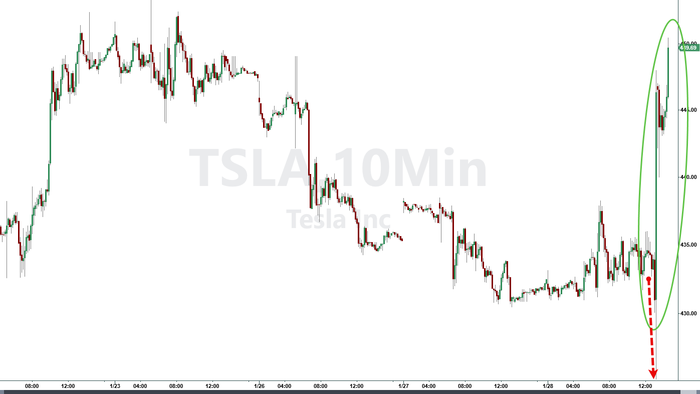
This little factoid buried at the end of the investor letter is what sent the stock sharply higher after hours (after it dumped in kneejerk response at first). An investment in xAI, and leverage of its work in AI, is what a lot of Tesla shareholders have been calling for. Those that advocated for the idea saw it as a way for Tesla to accelerate progress in humanoid robotics and autonomous driving. But there’s plenty of bullish Tesla followers concerned over that. AI development is capital intensive — in xAI’s case many billions of dollars — and some wonder for how long Tesla might be holding the bag on those losses.
While we wait for the mamangement call, the sell-side analyst notes are rolling in. This is what Ben Kallo of R.W. Baird wants to know on the call:
Key points we are monitoring include:
- Timing of product ramps for production of Cybercab/Semi/Megapack 3
- Updates on early driver-out robotaxi runs
- Cadence of potential Europe and China robotaxi approvals
- Margin impacts to Automotive & Energy from rise in lithium prices
- Demand signals for the post consumer credit environment in the US
Meanwhile, Matt Maley, chief market strategist for Miller Tabak + Co., said that though Tesla beat consensus estimates, it was the $2 billion xAI investment is what’s pushing the stock higher. “If Tesla is going to do as well as the bulls are thinking, it’s going to be with the Robotaxi and robotics. So, this investment is exactly what the bulls wanted to hear.”
And indeed, after initially dumping after hours, TSLA stock has since managed to rebound and is now trading near session highs…
… up about 3% in postmarket trading, which is a significantly muted move compared with the 5% in either direction that options traders were pricing in. Still, if that move holds through the end of regular trading tomorrow, it will be larger than the stock reaction seen after the third-quarter results came out in October.
Loading recommendations…
Read the full article here