
Trump Says Tech Giants Must Bear Cost Of Data Center Electricity, As Microsoft Joins OpenAI In Demanding Subsidies

We have been warning about this for months…
In one year, this will be the most popular chart on this site pic.twitter.com/h93gWXMoNL
— zerohedge (@zerohedge) August 11, 2025
… and months….
between exploding electricity bills and lack of jobs for grads, a new luddite revolution is coming – they will be burning down data centers within a year
— zerohedge (@zerohedge) August 25, 2025
… and now that even the deep state spies at the WaPo finally catching on…
5 months later https://t.co/reP3n5lhfp pic.twitter.com/5Lg5pPiXl4
— zerohedge (@zerohedge) January 6, 2026
… the future finally caught up to the present, and last week we noted that according to Bloomberg soaring retail electricity prices have become a political issue in several US states, especially in PJM, the Mid-Atlantic regional grid, which as we discussed recently, is woefully under-energized.
“eight out of the 13 US regional power markets are already at or below critical spare capacity levels.” – Goldman https://t.co/YYAGUukfwR pic.twitter.com/eU4XPFAMrp
— zerohedge (@zerohedge) November 23, 2025
As Bloomberg said, paraphrasing us 5 months ago, “Power prices emerged as a a major campaign theme in off-year elections in New Jersey and Virginia in 2025, and will play a big role in 2026’s upcoming national midterms and state elections.”
This is just the start: as we discussed over a month ago, data center power demand could reach a staggering 106 GW in 2035. For context, the US had about 25 GW of operating data centers in 2024 (according to Bloom Energy). Which means that unless all these data centers somehow find “behind the meter” sources of collocated power, electric bills will, pardon the pun, go nuclear.
A July report from the Department of Energy estimated an additional 100 GW of new peak capacity is needed by 2030, of which 50 GW is attributable to data centers. Those facilities could account for as much as 12% of peak demand by 2028, according to Lawrence Berkeley National Laboratory.
Bloomberg’s conclusion: “Affordability politics have mixed implications for climate (renewables are cheap, but some programs expensive), and for data centers, which take the blame for rising prices.”
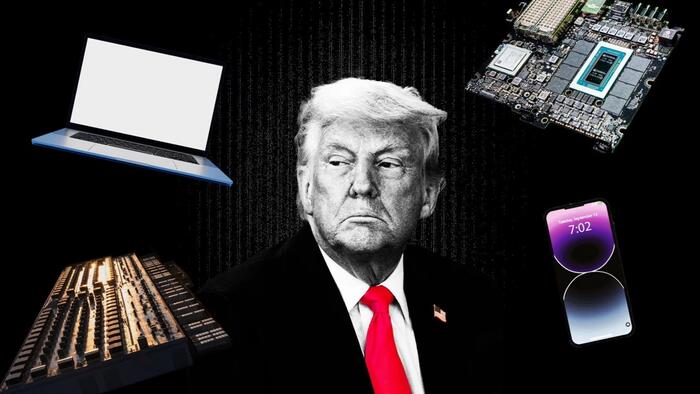
Overnight, Trump’s staff appears to have read our post again, and in a late night post on Truth Social, the president – addressing American voter concerns about rising electricity prices – said his administration had been in talks with one of the largest energy hogs, Microsoft, to ensure that consumers “don’t pick up the tab” for enormous data centers.
In a Truth Social post, he added that while the data centers “are key” to the artificial intelligence boom, the “big Technology Companies who build them must ‘pay their own way.’”
He said that Microsoft would make “major changes,” but was not specific.
A few hours later, on Tuesday morning, Microsoft unveiled an initiative to curb water usage at its US data centers and limit the impact on the general population from surging in power prices.
Microsoft said it will pay utility rates high enough to cover its power costs and work with local utilities to expand supply when needed for its data centers. It also pledged to replenish more water than its data centers consume, saying it would start publishing water-use information for each data center region in the U.S., along with its progress on replenishment.
“Especially when tech companies are so profitable, it’s both unfair and politically unrealistic for our industry to ask the public to shoulder added electricity costs for AI,” Microsoft Vice Chair and President Brad Smith said in a statement.
The company said on Tuesday that as part of its investment in Wisconsin, it is supporting a new rate structure that would prevent data center power costs from being passed on to consumers. Microsoft will also train local residents to fill construction and maintenance jobs at its data centers, as well as provide AI literacy training to communities.
Political leaders across the U.S. are urging a rapid expansion of data-center capacity and new power production to keep the country competitive in AI. However, local communities are voicing concerns over how the power-hungry facilities will impact their utility bills and use land, water and other natural resources in the region.
But before you get the false impression that Microsoft is actually doing something out of the goodness of its heart and is not seeking the highest possible IRR, last night Microsoft made its true intentions clear when it warned that US AI groups are being outpaced by Chinese rivals in the battle for users outside the west, as China combines low-cost “open” models with hefty state subsidies to gain an edge.
Brad Smith, Microsoft’s president, told the FT that the rapid adoption of Chinese AI start-up DeepSeek’s technology in emerging markets such as Africa underscores the competition American firms face around the world.
“We have to recognize that right now, unlike a year ago, China has an open-source model, and increasingly more than one, that is competitive,” he said. “They benefit from subsidization by the Chinese government. They benefit from subsidies that enable [them] to basically undercut American companies based on price.”
Translation: the US has to subsidize its own AI companies (such as Microsoft wink wink) if it wants to defeat China in the new arms race.
And while first OpenAI and now Microsoft are begging for US subsidizes and, eventually, bailouts of their AI businesses, China has already overtaken the US in the global market for so-called “open” AI models, which are often free to use, modify and integrate by developers. And, after a few years when instead of competing with China on the merits of technology the US hyperscalers are hoping for the US to eliminate Chinese competition, we fully expect China to overtake the US in closed models as well.
Loading recommendations…
Read the full article here