

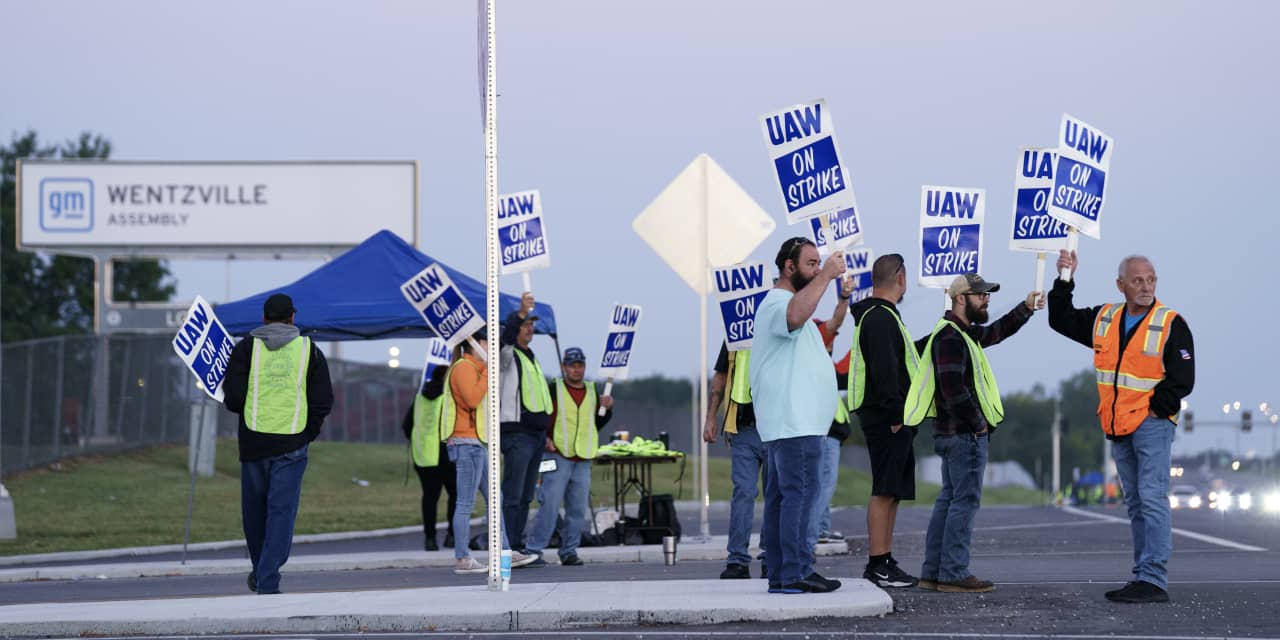
The United Auto Workers’ novel tactic of staging partial strikes at each of the Big Three automakers thrusts labor negotiations into uncharted waters even as the industry retools for electric vehicles.
The backdrop is the massive shift as the auto makers stop assembling internal-combustion vehicles, and switch to simpler EVs that will require fewer UAW workers to assemble.
“It’s the biggest change since the moving assembly line was introduced in 1913,” says Harley Shaiken, a professor emeritus at the University of California at Berkeley, who specializes in labor and the global economy. “We are in a unique situation.”
So far, the UAW has opted not to strike at engine plants or transmission plants that supply multiple assembly plants. Instead, at midnight Thursday, it struck three assembly plants: one each at
Ford Motor
(ticker: F),
General Motors
(GM), and
Stellantis
(STLA), the parent of Chrysler and Jeep.
“I think a lot of people including me were surprised that they were initially targeting assembly plants rather than powertrain plants,” says David Whiston, an equities analyst for U.S. autos at Morningstar. “Right now, the damage isn’t as severe as it could have been for a first wave.”
Nonetheless, the UAW’s tactic of striking all three car makers simultaneously represents a gargantuan change from past contract negotiations, when the UAW picked a single strike target among the Big Three, and pressured that company to accept a contract. If the car maker balked, the UAW would shut down its factories through a strike even as competing auto makers keep cranking out new vehicles.
After the UAW reached a contract with its initial target, it would then threaten to strike the competing auto companies unless they, too, signed similar contracts. This approach is called pattern bargaining, and it was a remarkably successful tactic in the 1960s and 1970s as the union negotiated increasingly generous contracts.
Times have changed. Auto workers’ pay and benefits haven’t kept up with inflation in recent decades. The auto makers now employ thousands of temporary workers who earn far less than permanent workers. In total, U.S. auto workers, both union and nonunion, have seen their inflation-adjusted wages and benefits slip about 30% over the past 30 years, Shaiken said.
In addition, the UAW is headed by a new president, Shawn Fain, who won election earlier this year as an underdog candidate. Fain has been critical of past union leadership, and has vowed to use more aggressive tactics against the car makers to get a 40% pay increase for auto workers in their new contracts.
“Keep in mind the union negotiated multiple contracts under the old approach and ended up falling further and further behind,” say Robert Bruno, a labor professor at the University of Illinois, Urbana-Champaign.
Instead of continuing to negotiate when the contract expired at 11:59 p.m. Thursday, Fain immediately called for strikes against all three auto makers. Despite the more strident tone, the strike itself has in some ways been less menacing so far than past strikes, which often shut down all the factories of an auto maker.
To be sure, the UAW has idled three of the most profitable assembly plants, but the partial strike also puts less pressure on each auto maker than a full strike.
The current strikes are only the opening dance steps. The union could escalate its strikes at all three auto makers, or just at one. Or it could turn up the pressure at two of them, even while negotiating with the third one. Anything is possible. UAW President Fain has said the union is keeping all options on the table.
And there will be political pressures. President Biden said he plans to send White House senior advisor Gene Sperling and acting Labor Secretary Julie Su to Detroit in the coming days to help reach a fair contract.
For now, S&P Global Ratings says the Big Three appear to have “modest cushion in terms of inventory,” according to a note on Friday. “As of Sept. 1, 2023, we believe GM and Ford had adequate vehicle inventories to avoid any material permanent earnings or share loss, and we believe Stellantis may have proactively overstocked some high-volume models.”
Shaiken says Ford has the best relations with the UAW. Even though both Ford and GM both are offering 20% pay increases over the contract, the union might decide to negotiate a contract at Ford, and make it the pattern for the entire industry, Shaiken says.
The union has an approximately $825 million strike fund, and plans to pay workers on strike about $500 a week. It could last longer under the targeted approach the union has adopted. The strike fund would deplete “very quickly”—within six to 11 weeks, depending on workers’ healthcare costs—if the UAW were to launch a total strike against all three companies, Morningstar’s Whiston says. “I think it’s a strike where the union would run out of money before the auto makers.”
But the truth is that nobody, except perhaps UAW President Fain, has any idea what happens next. The union is unlikely to settle for a 20% pay increase, and the auto makers are unlikely to accept a 40% increase. The big unknown is which side moves the most.
“I think the numbers will be considerably above where the auto makers are right now,” Bruno, the University of Illinois professor, said. “That is a way to help them purchase their way out of a longer shutdown.”
Write to Neal Templin at [email protected] and Catherine Dunn at [email protected]
Read the full article here