

Update (1520ET):
Analysts Erika Najarian and Tim Chiodo told clients that President Trump’s proposed 10% one-year cap on credit card interest rates is “unlikely.”
The analysts explain their reasoning:
With the midterms ahead and affordability remaining top of mind for voters, President Trump posted on social media that he is calling for a 10% rate cap on credit card APRs beginning on January 20, 2026, effective for one year.
We note that:
It would take an Act of Congress for such rate caps to be put in place, given the overwhelming legal challenges an executive order would likely face;
The legal challenges faced by the CFPB’s late fee rule (dead in the water) are a precedent for non-Congressional action;
and media reports indicate that credit card rate caps were discussed but failed to be included in the 2025 Genius Act, suggesting that the industry lobby made an impact.
Additionally, the analysts said the 10% cap on credit card APRs would reduce credit availability for working-class Americans. They warned that 26% of credit card spending would be at severe risk, implying that a softening in the consumer economy would likely materialize.
Analysts say a 10% credit card rate cap would hit Bread Financial and Synchrony Financial the hardest, with Capital One also likely to underperform. JPMorgan, Citi, Bank of America, Visa, and Mastercard would see milder negative impacts, while American Express is viewed as the most resilient, thanks to its high-end customer base and heavy reliance on fee income rather than interest income.
* * *
European and US credit card companies are sliding in premarket trading after President Trump said on Truth Social late Friday (read report) that a 10% cap on credit card interest rates is very much on the table as part of his push to improve affordability.
In a Truth Social post, Trump said Americans are being “ripped off” by credit card companies that charge interest rates of 20 to 30% and vowed that his administration will put an end to it.
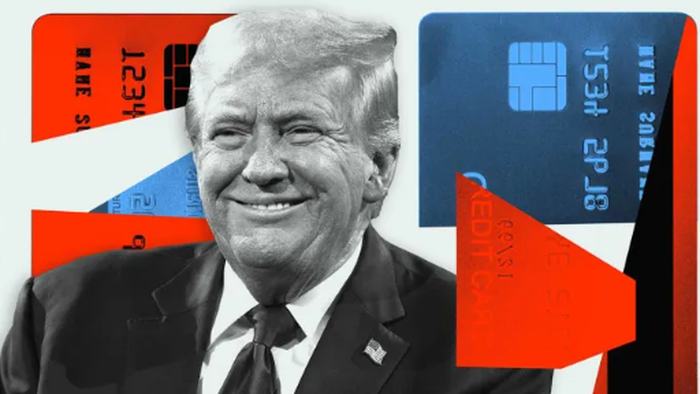
“AFFORDABILITY! Effective January 20, 2026, I, as President of the United States, am calling for a one-year cap on Credit Card Interest Rates of 10%,” the president stated.
The cap’s proposed start date coincides with the anniversary of Trump’s second-term inauguration and, if implemented, would fulfill his 2024 election campaign pledge.
Two months later… https://t.co/POf3Y4jlrq pic.twitter.com/D4BlY4PD1i
— zerohedge (@zerohedge) January 10, 2026
American Express, Capital One, Visa, Mastercard, JPMorgan, Citi, and Wells Fargo all declined in New York premarket trading, with Capital One and Citi among the hardest hit due to their heavy exposure to credit card lending.
Premarket movers:
-
American Express -4.4%,
-
Capital One Financial -8.7%,
-
Mastercard -2% and Visa -1.6%
Also track:
-
Wells Fargo -2.1%,
-
JPMorgan Chase -3%,
-
Citi -4%
European lenders that offer US credit cards were also declining late in the session:
-
Barclays -3.2%,
-
Santander -1.6%
-
and HSBC -.2%
Goldman analyst Gaelle Jarrousse commented on credit card firms and bank stocks tumbling in the European cash session, as well as the downward pressure on the same types of companies in the U.S. premarket:
Let’s start with BARCLAYS down 4-5% at the open on the US CREDIT CARD CAP. Negative headlines post Friday US close from Trump who suggested a cap on credit cards to 10%. However, for this to work, the congress needs to pass a law and we have seen in the past, senators such as Sanders introducing bills proposing a 10% cap but none of them advanced into law. On top of that, banks and credit cards companies have started to lobby and highlighted the contraction of credit card availability that will result from such a measure.
. . .
The US credit cards headline is adding to the pressure we have seen on banks over past few sessions given valuation level (sector on 9.5x 27e) and positioning.
In a separate note, JPMorgan analyst Vivek Juneja warned there will be a “material hit” if this is enacted and “could push consumers into more expensive debt.”
Juneja said that while the news will be negative for bank stocks, “this rate cap would not address the root of the problem,” which is the rising Fed fund rate.
He said that among the banks in the JPM universe: “Citi has the highest share of credit card loans at 23% of total, followed by JP Morgan (16%), Bank of America (9%), US Bancorp (8%), and Wells Fargo (6%).”
Bloomberg Intelligence analyst Philip Richards pointed out that Trump’s demand for lower credit card rates “might not be enforced in full given the strength of US bank lobby groups.”
Cowen analyst Moshe Orenbuch said, “This is a resurgence of Trump’s campaign promise, and an escalation of the headline risk for credit card issuers.”
Loading recommendations…
Read the full article here