

Published on •Updated
Ukraine has agreed to an external inspection of the damaged Druzhba pipeline funded by the European Union, Brussels said on Tuesday, just two days before European leaders gather for a summit hoping to lift Hungary’s veto on a €90 billion loan for Kyiv.
ADVERTISEMENT

ADVERTISEMENT
The bloc has also offered to finance the repair works.
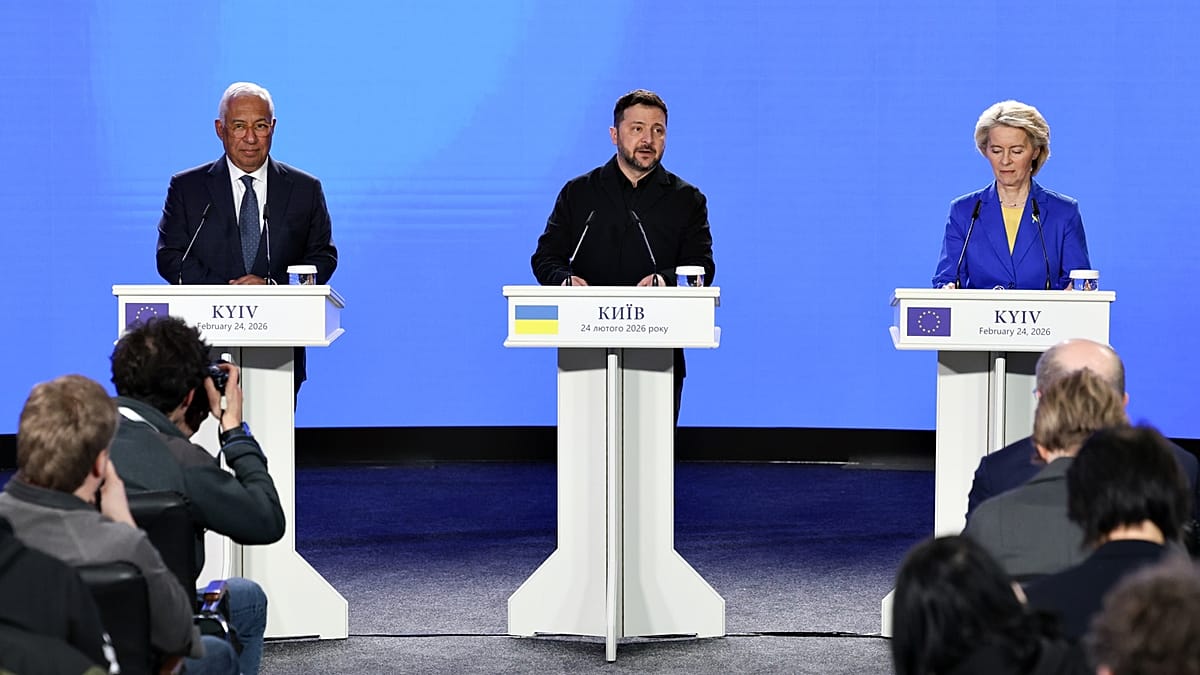
“The EU has offered Ukraine technical support and funding. The Ukrainians have welcomed and accepted this offer,” European Commission President Ursula von der Leyen and European Council President António Costa said on Tuesday.
“European experts are available immediately.”
The political breakthrough comes amid rising tensions betwen Hungary and Ukraine that have hijacked the €90 billion loan endorsed by the 27 EU leaders in December.
Hungarian Prime Minister Viktor Orbán claims the pipeline, which carries cheap Russian oil, is operational and has been kept shut by Ukrainian President Volodymyr Zelenskyy for political reasons to influence the upcoming Hungarian elections on 12 April.
Over the weekend, President Zelenskyy complained he was being pressured to reopen the pipeline by European allies and said that reinstating Druzhba was a bad idea, although he acknowledged that it was his personal view rather than the consensus.
In a letter to von der Leyen and Costa, Zelenskyy said Orbán’s allegations are “unfounded” and argued that the interruption was caused by Russian attacks on the pipeline and its surrounding infrastructure in late January.
The “serious” damage inflicted on the Brody pumping station, in eastern Ukraine, makes it “impossible” to carry oil safely through the pipeline, according to Zelenskyy.
Repairing the pumping station to allow oil flows would need repair works for one and a half months, he added, provided that Moscow does not launch a new attack.
“Within this context, I welcome and accept your offer of the necessary technical support and funding to be able to conclude the repair works as well as to explore the long-term sustainable options,” Zelenskyy said in comments addressed to von der Leyen and Costa.
In their respective letter, von der Leyen and Costa argue that fixing Druzhba has become of “greater importance” due to the energy market volatility triggered by the war in the Middle East, which has pushed oil prices above $100 a barrel.
In reaction to the turmoil, the United States has eased sanctions on Russian crude at sea, prompting swift condemnation from European allies.
“We hope that the EU assistance can pave the way for overcoming the current blockage and ensure the rapid repair of the pipeline,” von der Leyen and Costa say.
The two leaders assuage Zelenskyy that the repair operation will not steer the EU away from its common goal to phase out all Russian fossil fuels by the end of 2027.
The Commission has already presented a permanent ban on Russian gas and was expected to unveil an equivalent measure on Russian oil sometime in spring, but the war in the Middle East is likely to delay the timeline.
“This would represent a decisive step towards strengthening the European Union’s energy independence and eliminating vulnerabilities associated with Russia’s use of energy as a weapon,” Zelenskyy responded.
A Commission spokesperson did not provide a specific amount of financial assistance that could be provided to Kyiv. The fact-finding mission is already being prepared and could be deployed in the coming days if circumstances allow.
It was not immediately clear if the compromise announced on Tuesday would be enough for Orbán to lift his veto before Hungarians go to the polls on 12 April. Orbán had said that only the return of flows would convince him to change his mind.
Read the full article here