

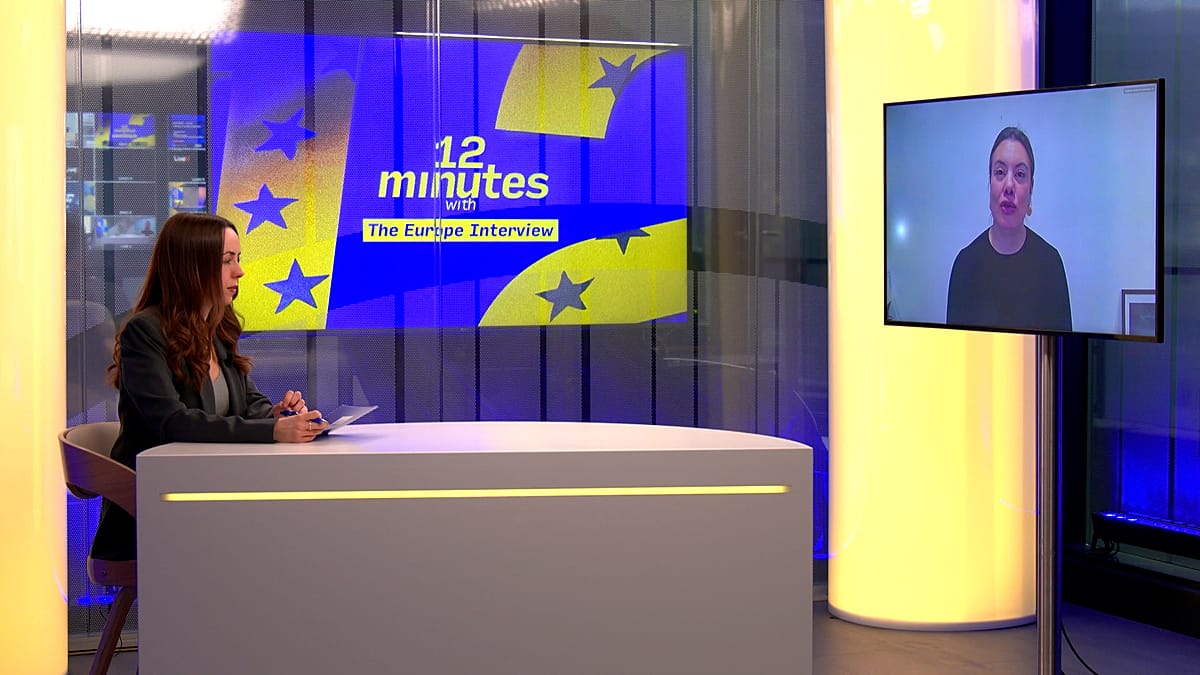
Greenland’s Minister for Mineral Resources, Naaja Nathanielsen, has told Euronews her government is yet to “gain clarity” about Washington’s demands over Greenland, despite US President Donald Trump claiming that a framework for a potential agreement is already in place.
“We still have to gain clarity about what America’s interests are concretely. We really haven’t heard anything yet,” Minister Nathanielsen, whose portfolio also covers business and energy, said on Euronews’ interview programme 12 Minutes With.
The US, Greenland and Denmark are set to enter talks over a deal that would allow the US to gain an even greater foothold in the Arctic island. This news comes after President Trump u-turned on his earlier threats to impose tariffs on European countries unless the sale of Greenland to the US was agreed.
The talks were agreed after NATO Secretary-General Mark Rutte provided an off-ramp for President Trump to climb down on his threats during discussions at the World Economic Forum in Davos.
Nathanielsen said there should be two different negotiation tracks, with the first focusing on bolstering the defence of Greenland with a greater NATO presence in the high north, and the second on boosting commercial and economic cooperation with the US. However, she cautioned that both tracks should be kept separate.
“I do not want to combine any form of defence agreement with access to our minerals,” she said.
The Arctic island is a hotbed of critical raw materials and minerals, although experts caution that their extraction is a complex and expensive exercise with little short-term returns.
While Nathanielsen said that as a “rules-based” country, Greenland cannot give the US exclusive mineral access, there is a willingness to “deepen” the commercial relationship and cooperate on developing Greenland’s mineral sector.
Her government is also willing to reopen a 1951 defence pact between Denmark and the US over Greenland. Last updated in 2004, the pact allows Washington to increase troop deployment on the island, provided Danish and Greenlandic authorities are informed in advance.
“If you look at the 1951 agreement, the US has wide access to Greenland, and we have no problems with this. We also do not have any problems with some sort of update of that agreement,” Nathanielsen said, cautioning that her government will not compromise on its sovereignty and integrity of its borders.
This 1951 agreement saw the emergence of dozens of military bases across the island; however, it now only has one, Pituffik Space Base.
Minister Nathanielsen declined to comment on whether Greenland could contemplate giving the US sovereignty over pockets of its territory, saying her government first needs to receive concrete proposals from the Trump administration.
Lots of ‘wishful thinking’ in Europe
Greenland has been caught at the centre of a geopolitical storm in recent weeks, with the world on high alert as President Trump refused to rule out the prospect of taking the island by force. He then threatened a trade war to force negotiations on greater US influence over the island.
Trump’s threats have left their mark on Greenlandic society. “People feel that what is happening now is unjust, and they find it difficult to wrap their heads around the fact that an ally would treat us like that,” Minister Nathanielsen said.
The episode has also raised the uncomfortable question of whether European allies would be ready and willing to defend Greenland should the US decide to use force to capture it.
In response to Trump’s recent discourse regarding control of Greenland, several European NATO states, such as France, Germany, and Sweden, sent military personnel to Greenland for joint military exercises to demonstrate readiness to defend the island.
“I think that right now (there’s) a lot of wishful thinking in Europe, leaning towards the things that were, but we are in a changing world order,” Minister Nathanielsen said.
“If Greenland is at stake in some form or other in the future, then so is the entire Western world,” she added, explaining that annexing Greenland would represent a break with international law. “So that would change the situation, not only in Greenland, but for everybody who is affected and lives by our values.”
You can watch the full interview on Euronews on Monday at 6.15 and 9.15 CET.
Read the full article here