

The U.S. military’s reliance on Chinese rare-earth minerals is emerging as a strategic vulnerability as Washington’s conflict with Iran unfolds and President Donald Trump prepares for a closely watched visit to Beijing later this month.
US officials and analysts say the war has intensified concerns about supply chains for the specialized minerals used in advanced weapons systems, SCMP reports. According to people familiar with the issue, the U.S. may have only about two months of rare-earth inventories remaining, raising questions about how long current military operations could be sustained if access to Chinese supplies were disrupted.
As we noted in 2023, former Raytheon CEO Greg Hayes admitted that Beijing effectively has the US military’s supply chain by the balls thanks to its reliance on rare earths and other materials which come from, or are processed in, China.
According to Hayes, Raytheon has “several thousand suppliers in China,” because of which “decoupling … is impossible.“
“We can de-risk but not decouple,” he told the Financial Times, adding that he thinks this is the case “for everybody.”
“Think about the $500bn of trade that goes from China to the US every year. More than 95 per cent of rare earth materials or metals come from, or are processed in, China. There is no alternative,” Hayes continued, adding “If we had to pull out of China, it would take us many many years to re-establish that capability either domestically or in other friendly countries.”
Hayes’ comments underline the difficulties facing western manufacturers amid growing friction between China and the US and its allies.
Beijing in February imposed new sanctions on both Raytheon and US defence peer Lockheed Martin for supplying weapons to Taiwan. Hayes has also been placed under sanctions.
The sanctions have had little commercial impact as the groups are not allowed to sell military equipment to China. Raytheon, however, has a substantial commercial aerospace business in the country through its engine subsidiary, Pratt & Whitney, and aviation systems and cabin equipment specialist Collins Aerospace. It has about 2,000 direct employees in China. -FT
Hayes – at least two years ago, said that the company is looking “to take some of the most critical components and have second sources but we are not in a position to pull out of China the way we did out of Russia.“
Now, concerns over the allegedly limited supply will loom over Trump’s planned meeting with Chinese President Xi Jinping scheduled to take place March 31 to April 2, according to a White House official, while people briefed on the discussions say rare-earth supplies could dominate the agenda when the two leaders meet.
Rabobank’s Michael Every has drawn parallels to the 1956 Suez Crisis, when the United States used financial pressure to force Britain and France to halt military operations in Egypt. In that episode, Washington’s leverage reshaped the geopolitical balance among Western powers.:
This is obviously of critical importance. To extend an analogy used yesterday, is China of 2026 the US of 1956 and the US of 2026 the UK and France of the Suez Crisis? (This is as Germany may emulate Japan in shoring up critical minerals supply via joint purchasing from its key firms aimed at reducing reliance on China.)
Today, the roles could be reversed. China’s control over critical mineral supplies raises the possibility that Beijing may wield similar influence over Washington at a moment when U.S. military operations and industrial supply chains depend heavily on those materials.
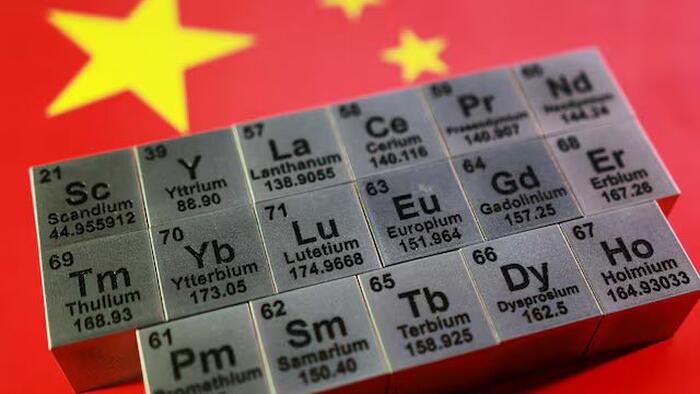
Rare-earth elements – particularly heavy varieties such as dysprosium and terbium – are essential to the manufacture of high-performance permanent magnets, radar systems, missile guidance components and propulsion systems used in modern weapons. China has long dominated global production and processing of these minerals, leaving the U.S. dependent on imports for critical components of its defense industry.
A report this month from the U.S. Geological Survey found that China accounted for 71% of U.S. rare-earth imports between 2021 and 2024 (so obviously less reliant than 2.5 years ago). During that period, China was the sole supplier of certain heavy rare earths, including terbium, with no immediate alternative sources available.
Marina Zhang, an associate professor at the University of Technology Sydney’s Australia-China Relations Institute, told SCMP that the imbalance gives Beijing “significant indirect leverage over the duration and cost of potential conflicts,” creating what she described as an “asymmetric vulnerability for Washington,” potentially allowing China to influence geopolitical negotiations by tightening or loosening access to materials vital for weapons production.
Zhao Minghao, a professor at Fudan University’s Institute of International Studies, said Beijing is likely to press the U.S. to ease tariffs and export controls in exchange for assurances on stable rare-earth supplies.
The issue has gained urgency as the U.S. military burns through munitions in its campaign against Iran, which began Feb. 28. President Trump initially projected that the strikes could last four to five weeks but said Monday that American objectives had nearly been achieved and the crisis could end “very soon.”
The Washington Post, citing unnamed U.S. officials, reported that the Pentagon expended roughly $5.6 billion worth of munitions during the first two days of operations alone, highlighting the pace at which advanced weapons stockpiles are being drawn down.
While existing missile inventories could support several months of combat, replenishing them could prove difficult if access to Chinese minerals is constrained, according to Amanda van Dyke, founder of the industry think tank Critical Minerals Hub.
“Missile stockpiles are more than sufficient to sustain the Iran war for at least three to six months,” she said. “But restocking those munitions afterward may take much longer without Chinese minerals.”
The Trump administration has attempted to mitigate the risk by launching “Project Vault,” a $12 billion public-private initiative aimed at building strategic stockpiles of critical minerals. Industry analysts say the program may help but could fall short of meeting the specific needs of modern weapons systems.
China has already demonstrated its willingness to use rare-earth exports as leverage. In April, Beijing imposed export controls on seven medium and heavy rare-earth elements – including dysprosium and terbium – requiring special licenses for shipments abroad. The move came in retaliation for U.S. tariffs introduced under Trump’s so-called “Liberation Day” trade measures.
Additional restrictions introduced in October were suspended the following month as part of a temporary trade truce, though the earlier licensing requirements remain in place.
For Washington, however, the stakes may extend beyond trade. As the conflict in Iran continues and munitions stockpiles shrink, the availability of rare earths could become an increasingly central factor in both military planning and diplomacy.
Read the full article here